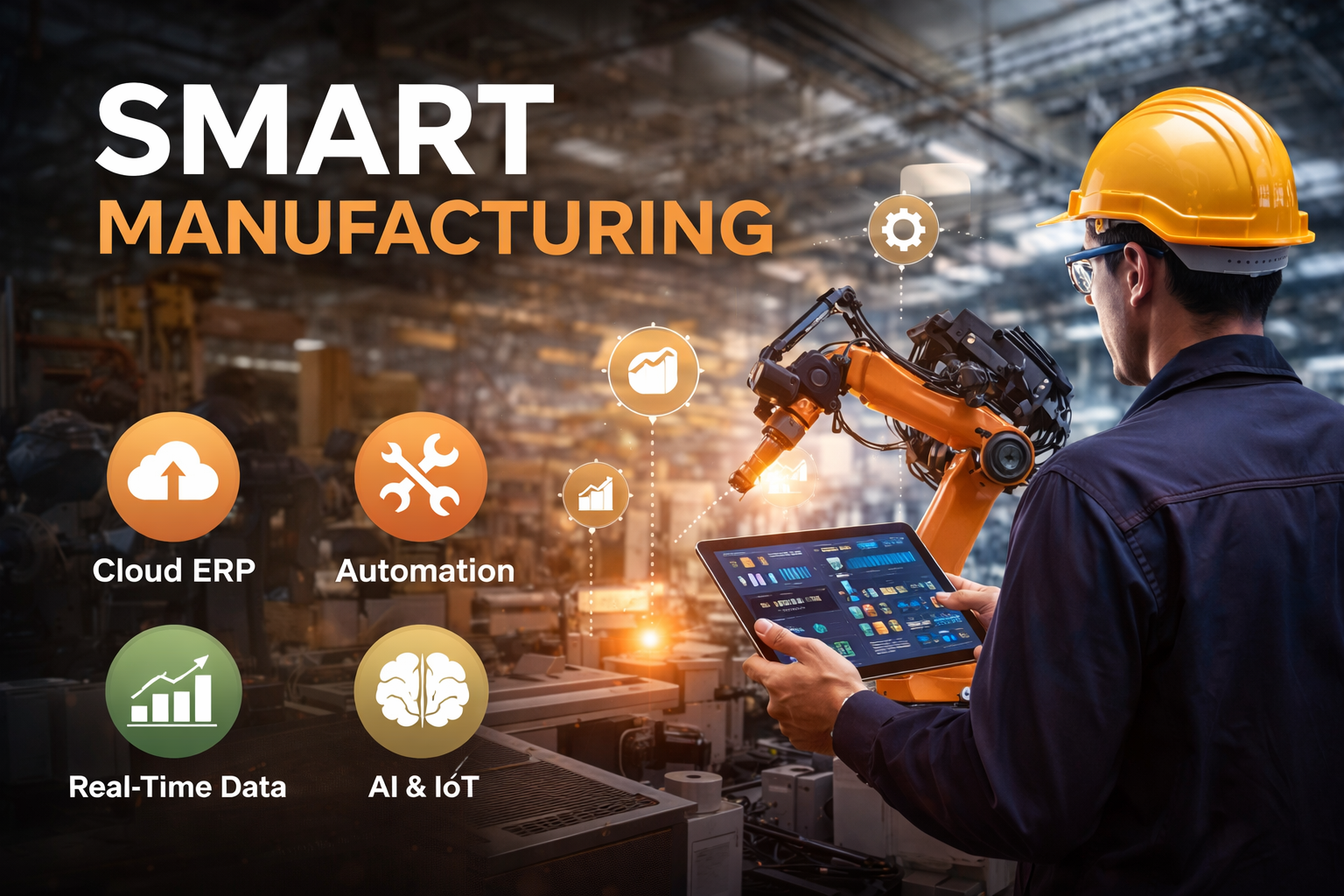
What is Smart Manufacturing?
Smart Manufacturing is a modern approach to production that uses advanced technologies like IoT, Artificial Intelligence (AI), and data analytics to automate and optimize manufacturing processes. It enables real-time monitoring, improves efficiency, reduces downtime, and helps businesses make faster, data-driven decisions. Unlike the current form of manufacturing, it evolves from Industry 3.0 to Industry 4.0, helping businesses benefit from higher labor productivity, reduced fuel costs, lower defects, and faster response times.
In today’s highly competitive and rapidly evolving market, businesses must adapt to fluctuating demand, optimize production workflows, and align with new market trends. An ERP software for manufacturing industry plays a vital role in smart manufacturing. It provides a unified interface to use data from interconnected machines and deliver business-critical insights, allowing manufacturers to transform their plant operations, tackle disruptions, reduce delays, and drive digital transformation.
Key Technologies Used in Smart Manufacturing
Smart manufacturing technologies include IoT devices, Cloud Computing, Machine Learning (ML) and Artificial Intelligence (AI), Hybrid Manufacturing, and Autonomous Robots, all of which are essentially part of Industry 4.0.
- Internet of Things (IoT): Facilitates real-time transmission of data from a network of interconnected devices. For example, manufacturers can gather data from smart sensors to detect machine health & performance, and accordingly plan machine maintenance activities to reduce the risk of sudden equipment breakdown and production disruptions. A comprehensive ERP software is used to transmit the data in real-time for strategic decision-making.
- Artificial Intelligence (AI): Smart manufacturing leverages AI and ML algorithms to convert large, complex data into small, actionable insights. The predictive analytics help manufacturers accurately forecast future occurrences (such as sudden demand surges and drops) based on strongly data-backed results, rather than gut feelings.
- Cloud Computing: In today’s business environment, the cloud has almost become a necessity rather than a luxury. Smart manufacturing uses cloud computing technology, eliminating the need for extensive on-site IT infrastructure, significant capital investment, and regular employee training. Cloud-powered Cloud ERP software facilitates a secure, scalable, and sophisticated environment for real-time data sharing, collaboration, and integration, ensuring smooth production operations.
- Hybrid Manufacturing: Hybrid Manufacturing combines both additive and subtractive manufacturing technologies into a single system, facilitating precision and greater efficiency. Unlike conventional manufacturing, it provides greater design freedom, efficiency, and flexibility. This advanced integration approach to manufacturing allows businesses to achieve complex geometries that were not possible to achieve with conventional manufacturing.
- Autonomous Robots: As the manufacturing technologies evolve globally, companies are using autonomous robots to deliver quality products and gain unmatched efficiency & accuracy. These robots are equipped with intelligent sensors and advanced navigation systems that transmit data in real-time, driving efficiency in order fulfillment and supply chain operations.
- Virtual Prototypes: Virtual Prototypes is an interesting concept that allows engineers to simulate, test, and refine products in a virtual environment, eliminating the financial and other risks associated with expensive physical products. With virtual prototypes, engineers can test different variations of the products in a simulated environment and explore wider design spaces to boost conversions and capture new markets.
Real-world Benefits of Smart Manufacturing
Encompassing smart manufacturing provides various benefits, from improved productivity, better quality output, reduced supply chain risks, and better decision-making.
- Improved Productivity: Companies implementing smart manufacturing benefit from lower repetitive labor work as their labor can focus on higher-value operations. Adopting smart manufacturing practices and integrated technologies such as IoT, ML, and AI improves the overall productivity and efficiency. Manufacturers benefit from reduced disruptions, faster operations, and better control over production operations.
- Better Production Quality: Smart manufacturing facilitates access to real-time data through integration with robotics and IoT sensors to ensure precision and quality in the production process. It helps businesses detect production quality issues in real-time, leading to standardization, lower returns, and improved customer satisfaction.
- Reduced Production Costs: Smart manufacturing brings down the production costs. It helps you predict machine failures even before they occur, thus saving hefty repair costs later. Early detection of machine errors is useful to ensure continuity in the production process and align your manufacturing strategies with changing market requirements.
- Supply Chain Resilience: Manufacturing ERP software consolidates data from different systems to monitor performance in real-time and identify & fix operational bottlenecks across various levels. It improves the accuracy of your demand forecasts and provides greater stock visibility, leading to improved market responsiveness and faster fulfilment.
- Big Data and Analytics: Smart manufacturing is rightly considered the future of production. The use of integrated systems and digital devices builds a modular production system, which requires little to no supervision. Embracing it allows companies to streamline the entire chain of processes and save on energy and resources.
Smart Manufacturing Implementation Steps
Smart manufacturing implementation steps include deploying IoT sensors, predictive maintenance software, performance KPIs,
- Develop a Clear Strategy: The first step towards implementing smart manufacturing is developing an enterprise-level strategy for adopting new technologies & tools and organizing the company’s resources. Outline potential changes in the current processes and whether the new technologies and tools will be implemented in phases or in a big bang.
- IoT Sensors: These are specialized sensors that detect physical changes in temperature, motion, and machine vibration. Build a network of IoT sensors to capture machine data in real-time, and convert and transmit this data to a specialized ERP software for trend detection.
- Predictive Maintenance: Maintenance management software provides Predictive Maintenance capabilities to monitor machine health and performance data in real time and detect anomalies. Thus, manufacturers can build strong data-driven strategies for conditional maintenance and reduce downtime.
- Performance Indicators: Key Performance Indicators (KPIs) are vital for businesses. Implement them to actively track performance and measure how effectively your company is achieving your strategic objectives. Compare your actual performance against benchmarks, industry standards, and rivals’ performance to evaluate and fine-tune your business strategies.
- Feedback Management: After deploying smart manufacturing, it’s important to regularly collect feedback and make necessary adjustments to improve performance & responsiveness, and fix bottlenecks. Always stay abreast of the modern tools and technologies in the world of manufacturing to accelerate your smart manufacturing journey and gain the required flexibility, adaptability, and interoperability.
Best Practices for Smart Manufacturing Success
Here are the proven ways to ensure smart manufacturing success:
- Single Source of Truth: Consolidate data from different sources (such as different departments across your organization) using an Enterprise Resource Planning system. Your ERP stores data in a structured format and acts as a single source of truth, eliminating potential inaccuracies and duplication. It ensures everyone has access to the same, up-to-date information at all times.
- Data Security: Protect your organization’s data against data theft, breaches, and modern data security challenges. Implement robust data security practices such as encryption and role-based user permission settings in your ERP.
- Adopt Phased Implementation Strategy: There are two implementation strategies, viz. Big Bang and phased implementation. The latter will help you avoid potential disruptions in the business operations and smoothly implement smart manufacturing strategies and technologies throughout the business.
- Workforce Training: Conduct training sessions with your employees. Train them to use evolving technologies and tools to harness their full potential and achieve exceptional results. Remember, smart manufacturing success isn’t possible without workers’ participation.
Gain Precision & Intelligence with Sage X3
Gain end-to-end visibility across different processes, machines, and resources. Streamline predictive maintenance and gain the kind of interoperability required with automation and strategic decision-making.
Sage X3 is a leading solution ideal for businesses looking to implement and harness the full potential of smart manufacturing. Unlock new levels of productivity, gain centralized analytics, and streamline predictive maintenance workflows with this new-age solution tailored for manufacturing businesses.
Discover how your business can stay compliant effortlessly. Schedule a quick demo with us today.

Frequently Asked Questions
1. Explain what smart manufacturing means in simple words.
Smart Manufacturing is a modern concept of manufacturing that involves integrating advanced technologies such as IoT, big data, ML, AI, and cloud computing to monitor & optimize production levels, and build a self-regulating system to improve operational performance.
2. What are common smart manufacturing use cases?
Here are the most common smart manufacturing use cases:
- Quality Control: Gain unprecedented control over the production process, ensuring consistency in the product quality and lower risk of defects.
- Lower Operational Costs: Monitor resource consumption, identify areas of excessive energy consumption, and minimize waste.
- Product Customization: Produce unique and custom-designed products that meet your unique customer requirements and leverage modern technologies such as 3D printing.
- Supply Chain Optimization: Optimize supply chain operations, improve delivery times, and gain real-time insights at every level.
- Reduced Risk of Accidents & Injuries: Continuously monitor machine conditions and develop automated alerts that trigger upon detecting potential hazards, ensuring labor safety.
3. What are the common challenges in adopting smart manufacturing practices?
Here are the most common challenges in smart manufacturing practices:
- Implementation Costs: Implementing modern technologies and tools can be capital-intensive, especially for small companies or startups.
- Implementation Delays: Your prescheduled ERP implementation process may get delayed due to data conversion and other issues
- Integration Complexities: Integrating IoT devices, ERP software, and other tools requires deep technical expertise.
- Large Volumes of Data: Much like the data can be an asset, it can be an obstacle when in large volumes.
- Data Theft: Without a clear data security plan and robust safeguards in place, you risk digital data theft.