What is Predictive Maintenance?
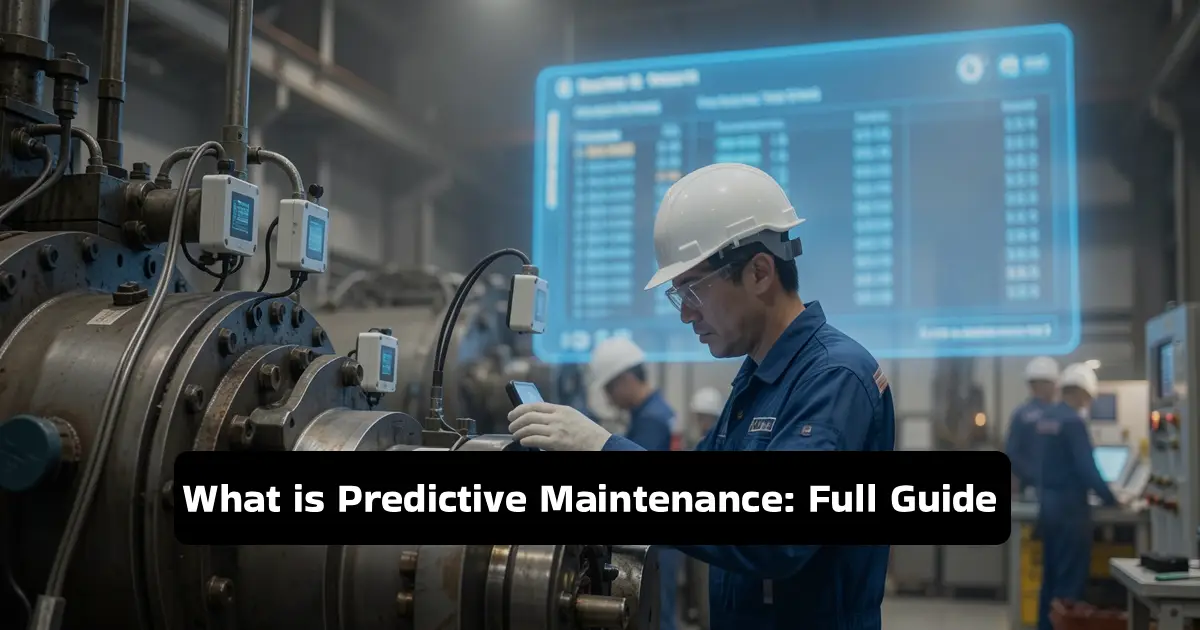
Predictive Maintenance is an ongoing process of analyzing the asset and equipment condition to prevent unplanned downtimes and machine failures. It requires strong Internet of Things (IoT) integration for advanced problem diagnosis, identifying equipment failure even before it occurs, and scheduling maintenance plans. Moreover, it ensures the safety of the workers and the premises by preventing or minimizing machine-related accidents.
Companies use Predictive Maintenance Software to automate the collection of a combination of real-time data from numerous IoT-integrated devices. It supports tracking everything from the machine speed & performance, fuel, temperature, pressure, and vibration, for extensive trend analysis. Besides, your CMMS Software delivers real-time alerts and notifications using sophisticated algorithms that enhance decision-making and prevent potential machine breakdown.
Types of Predictive Maintenance
The four types of predictive maintenance are Vibration Analysis, Infrared Thermography, Ultrasonic Analysis, and Oil Analysis.
1. Vibration Analysis
This involves transmitting machine vibration data (such as vibration frequency and amplitude) for detecting anomalies, which can hint at potential mechanical failures or degraded machine health and performance. Companies can diagnose various machine conditions, such as looseness, bearing wear, and misalignments.
2. Oil Analysis
This type of predictive maintenance strategy is mostly used in heavy industrial machinery such as hydraulic systems, turbines, and engines. Oil samples are taken from the machinery and tested for potential contamination, oxidation, and other changes. The company uses Machine Learning (ML) and Artificial Intelligence (AI) algorithms to identify patterns and develop maintenance strategies.
3. Electrical Testing
A useful method for early detection of electrical faults. Mostly used in industrial power systems such as circuit breakers, switchgears, and transformers, in addition to data centers. Consistently monitors the voltage and current fluctuations to cut off power and prevent potential damage to the electrical systems.
4. Ultrasonic Analysis
High-frequency sounds are captured from the machine to detect potential leaks, friction, and mechanical stress. Special sensors are used to detect sound waves generated by fluid and gas leaks, deteriorating bearings, and poor lubrication, which are otherwise not audible to the human ear. This method is not only useful for maintenance purposes but also to avoid the risk of fire and explosion due to leaks.
5. Infrared Thermography
This method involves using thermal imaging cameras to identify potential faults such as loose connections, excessive stress, and electrical faults. The company installs thermal cameras that capture heat distribution across surfaces and transmit this information with the help of IoT devices. When the temperatures grow exponentially in a pattern, it indicates a potential fault, requiring scheduled maintenance.
Top 5 Benefits of Predictive Maintenance
Now, let’s deep dive into the prominent advantages of predictive maintenance with your specialized ERP software:
1. Avoid Unplanned Downtimes
Predictive Maintenance gives greater emphasis on addressing machine-specific issues on time and preventing complications (such as unnecessary strain or rise in temperature). This helps you prevent unplanned downtimes and ensure ongoing production activity.
2. Improved Asset Lifespan
Predictive Maintenance avoids both over-maintenance and under-maintenance, which can be detrimental to your asset. Furthermore, it ensures your asset runs in optimum condition at all times to improve its lifespan, avoid operational risks, and optimize asset reliability.
3. Reduced Costs
Reduced downtimes and fewer maintenance & repair activities translate into cost-efficiency and increased profit margins. Not just that, the improved asset lifespan leads to lower procurement costs in the future.
4. Enhanced Safety
Predictive Maintenance ensures continued safety and protection from hazards to humans and organizational assets. It ensures adherence to safety protocols, helping avoid instances of shock, fire, and people getting caught in between machines or struck by sharp objects.
5. Energy Efficient
Predictive maintenance can help run machines at optimum settings, thereby reducing CO2 emissions and saving energy costs by preventing high-energy restarts. Reducing excess energy consumption directly translates into cost savings.

Limitations of Predictive Maintenance
Predictive Maintenance can be costly, complex, and often prone to false flags. Here are the common disadvantages of predictive maintenance:
1. High Initial Costs
Companies may incur higher initial costs for the installation of Internet of Things (IoT) devices, sensors, and analytical tools.
2. Data Complexity
IoT-based devices and sensors transmit machine-specific data, which can be complex to read and analyze, requiring special training and customization.
3. False Flags
Much like any other technology, predictive maintenance is not 100% reliable and subject to false alarms, which can lead to unnecessary maintenance costs.
4. Machine Compatibility Issues
Older and low-quality machinery may not support real-time data integration with IoT devices and sensors, making predictive maintenance nearly impossible.
Common Industry-specific Examples of Predictive Maintenance
In today’s highly competitive business landscape, predictive maintenance has been commonly used across varied industries:
- Manufacturing Industry: The manufacturing industry commonly uses IoT-based sensors alongside Manufacturing ERP software to analyze machine temperature, vibrations, and other vital statistics that are useful to derive meaningful conclusions.
- Automotive Industry: Mostly used for vehicle predictive maintenance. Involves extensive data collection to identify unprecedented predictive accuracy and the future condition of an asset using an Automotive ERP.
- Steel Industry: The industry collects real-time data about machine speed, vibration, and rotation to improve the equipment lifespan and reduce potential production delays.
- Aluminium & Metal Sheets: Machine logs and process parameters are thoroughly analyzed with an ERP for Aluminum and Metal Sheets Industry to accurately predict potential wear & tear, and minimize repair costs.
What’s the Difference Between Predictive and Preventive Maintenance?
The concept of predictive and preventive maintenance strategies differs significantly. Here’s how:
| Predictive Maintenance | Preventive Maintenance | |
|---|---|---|
| Concept | Predictive Maintenance is a maintenance strategy that aims to prevent potential machine breakdowns even before they occur. | Preventive Maintenance is a proactive, scheduled maintenance strategy that involves regular inspections, repairs, and cleaning to ensure equipment runs smoothly. |
| Primary Focus | The primary focus is predictive analytics, data collection, and asset performance tracking. | The primary focus is performing asset maintenance at a specific time interval (for example, every time the vehicle reaches a certain kilometer) |
| Goal | Aims to improve asset efficiency & longevity and lower potential failures | Aims to provide realistic information about asset health and performance |
| Requirements | Makes use of advanced tools and sensors | Makes use of manuals and standard operating procedures. |
| Implementation Costs | Large upfront costs | Typically, not higher |
| Need for Machine Downtime | Machine downtime is typically not required. | Machine downtime is mostly required. |
Other Types of Maintenance Strategies
The following are the three types of predictive maintenance:
1. Corrective Maintenance
Corrective maintenance aims to restore the original functionality of the machine after a fault has already been detected in it. If the corrective maintenance was not planned before, it could cost more than a planned one.
2. Preventive Maintenance
As the name suggests, Preventive Maintenance aims to prevent potential machine failure from occurring through extensive trend analysis of historical data. It aids in risk mitigation by following a predefined maintenance schedule for sustained productivity gains.
3. Risk-based Maintenance
It is mainly deployed on the risk-sensitive critical devices to ensure maximum safety of assets, employees, and premises. There are two phases of risk-based maintenance, viz. Risk assessment and Maintenance planning based on the risk.
Summary
Businesses across the world are using cutting-edge technologies to perform predictive maintenance. This enterprise-level tool helps them anticipate early signs of machine breakdown and ensure continuity in the production activity. It involves gathering crucial data such as machine temperature, pressure, vibration, and noise level, which is then analyzed to detect patterns to derive specific conclusions.
Predictive Maintenance FAQs
1. What is the meaning of predictive maintenance?
Predictive Maintenance is a condition-based maintenance strategy that involves estimating an asset’s degradation state and performing comprehensive maintenance activity. It involves continuous monitoring of machine operating conditions using dedicated sensors to detect machine faults early and develop smart, cost-efficient maintenance plans.
2. What are the key components and functionality of predictive maintenance?
The key components and functionality of predictive maintenance are as follows:
- Actionable Insights: Delivers automated alerts for the maintenance teams for cost-effective maintenance plans.
- Condition Monitoring: Sensors detect anomalies, such as sudden rises in temperature or machine vibrations.
- Data Analysis: Extensive analysis of historical data to derive patterns and conclusions (such as estimated time for potential machine breakdown).
3. Why is predictive maintenance important for industrial systems?
In today’s highly competitive business environment, predictive maintenance has become highly essential for industrial systems. Here’s why:
- Reduced Downtimes: It helps businesses reduce unplanned production downtimes by ensuring optimum utilization of machines and other resources.
- Data-driven Maintenance: It eliminates unwanted maintenance activities, reducing the overall maintenance and repair costs.
- Risk Mitigation: As your machinery is well-maintained, it promotes workplace safety and reduces the risk of hazards, accidents, and serious injuries.
4. Which data is required for predictive maintenance?
Predictive Maintenance requires a combination of data, including:
- Machine Data: Includes machine temperature, pressure, vibration, friction, and other data obtained through machine sensors and other IoT-based devices.
- Operational Data: Machine speed, performance, and usage pattern (for example, Mon-Fri, 10 am to 4 pm.
- Maintenance Logs: Complete records of previous machine maintenance and repair activities, including the timestamp of machine breakdown (if applicable).
- User Manual: A detailed guide provided by the Original Equipment Manufacturer (OEM) with machine handling and safety information.
5. How does predictive maintenance differ from preventive maintenance?
Both predictive and preventive maintenance are integral components of today’s manufacturing planning and operations. However, they both differ in their approach. Predictive maintenance primarily focuses on actual asset condition and prioritizes machines that are at a higher risk of breakdown. In contrast, preventive maintenance is based on regular intervals of maintenance schedules (such as quarterly air filter replacements, annual inspections, etc.).