Quick Summary
- MRO stands for Maintenance, Repair, and Operations.
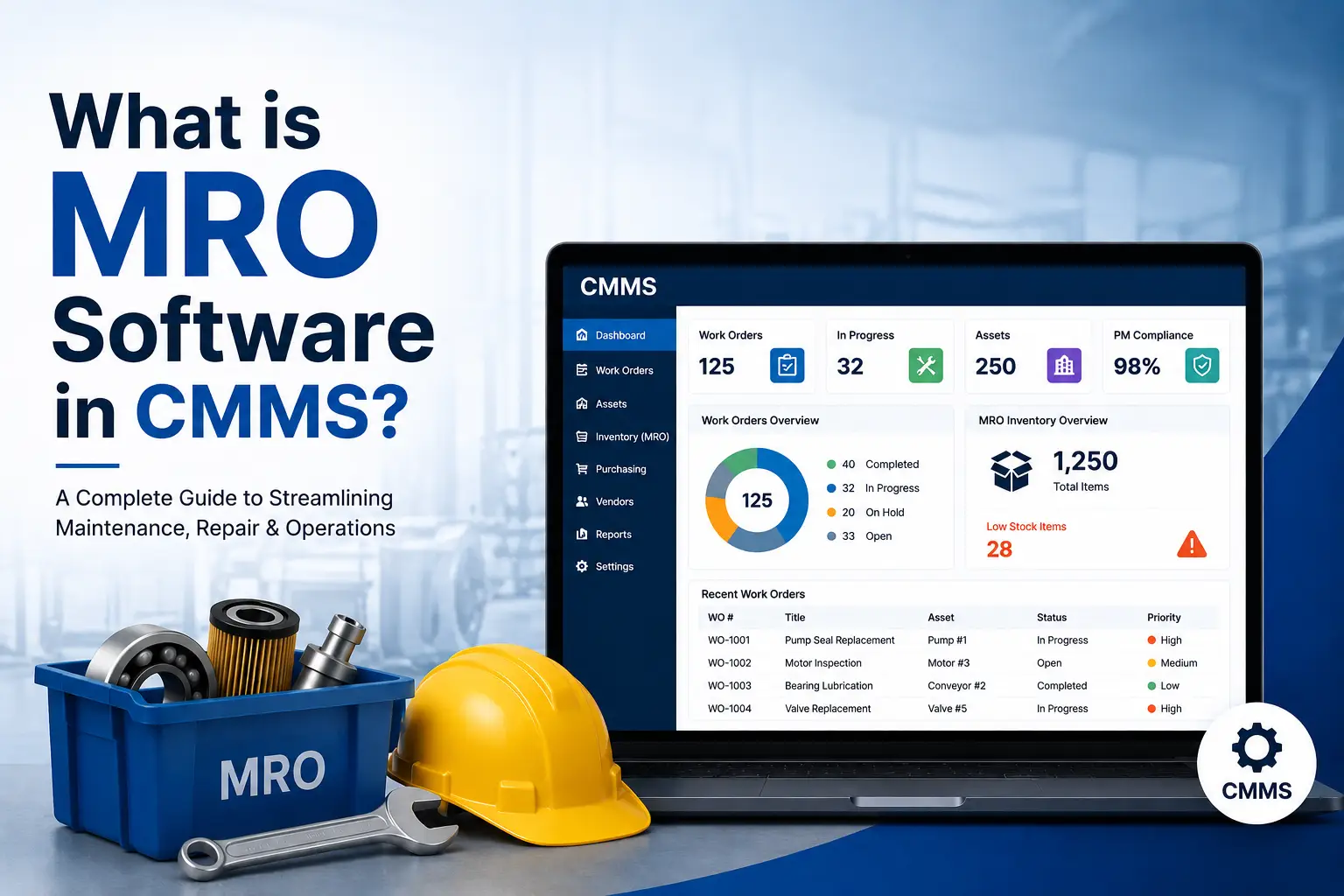
- MRO Software within a CMMS (Computerized Maintenance Management System) helps organizations track spare parts, inventory, and maintenance equipment in real time.
- The system can automatically generate a Purchase Order (PO) when stock levels fall below predefined minimum thresholds.
- It eliminates inventory discrepancies by ensuring recorded stock matches actual warehouse availability.
- Implementing MRO-driven preventive maintenance can reduce maintenance expenses by 12–18% while lowering warehouse storage costs.
- Cloud-based CMMS platforms such as DimoMaint MX provide seamless integration between maintenance operations and inventory management.
What is MRO Software in CMMS?
In a CMMS (Computerized Maintenance Management System), MRO Software refers to Maintenance, Repair, and Operations, which is an integral component that ensures the organization’s equipment, systems, and facilities remain functional & stable at all times.
The MRO and CMMS software integration facilitates robust spare parts tracking, automated reordering, Purchase Order generation, and standardization in the procurement workflows. More than just keeping your equipment running, it plays a strategic role in developing preventive, corrective, and predictive maintenance activities to enhance overall productivity.
Let’s further deep dive into the concept of Maintenance, Repair, and Operations:
- Maintenance: Maintenance is the process of inspecting or servicing an asset (such as a machinery, or vehicle) to ensure it runs in optimal working conditions, and doesn’t break down. There are three types of maintenance, including preventive maintenance, predictive maintenance, and condition-based maintenance.
- Repair: Repair is the process of restoring the state of an asset to its working condition. It includes a range of activities including asset diagnostics, corrective action, and record-keeping.
- Operations: Operations involves getting deeper insights into your organization’s assets, managing Work Orders, managing spare parts, planning maintenance schedules, and performing all those activities resulting in extending the functional lifespan of your asset.
What are the Benefits of Integrating MRO into CMMS?
Thanks to integration between MRO and CMMS software, businesses can now benefit from reduced downtimes, lower carrying costs, and the elimination of ghost stocks, as well as improved productivity.
1. Minimizes Downtimes
MRO helps prevent unexpected equipment failures, thereby ensuring your business runs smoothly. It empowers businesses with predictive maintenance to foresee equipment failure and perform timely maintenance activities. The CMMS software consolidates data from different sources, providing strategic reports for smart decision-making.
2. Reduces Carrying Costs
According to a report published in the Business Standard, India’s warehouse costs are rising amid increasing land and construction costs. MRO-CMMS software integration helps reduce warehouse storage costs, achieve significant cost savings, and free up working capital.
3. Eliminates Ghost Stock
When your Point-of-Sale (POS) machine classifies an inventory as “in stock” while it doesn’t actually exist in the warehouse, it is said to be a “ghost stock“. Automated inventory tracking through barcode/ QR code scanner integration improves inventory tracking accuracy and eliminates ghost stock.
4. Improved Productivity
Maintenance tracking software digitizes your workflow, reduces manual paperwork, brings clarity to maintenance tasks, and improves the level of inventory accuracy. As a result, businesses drastically reduce their downtimes, prevent over & under-stocking, and lower procurement cycles.
What are the Core MRO Functionalities in CMMS?
The core functions of the MRO software in CMMS are cost savings, MRO inventory tracking, automated reordering, work order integration, and asset lifecycle management.
1. Cost Savings
MRO empowers businesses with preventive maintenance capabilities. Companies adopting preventive maintenance strategies save between 12-18% on total maintenance costs, according to a report published by the US Department of Energy in 2023.
2. MRO Inventory Tracking
Track everything from spare parts and tools to safety gear. Order the correct parts in a timely manner to ensure regular maintenance activities and maximize asset lifetime.
3. Automated Reordering
Set a minimum threshold for automatic reordering of MRO stock. Whenever the stock falls below the minimum threshold, an automated Purchase Order will be generated to the vendor.
4. Work Order Integration
Achieve seamless integration between maintenance workflows with the inventory tracking and procurement processes for real-time analysis, cost tracking, and compliance management.
5. Asset Lifecycle Management
Manage assets from their procurement to disposal, monitor asset costs, develop data-driven maintenance strategies, and extend your asset lifespan.
What are the 4 Pillars of the MRO Software in CMMS?
The core pillars of the MRO software are PO automation, MRO supplier management, asset lifecycle cost tracking, and compliance management.
1. Procurement & Purchase Order (PO) Automation
MRO in Cloud CMMS streamlines the sourcing, approval, and processing processes, thus bringing standardization, greater approval controls, and better integrations.
2. MRO Supplier Management
Prevent delays in the procurement of critical parts, set clear performance expectations, track supplier performance, and ensure continuity in the production process all the time.
3. Asset Lifecycle Cost Tracking
Monitor assets costs, maintenance costs, spare parts & tooling expenses, depreciation rates, and inventory costs. A manufacturer in Bhopal invested in MRO, resulting in about 13% reduction in maintenance costs.
4. Compliance Management
Offers master data standardization, comprehensive regulatory reporting, and end-to-end documentation for regulatory compliance and meeting industry standards.
What are the Types of MRO Activities?
The specific types of MRO activities may vary depending on the industrial context. Here are the most common types of MRO activities:
1. Infrastructure Repair and Maintenance
This involves various repair and maintenance activities such as building maintenance, pest control, services (such as plumbing & wiring), predictive monitoring (structural sensor checks), managing water infrastructure (clearing blockages, and replacing valves), and so on.
2. Production Equipment Repair and Maintenance
This involves asset-specific maintenance and repair activities intended to avoid unexpected asset breakdowns and halt in the production activities. For example, replacing machine components (either on timely basis or upon developing a fault such as persistent overheating) to ensure the asset runs in optimal condition.
3. Material Handling Equipment Maintenance
Material handling equipment play a supportive role in the production activity. These include equipment (such as robotic arm) used for transporting raw materials and finished goods. Although they are not directly involved in the production activity, their maintenance & repair are essential for smooth operations.
4. Tools & Consumables Maintenance
Tools include electric saws, grills, hammers, and screwdrivers which are used during the maintenance and repair process. Maintenance of the tools include grinding, sharpening and coating to improve their lifespan and ensure readiness during the actual machine repair & maintenance. Similarly, consumables such as disposable gloves, motor oils, and lubricants, must be discarded and replaced.
Mastering MRO Operations with a Modern CMMS
A CMMS such as the popular DimoMaint MX CMMS, provides a central platform to manage organizational assets, maintenance schedules, spare parts & inventory, and MRO-specific data. Here’s how:
- Record-keeping: Keeps a comprehensive record of organizational assets for maintenance & repair
- Schedule Asset Maintenance: Plan and manage routine and predictive maintenance activities
- Cloud Connectivity: Empowers the maintenance staff with real-time data about maintenance & repair activities
- Work Order Management: Facilitates up-to-the-minute information about work orders to technicians
- Reduce Inventory Costs: Set minimum threshold for spare parts re-ordering, and track part locations across multiple facilities
- Strategic Decision-making: Plan and forecast maintenance activities efficiently by leveraging actionable insights.
Frequently Asked Questions (FAQs)
What is the full form of MRO?
The full form of MRO is Maintenance, Repair, and Operations.
What is the MRO meaning in simple words?
The MRO meaning in simple words, is Maintenance, Repair, and Operations. Businesses adopt MRO to prevent unexpected downtimes, ensure their assets run at peak performance, and monitor & limit their maintenance spending.
What are the key features of MRO software in a CMMS?
The following are the key features of the MRO:
- Inventory & Spare Parts Management: Keep production equipment running with stock optimization, material classification, and demand forecasting features
- Work Order Management: Assign jobs to the right employees, track labor & workflow progression, and work order creation
- Procurement Management: End-to-end tracking of spare parts, tools, lubricants, safety gear, and everything required to keep activities running
- Asset and Equipment Tracking: Asset downtime tracking, fuel management, and equipment maintenance
- Supplier Relationship Management: Manage a comprehensive vendor database, collaborate with them, and leverage volume discounts
- Maintenance Management: Monitor asset health through IoT sensor integration, manage preventive maintenance schedules, and reduce downtimes.
What is the difference between MRO and CMMS?
Both MRO and CMMS are very much related to asset management. MRO software primarily deals with the management of spare parts, physical supplies, and labor for smooth repair & maintenance activities. In contrast, the CMMS Software is a comprehensive software that supports broader maintenance management functions such as vendor data management, work order management, preventive maintenance management, and evaluating maintenance KPIs.