ERP software solutions are the modern miracle tool that can efficiently manage all your business processes and reports with its well-designed business modules, thereby bringing in a better production rate and keeping your business well organized. Furthermore, it provides real-time information about finance, order management, purchase, inventory, employee management, etc. precisely to help you plan each step cautiously. With features as such, web-based ERP software solutions can accelerate your business cycles, improve output and dependability, and provide higher levels of service to customers, suppliers and partners, thus pushing your business up for a success.
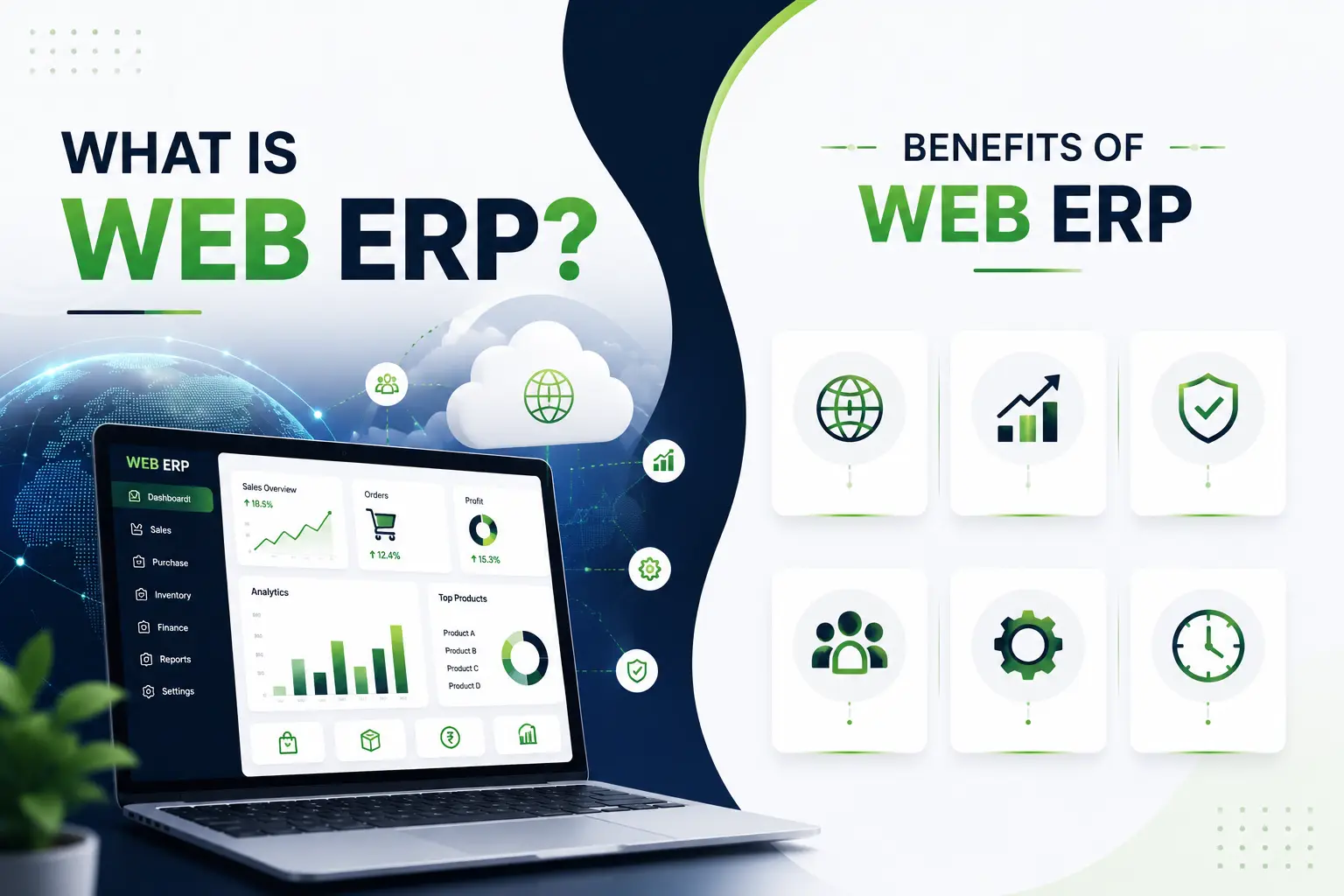
Now, SaaS based ERP or better known as web-based ERP system is an agile and a hassle-free way to manage your business on the go. Web based ERP system make use of your web browser as a front-end interface while all your important data are carefully stored and made available via cloud servers, giving you the freedom from a single point workstation. To add more to it web-based ERP software are a handy tool for the SMBs and upcoming startups as it simplifies back-office process automation without having to install additional servers to back your new business manager.
Today, there is a huge demand for going Cloud and having SaaS based ERP models due to increasing competition and urgency to fulfill all customer requests. The need for such a software setup is not without reason. The following are some advantages of a web based ERP solution:
Advantage of web ERP software:
- Quick installment, as known to all, the web connects the whole globe and all you need is a web-browser to get into action.
- Minimalist business costs and time consumption
- A centralized and reliable depository to all your crucial data.
- Easy accessibility and data updating.
- Compatible with almost every device connected to the web.
- Online training can be completed at user’s own time and pace.
- 24×7 availability of data to your employees wherever they are.
- Remote users like officials and sales representative can access the company system with any browser and exchange & update data without the need of Windows/Exchange Server and SQL Server database.
- Web-based ERP escalates the additional finance and time invested towards the maintenance of the server & other hardware.
- It also eliminates your concern on upgrading to the new parts or features.
- Reduces the chances of ERP failure.
- Enhanced presentation & Support.
- Contact through hand-held devices made easy.
Today, business management software vendors also offering SaaS based models on a subscription and free trial basis. The benefit of this is that the customer does not have to shell out a lot of money and he gets to try the software first before buying the whole product and taking it on – premise if needed.
Startups and SMEs benefit the most since their geographies and product line is still restricted and they can benefit by streamlining their processes before expanding their firm. From an ERP vendor’s side, they will benefit by providing faster implementations and turnarounds. The focus can then be getting more and more clients on board without the fear of servicing.
Web ERP vs On-Premise ERP: What’s the Difference?
Choosing between a web-based and an on-premise ERP is one of the most important decisions a growing business makes. Here’s a clear side-by-side comparison:
| Parameter | Web-Based ERP | On-Premise ERP |
|---|---|---|
| Deployment | Hosted on cloud servers, accessible via browser | Installed on your own servers and hardware |
| Setup Time | Days to weeks | Weeks to months |
| Upfront Cost | Low (subscription-based) | High (licenses + hardware) |
| Infrastructure Hosting | Hosted on vendor-managed cloud infrastructure | Hosted on in-house servers |
| Infrastructure Maintenance | Managed by the vendor | Managed internally or through third-party IT support |
| Accessibility | Accessible from anywhere through a web browser | Accessed through internal networks or VPN connections |
| Upgrades | Automatic and vendor-managed | Manual and IT-dependent |
| Scalability | Easier to scale users, storage, and modules | Scaling may require additional hardware and infrastructure upgrades |
| Best For | Startups, SMEs, growing businesses, and multi-location operations | Businesses requiring extensive customization, local server control, or legacy system integration |
GST and Statutory Compliance in Web ERP
For businesses operating in India, statutory compliance is a critical part of daily operations. Managing GST, invoicing, tax deductions, and audit requirements manually can increase compliance effort and the risk of reporting errors. Modern web-based ERP systems help simplify compliance management through built-in capabilities and localization integrations.
- GST Filing & Reconciliation – Automates GST calculations across transactions and generates GST-ready reports for reconciliation and return preparation
- E-Invoicing (IRN Generation) – Supports IRN generation and e-invoicing processes through GST portal integrations for applicable businesses
- E-Way Bill Management – Enables e-way bill creation and tracking directly within the ERP workflow
- TDS, TCS, RCM, and ITC Management – Ensures tax compliance by applying relevant TDS, TCS, reverse charge mechanism (RCM), and input tax credit (ITC) rules based on transaction and business requirements.
- Audit Trail and Compliance Tracking – Maintains transaction logs and audit records to support statutory and financial compliance requirements.
Which Businesses Should Choose Web-based ERP?
Web-based ERP delivers the most value for businesses in these situations:
- Growing MSMEs – Businesses scaling beyond basic accounting tools, with increasing complexity in inventory, sales, and production.
- Multi-location businesses – Manufacturers, traders, and distributors operating across branches, warehouses, or cities, that need real-time visibility from a single system.
- Manufacturers & distributors – Businesses managing production planning, job costing, supply chain, or bulk order processing.
- Compliance-heavy industries – Pharma, food & beverage, chemicals, and trading businesses with strict GST, e-invoicing, e-way bill, and audit trail requirements.
- Export-oriented businesses – Companies dealing in multi-currency transactions, foreign invoicing, and customs documentation.
- Businesses replacing legacy systems – Companies running on outdated software or disconnected spreadsheets looking to bring all operations under one roof.
Conclusion
A web-based ERP system brings business operations to a single connected platform accessible on a web browser. As businesses grow, this kind of flexibility becomes less of an advantage and more of a necessity. With lower dependency on infrastructure and faster scalability, web ERP helps businesses operate with enhanced efficiency.
Thus, to conclude it with, a web ERP service can get to work right from the day one with all its efficiency, while all you have to do is feed in the right data, and prepare it share your load. Web based ERP is indeed the next step towards a smarter business management that escalates failure and multiplies your overall work performance seamlessly.
To know more about web based ERP software such as Sage 300, contact us here. You can also drop us a mail at sales@sagesoftware.co.in for free erp software demo and consultation.
Web ERP FAQs
1. How much does web ERP software cost?
Web-based ERP software is usually offered on a subscription model, where pricing depends on the number of users, modules, and business size. Small businesses prefer starting with basic plans, while larger organizations opt for advanced features, integrations, and have higher usage requirements. Thus, costs vary widely based on functionality and scale.
2. Is web ERP software GST compliant?
Leading web ERP software like Sage ERP include features for GST calculation, e-invoicing, e-way bill generation, TDS/TCS management, and audit trails. Compliance becomes much more efficient while reducing manual work and reporting errors.
3. When is the right time to switch to web ERP from basic accounting tools?
It is usually a clear sign to move to web ERP when basic accounting software starts feeling limited for day-to-day operations like inventory tracking, tax compliance, multiple locations, or real-time reporting.