Key Takeaways:
- Business Intelligence (BI) converts raw data into real-time actionable insights for smart decision-making.
- With BI tools in ERP software, businesses gather, analyse, and quickly act on large volumes of data, eliminating potential delays & guesswork.
- BI empowers pharma businesses with real-time insights, data-driven decisions, operational efficiency, competitive advantage, and strategic customer intelligence.
- Sage X3 empowers pharma manufacturers with powerful BI tools offering advanced reports, interactive visualisations, and custom dashboards.
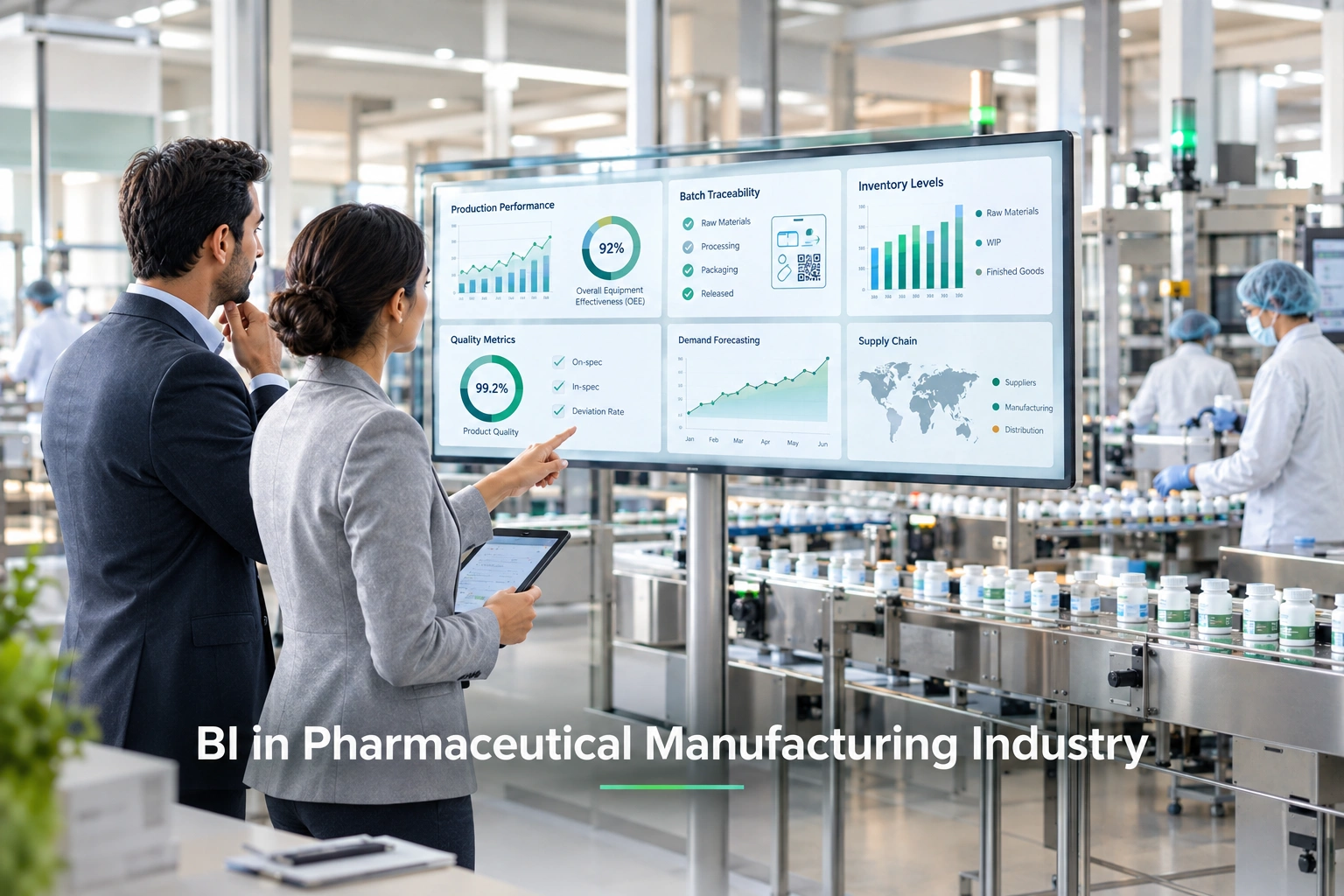
Business Intelligence for pharma manufacturing helps companies turn complex business data into actionable insights across production, inventory, quality, supply chain, and finance. It enables manufacturers to improve operational visibility, automate reporting, and make data-driven decisions. Hence, the adoption of Business Intelligence is expanding rapidly in India’s pharma manufacturing industry, driven by the widespread need for technological adoption and workflow automation. The Indian business intelligence market was estimated at $651 million in 2025, according to a research report by 6WResearch. It is forecasted to reach Rs. 935 million by 2032, growing at a 6.5% CAGR during the forecast period.
What is Business Intelligence in Pharma Manufacturing?
Business Intelligence (BI) helps pharma manufacturing companies gather, analyse, and understand large volumes of information to improve decision-making accuracy. With BI and advanced analytics in a single interface, pharma manufacturers can spot issues & trends early and automate risk assessment.
ERP software processes vast amounts of data and converts them into rich, actionable insights that support strategic decision-making. It enables rapid digital transformation and a data-driven culture, eliminating guesswork from traditional decision-making. Its advanced analytical capabilities are tailored to meet pharmaceutical companies’ growing needs.
Also read: The Future Of Pharmaceutical Manufacturing
Example of BI in Pharma Manufacturing
A popular pharma manufacturing company in Surat reduced production expenses by 17% with a dedicated pharma ERP software. ERP helped them focus on high-margin products by facilitating real-time tracking of inventory needs, batch-wise production defects, and changing demand patterns.
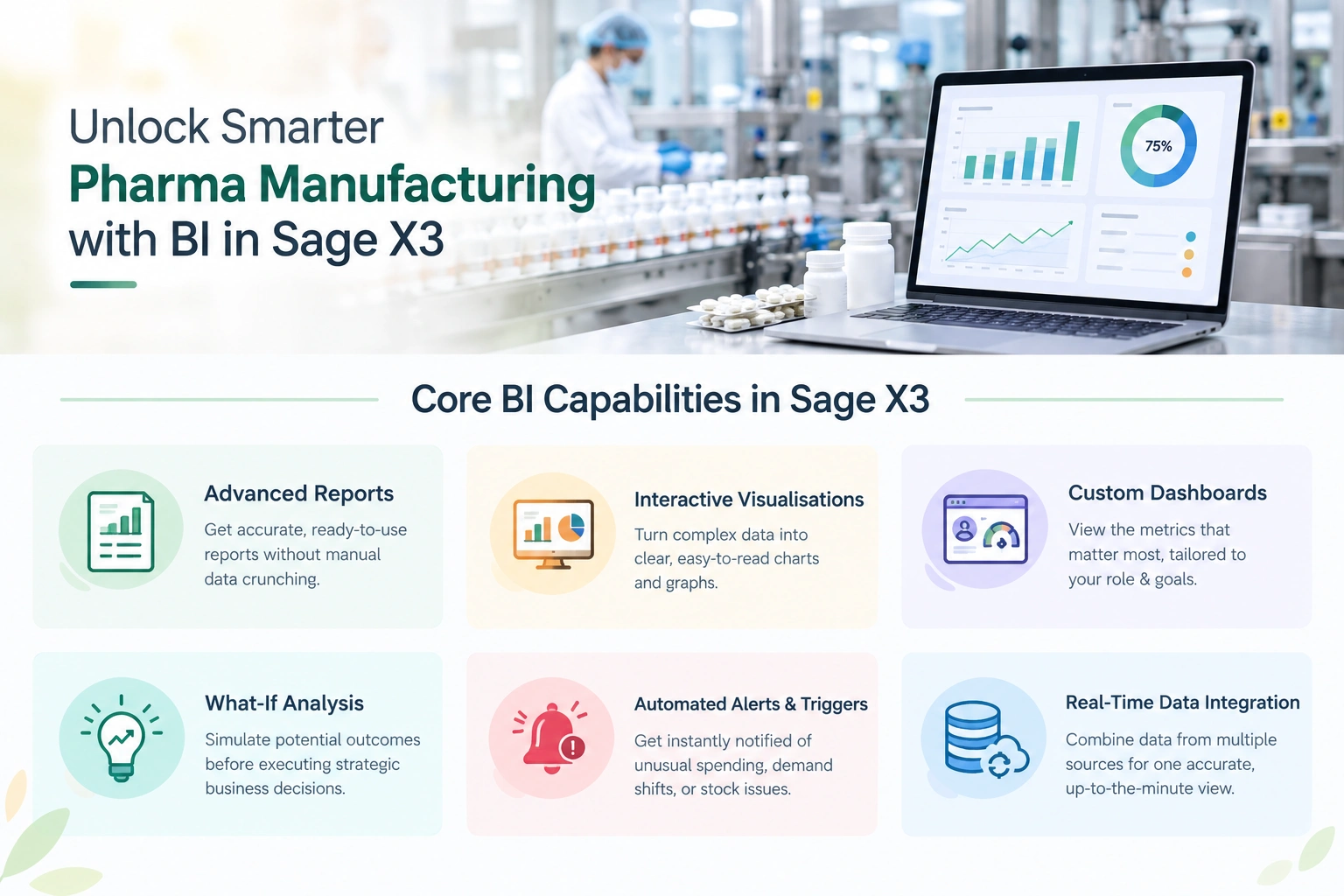
ERP’s ability to process large volumes of data reduces manual workload and facilitates quick insights through interactive charts, reports, and customised dashboards. For example, when sales data fluctuates unusually, the system triggers automated alerts so the production team can focus on increasing production capacity and procuring sufficient raw materials.
Methods of Business Intelligence in Pharmaceutical Industry
In the pharmaceutical industry, Business Intelligence (BI) employs various methods, including Data Gathering and Integration, Data Cleaning and Warehousing, Data Mining, Online Analytical Processing (OLAP), Descriptive Analytics, Predictive Analytics, Data Visualisation and Reporting, and Performance Benchmarking.
- Data Gathering and Integration: This involves collecting data from different sources and combining it to get a granular view.
- Data Cleaning & Warehousing: Cleaning & re-organising the raw data in a structured manner for quick retrieval
- Data Mining: Data Mining process involves analyzing large volumes of datasets to uncover trends & patterns.
- Online Analytical Processing (OLAP): Querying and examining data using multiple methods as part of Online Analytical Processing (OLAP)
- Descriptive Analytics: Performing a thorough review of current and historical data to unveil baseline performance information
- Predictive Analytics: This involves quick & accurate forecasting of future events by combining both current and historical data
- Data Visualization and Reporting: Data Visualisation involves converting large volumes of data into small, actionable insights delivered in charts, reports, and dashboards
- Performance Benchmarking: Tracking current performance against predictions with several Key Performance Indicators
Difference Between Traditional BI & Modern BI
Traditional BI in the pharma industry heavily relied on limited data sources. It also suffered from data silos and unnecessary delays. It would take weeks or months to manually generate static reports and tables. It lacks the kind of flexibility and self-service capabilities needed to serve modern enterprises.
Modern BI in the pharma industry consolidates data from a wide variety of sources in real-time, delivering results instantly. The results are generated in the form of intuitive charts, reports, and custom dashboards. Unlike traditional BI, it doesn’t rely on descriptive analytics alone. Instead, it goes further by integrating Predictive Analytics, Prescriptive Analytics, Artificial Intelligence (AI) & Machine Learning (ML).
Benefits of Business Intelligence for Pharma Industry
Adopting BI in pharmaceutical manufacturing industry offers several benefits, including real-time insights, data-driven decision-making, improved operational efficiency, competitive advantage, and strategic consumer intelligence.
1. Real-time Insights
Adoption of Business Intelligence helps businesses bridge the gap between problem occurrence, identification, and resolution. For example, automated alerts & triggers help businesses adhere to their budgets by continuously monitoring transactions in real-time and flagging abnormal corporate spending.
2. Data-driven Decision-making
Business Intelligence (BI) removes guesswork and empowers companies with real-time decision-making capabilities. For example, BI finds unpredictable demand spikes by analysing historical sales so that the manufacturer can better prepare to manage unexpected demands and prevent under- and over-stocking.
3. Improved Operational Efficiency
A Delhi-based pharma company achieved a 12% increase in production capacity through the ERP software for pharma manufacturing adoption. BI eliminates inefficiencies at different levels of operations through root-cause analysis and What-If scenario analysis. It provides intelligent tools to stay ahead of the competitors.
4. Competitive Advantage
BI paves the way for competitive advantage. A research report released by the Securities and Exchange Board of India (SEBI) in 2025 states that data has emerged as a strategic asset for Indian businesses seeking actionable insights and making informed decisions. India’s corporate sector is investing in digital analytics and business intelligence tools to harness the power of BI.
5. Strategic Customer Intelligence
Pharma companies can decode customer requirements & preferences by monitoring customers’ behavioural patterns, market trends, and consumer preferences. It pulls information from different sources such as CRM software, e-commerce platforms, and Point-of-Sale (PoS) devices.
How Sage X3 Enables Business Intelligence for Pharma Manufacturing
Traditional BI may have worked well in the past, but it struggles to keep pace with today’s fast-moving, AI-driven business environment requiring speed, precision & accuracy. With ever-growing operational complexities and competitive pressures, pharma manufacturing businesses face significant roadblocks. Sage X3 empowers them with advanced enterprise-grade Business Intelligence features to monitor consumer behaviour, financial transactions, and profitability. It offers smart insights, interactive visualisations, and dashboards to detect hidden trends & patterns, increasing their agility & competitiveness.
Conclusion
Business Intelligence is becoming essential for pharma manufacturers looking to make faster, data-driven decisions and maintain better control over complex operations. From monitoring production and inventory to analysing financial performance and identifying emerging trends, the right BI capabilities can turn operational data into actionable insights.
Sage X3 brings Business Intelligence capabilities directly into the ERP environment, helping pharma businesses access real-time information, visualise key metrics, analyse potential outcomes, and respond quickly to changing business needs. By combining ERP and BI, manufacturers can improve visibility across operations and build a more agile, data-driven business.
Frequently Asked Questions (FAQs)
1. Is BI useful only to large pharma manufacturing companies?
No, BI for pharmaceutical manufacturing is useful for companies of all sizes. Whether you’re a small, medium or large enterprise, you will benefit from business-critical insights with real-time, accurate, and consistent analysis and decision-making.
2. What are the common use cases of BI in pharma manufacturing?
Here are the practical use cases of BI in pharma manufacturing:
- Demand Forecasting: Analyse historical data and accurately predict demand for your products
- Production Planning: Plan production activity, align resources, and procure raw materials based on changing market requirements
- Inventory Optimisation: Plan and monitor your inventory levels, automate replenishment, and avoid stockouts & excess stock
- Key Performance Indicators (KPIs): Track and improve performance, budgets, sales, order fulfilment, and customer complaints
- Supplier Performance Analysis: Track & optimise supplier performance, material quality, procurement costs, and rejection rates.
3. How does BI enhance customer experience?
Companies adopting BI benefit from faster complaint resolution, personalised customer service, quick order fulfilment, and more accurate customer segmentation. Businesses can leverage Key Performance Indicators (KPIs) to track and improve response time, complaint resolution time, order accuracy, and return rates.
4. What is the role of data governance in BI?
Data Governance includes a set of policies, procedures, and technology tools aimed at ensuring data accuracy, security, and accessibility. Data Governance establishes clear protocols to reduce non-compliance risk, maintain data consistency, and derive best outcomes from the available information.