Key Takeaways:
- A General Ledger serves as the foundation of accounting that holds information about every financial transaction in a company across different departments
- A General Ledger provides valuable insights into a company’s cash inflow & outflow, and supports profitability analysis & strategic investment decisions
- Maintaining a General Ledger using the double-entry accounting system is mandatory in India as per Section 128 of the Companies Act, 2013
- Sage X3 consolidates financial data, automates generation of General Ledger entries, enhances accuracy, and supports faster closing & reconciliation
What is a General Ledger in Accounting?
A General Ledger (GL) is a master record that provides useful insights about each financial transaction that takes place within different business departments during a specific period of time. It serves as the foundation for the double-entry accounting system where every entry has at least one debit and one credit.
ERP software automates recording transactions into a general ledger and delivers comprehensive insights & audit trails into GL transactions. Automating traditional labor-intensive processes helps speed up month-end, year-end closing and reconciliations, allowing the accounting staff to focus on more strategic activities.
What Are the Core Components of a General Ledger?
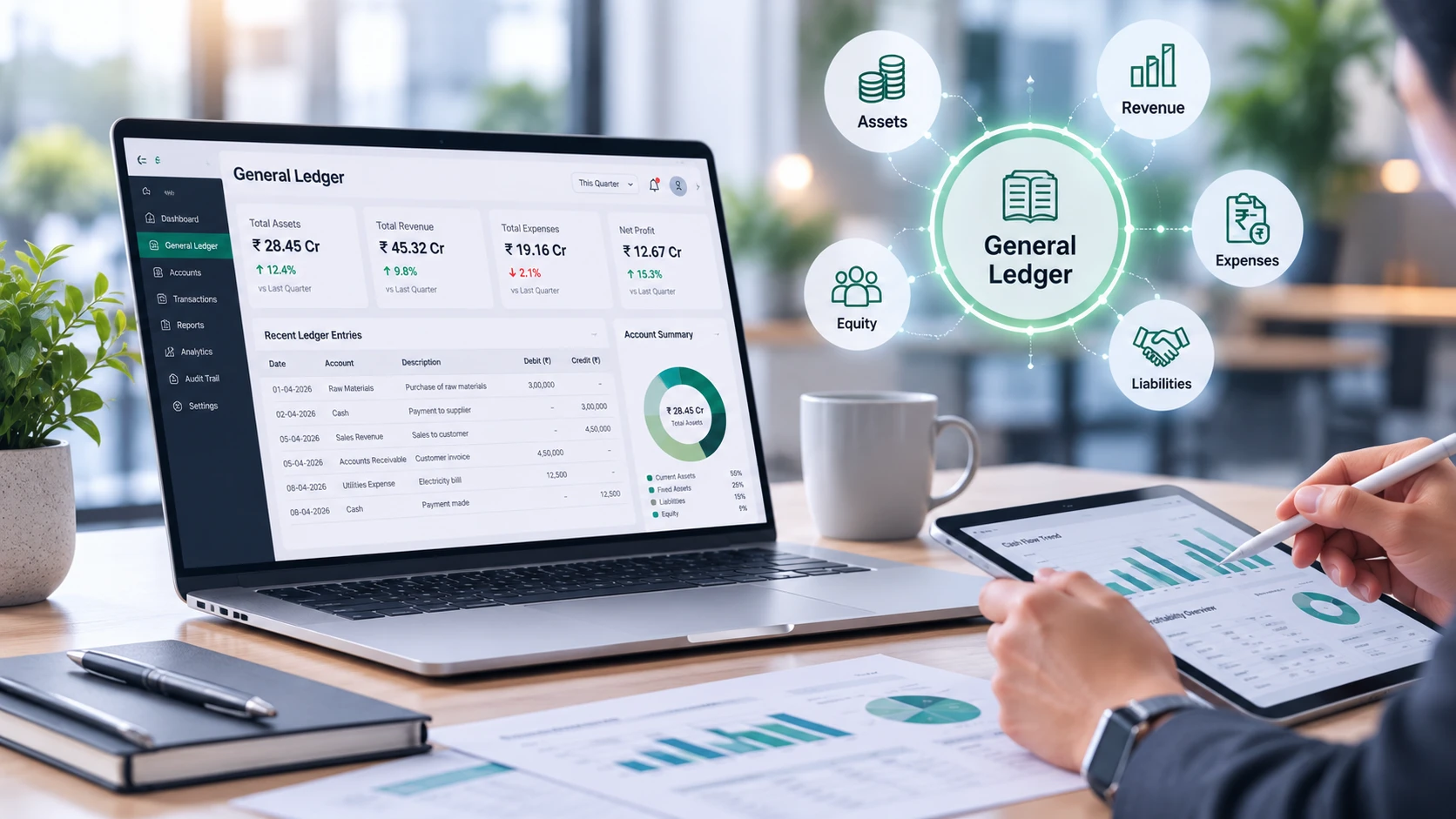
A General Ledger contains transaction date, particulars, description, debit amount, and credit amount as its core components.
- Transaction Date: Date on which the transaction occurred. For example – the exact date when the materials were procured)
- Particulars/ Account Title: The specific account being debited or credited. For example – Purchases, Bank, or CGST/ SGST.
- Description: A summary of the transaction. For example – Received cash from client for design services
- Debit Amount: Amount to be debited denoted in Indian Rupees (₹) and added to the left side of the account.
- Credit Amount: Amount to be credited denoted in Indian Rupees (₹) and added to the right side of the account.
What Types of Accounts Are Included in a General Ledger?
Every business transaction in a general ledger is classified by an account type such as revenues, expenses, assets, liabilities, and owners’ equity.
- Revenue: Revenue earned from various business activities. For example – sales revenue & service income
- Expenses: Costs incurred for operating the business. For example – salaries, rent, utilities, and marketing charges.
- Assets: Tangible & non-tangible properties owned by the business. For example – machinery, inventory, and cash
- Liabilities: Financial obligations towards external stakeholders. For example – Govt taxes, loans, and accounts payable
- Equity: Share capital, retained earnings, and other shareholders’ interest
General Ledger Example: How Does It Work?
Here’s a simple example of a General Ledger entry in the Indian context:
An Indian manufacturer purchases raw materials worth Rs 300,000 and pays the amount in cash. The following General Ledger entries will be recorded for this transaction:
| General Ledger Account | Debit (Dr) | Credit (Cr) |
|---|---|---|
| Raw Materials Account | Rs. 300,000 | – |
| Cash Account | – | Rs. 300,000 |
| Total | Rs. 300,000 | Rs. 300,000 |
Explanation: The Raw Materials Account is debited because they are procured, and the Cash Account is credited because the company’s cash balance has decreased by Rs. 300,000.
6 Reasons Why a General Ledger is Important for Businesses?
A General Ledger plays a significant role in a business’s financial management by maintaining the accuracy of the financial records, simplifying tax compliance, providing complete visibility, enabling early fraud detection, and facilitating better decision-making.
1. Maintain Accurate Financial Records
Section 128 of the Companies Act, 2013 mandates every company to maintain proper books of account, including the General Ledger, on an accrual basis using double-entry bookkeeping. Any non-compliance may result in fines or imprisonment.
2. Simplified Tax Compliance
Complete and accurate general ledger entries provide a true & fair picture of the company’s expenses, incomes, and sales, enabling businesses to stay compliant for tax purposes and maintain audit readiness.
3. Complete Financial Visibility
General Ledger provides a foundation to gain insights into the company’s cost structures, assets, and liabilities. Without general ledger entries, owners may not get a complete view of the company’s financial position and a deeper understanding of the financial challenges.
4. Fraud Detection and Prevention
Accurately recording general ledger entries and reviewing them from time to time helps businesses catch and prevent fraudulent activities even before they turn into a major issue, thereby ensuring end-to-end regulatory compliance.
5. Greater Financial Transparency
General ledger entries can be tracked back to their origin, fostering end-to-end financial transparency and audit-readiness. This helps instill confidence among external stakeholders such as shareholders and regulatory bodies.
6. Better Financial Planning and Decisions
Nowadays, businesses are using AI in ERP to track general ledger entries to gain crucial insights across different business functions, proactively build strategies, identify & mitigate risks, and improve the level of planning & decision-making.
What is General Ledger Reconciliation?
General Ledger Reconciliation is an important verification process in closing the books of accounts. It aims to ensure the accuracy of the recorded General Ledger (GL) entries and identify potential discrepancies by comparing the GL account balances with supporting financial records such as bank statements, receipts, and invoices.
Here are the steps involved in the General Ledger Reconciliation process:
1. Gather Relevant Documents
First things first, collect your supporting documents such as bank statements, receipts, and invoices. These are vital for verification purposes.
2. Verify Accuracy of GL Transactions
Verify the accuracy of the GL entries against your supporting documents. Comparing the balances will help you identify potential errors, discrepancies, and duplicate GL entries.
3. Investigate Discrepancies
Look for transactions where the amount doesn’t match. Income earned but not yet recorded or billed. Investigate the potential reason for the mismatch (errors, omissions, or time differences).
4. Make Adjusting Entries
Make adjusting entries into the affected General Ledgers. An Adjusting Entry is a journal entry made at the end of an accounting period to ensure financial reports reflect the true & fair business activity as per the accrual accounting rules and the matching principle.
5. Record and Document Findings
Maintain complete records of your reconciliation process for external auditing and compliance purposes.
What Are the Common Challenges in Maintaining a General Ledger?
Maintaining a general ledger is prone to human errors, accounting complexity, risk of fraud & misuse, scalability challenges, delays in reconciliation, limited real-time visibility, and inconsistency in the multi-entity processes.
1. Human Errors
Human errors are inevitable. Human errors during General Ledger recording can occur due to oversight, lack of communication, or insufficient knowledge/ training.
2. Accounting Complexity
Maintaining books of accounts is not an easy task, especially as your business grows in size and complexity. As transaction volumes increase, keeping the records complete and accurate can become a difficult task.
3. Risk of Fraud and Misuse
General Ledger entries could be manipulated by both internal teams and external threats, leading to distorted accuracy. Such intentional manipulations of the books of accounts can affect stakeholder trust.
4. Scaling Challenges
As business operations and sales keep growing, so does the volume of journal and ledger entries. Thankfully, the finance module in ERP takes care of this issue by automating everything and reducing manual work.
5. Delayed Reconciliation and Closing
The process of reconciling the general ledger with bank statements, financial records, and sub-ledgers is often time-consuming, labor-intensive, and prone to delays & discrepancies. Delays in reconciliation can affect month & year-end closing.
6. Limited Real-Time Visibility
Some businesses update their general ledger every week or month. Thus, finance executives may not have real-time visibility into the company’s cash flow, expenses, revenues, and account balances, impacting the overall decision-making ability.
7. Inconsistent Multi-Entity Processes
Different countries follow different accounting and reporting practices. Businesses operating across different countries & continents may find challenges in standardizing and maintaining consistency.
How Does Sage X3 ERP Simplify General Ledger Management?
Sage X3 modernizes the traditional bookkeeping and accounting process, including recording, tracking, and management of General Ledger entries. It provides AP automation, AR automation, procurement, payroll, and inventory management modules that directly integrate with your General Ledger, eliminating the need for manual data import. It gives your finance team speed & precision during the month & year-end closing and reconciliation activities.
Here’s how Sage X3 simplifies General Ledger management:
- Financial workflow automation and faster month & year-end closing.
- Automatically transfer transactions to the general ledger as soon as they occur
- Maintain audit trails throughout GL recording for better transparency
- Deliver advanced reports and customised dashboards for maximal accuracy
- Automates calculations, account mapping, and validation rules

Conclusion – General Ledger Efficiency and the Future of Financial Management
A General Ledger holds a significant position in financial management. It records every financial transaction across different departments over a specific period. These transactions are organized into separate accounts for easier review, tracking, and auditing. Without a general ledger, your financial statements risk becoming full of errors, inconsistent, untraceable, and non-compliant.
Sage X3 consolidates financial transactions such as purchases, sales, payroll, inventory, and accounts receivable & payable, eliminating the need to maintain several disconnected systems. It automates the generation of General Ledger (GL) entries, minimizing manual entry mistakes, discrepancies, and duplicate postings. It gives your finance team real-time insights into your company’s financial position and supports faster closing & reconciliation.
FAQs About General Ledger
1. What is the General Ledger meaning in simple words?
A General Ledger is the master accounting record that contains all the financial transactions of a business. It acts as the central hub that provides vital information about where the money comes from and where it goes.
2. What are General Ledger Entries?
A General Ledger (GL) entry is a financial transaction recorded inside a General Ledger. For example, a company buys office equipment worth Rs. 30,000 with cash. It debits the Office Equipment Account by Rs. 30,000 and credits the Cash Account by the equivalent amount.
3. What is a General Ledger Code?
A General Ledger (GL) Code is a unique numeric identifier assigned to each transaction to maintain a clear audit trail. Businesses use standard number ranges based on the financial account type (such as 1000-1999 for Assets, 2000-2999 for Liabilities, 3000-3999 for Equity, 4000-4999 for Revenue, and 5000-5999 for Expenses).
4. What is an Example of a GL Account?
Here are the most common examples of a GL account:
- Cash: Cash on hand or in the company’s bank account. Helps track cash inflow (sales, investment income) and cash outflows (procurement, operating expenses).
- Accounts Receivable (AR): Money owed to the business by external stakeholders such as customers. For example, outstanding invoices for credit sales
- Accounts Payable (AP): Money owed by the business to external stakeholders. For example, supplier payments for goods or services purchased
- Sales: Revenue earned from the sale of goods or services over a specific period of time
- Salaries: Salaries and compensation paid to the employees during an accounting period
- Rent Paid: Rental expenses paid for factories, warehouses, and office premises
5. What Is the Difference Between a General Ledger and a Journal?
A General Ledger is considered a master book of final entry that helps with the preparation of the trial balance and financial statements. In contrast, a Journal acts as a book of original entry containing business transactions in their raw form recorded in a date-wise manner.
6. Is a General Ledger the Same as a Balance Sheet?
No, a General Ledger and a Balance Sheet are not the same thing. While a general ledger contains detailed transaction records, a Balance Sheet provides a complete snapshot of the company’s health & financial position at a specific point in time, such as assets, liabilities, and equity. They both serve different purposes.
7. How Often Should a General Ledger Be Updated?
A General Ledger is typically updated as soon as a new transaction occurs. An Enterprise Resource Planning system automates this process and provides owners with a real-time overview of the high-volume sales transactions. Some businesses choose to record the general ledger on a weekly or monthly basis for payroll tracking and reconciliation purposes, respectively.