Quick Summary
- Demand forecasting enables businesses to forecast demand for their products and plan the production, inventory, procurement, and budgeting decisions
- There are three types of demand forecasting, viz. Quantitative, Qualitative, and Hybrid
- Quantitative forecasting predicts future demand based on historical sales data and statistical models using moving average, straight-line, and trend identification methods
- Qualitative forecasting focuses on customer insights, market research, and expert opinions, which are useful in the absence of historical data
- Some businesses use Hybrid Forecasting, which combines the power of data-driven analysis with expert judgement for better accuracy
- Modern ERP software automates the forecasting process, improves overall accuracy, and supports business growth
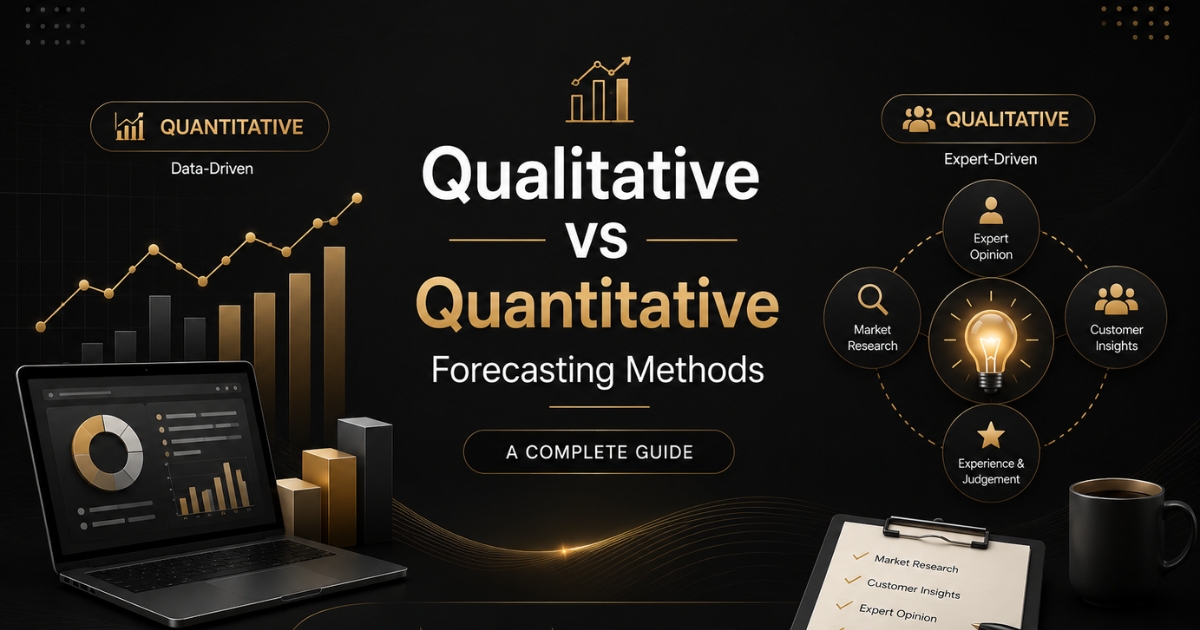
Quantitative and qualitative forecasting are the two main techniques in demand forecasting. The quantitative method uses past sales data to forecast future values, whereas the qualitative method relies on expert opinions to arrive at the most reasonable estimate of expected demand. There are several forecasting methods under each technique that companies can use to predict demand. Choosing the right method is crucial for accurate predictions and ultimately aligning resources and budgets.
Whether to use quantitative or qualitative forecasting depends on multiple factors like availability of clean historical data, time and cost constraints, market conditions, etc. In fact, many companies prefer a hybrid approach to minimise forecasting errors and benefit from the advantages of each method. In this guide, we explore the differences between qualitative and quantitative forecasting by discussing their various techniques.
What is Demand Forecasting?
Demand forecasting is a systematic process for estimating the future demand for products and services by analysing past sales, interviewing experts and customers, and understanding how external factors like market trends, seasonality, market cycles, competitors, and economic conditions affect demand.
For manufacturers, demand forecasting directly influences raw material and component purchases, inventory holding costs, stocking levels, and production capacity planning. If demand is expected to be high, they can negotiate better terms with vendors to reduce purchase costs and lead time. Besides, forecasting can also help determine warehouse storage requirements.
Demand forecasting is equally essential for service firms. Although maintaining physical inventory is not their key focus, they need to calculate staffing requirements and plan resources to ensure consistent customer service levels and be prepared to meet peak demand.
⇒ Quantitative Forecasting Methods
Quantitative forecasting uses data-driven techniques for predicting demand. This data is primarily sourced from your historical sales records and can be analysed using various statistical models. Quantitative forecasting can also include relevant external data that can affect demand. Such data could be economic indicators like inflation and rising disposable income, or market intelligence like a competitor expanding capacity.
Leading companies are effectively using modern ERP software solutions with built-in business intelligence tools to simplify forecasting. They can store and analyse a vast and complex set of internal data and study its correlation with external data. Powered by advanced data analytics, machine learning, and artificial intelligence, these solutions have completely changed the way modern quantitative demand forecasting is performed.
To help you understand the basics of data-driven demand forecasting, we are going to discuss the most common quantitative forecasting techniques here, including the naive method, the straight-line method, simple moving average, exponential smoothing, trend projection, causal analysis, nonlinear regression, and time series decomposition.
1. Naive Method
In the naive method of forecasting, you presume that the actual sales in the previous period is the true reflection of your future sales. So if you sold one lakh components last year, as per the naive approach, you expect the demand to be the same this year.
2. Straight-line Method
This is a direct projection of growth or decline from the previous period to the next period. Assuming that your sales rose by 5% last year, you expect the demand to grow at the same rate this year. A straight line assumes a linear trend without acknowledging outliers or growth indicators.
3. Simple Moving Average
The simple moving average method calculates the mean sales of the most recent past periods to predict future results. For example, when you frequently look at your sales from the last 60 or 30 days to find your average daily sales, that’s your moving average. It is one of the most fundamental smoothing techniques used in data analysis. A variation of this method is the weighted moving average, which assigns more importance to specific data points (usually the most recent ones). These methods are frequently used for demand-driven material requirements planning, which allows you to set inventory buffer zones as per demand.
4. Exponential Smoothing
A more advanced smoothing technique, exponential smoothing, assumes that recent sales data is significantly more relevant than older data, allowing you to react faster to new changes. This, in turn, minimises the impact of the bullwhip effect. Accordingly, the latest sales data is given more weight using a smoothing constant alpha.
The value of alpha (between 0 and 1) depends on how much you want to react to the latest data. You can easily assign different alpha values to different product categories using your ERP system. Practically, a fast-moving item may get a higher alpha of 0.7, while an item with relatively stable demand may get an alpha of 0.2
5. Trend Projection
In trend projection, you can easily project future trends, say six months from now. Visually, it is represented on a graph with the X-axis denoting time, and the Y-axis indicating sales figures for previous months. Depending on your sales numbers, you will get an upward slope, a flat line, or a downward slope. This method averages out the outliers.
6. Causal Analysis
Causal analysis helps determine the impact of a cause on demand. Also called associative forecasting, this method uses regression analysis, either simple linear or multiple linear regression. While most quantitative techniques use internal sales data, causal analysis examines how an external factor (independent variable) influences demand (dependent variable).
For example, if a ready-to-eat product category in the food manufacturing industry moves from 12% to 5% GST, the resulting price drop is likely to increase consumer demand. As one cause is in focus here, we use simple linear regression. However, if, in addition to the GST drop, the manufacturer learns that quick commerce platforms like Zepto and BigBasket are expanding into 50 new cities, they may want to predict demand using multiple linear regression to account for two factors. Another variation of causal analysis is econometric modelling, where you study the impact of economic factors like GDP and inflation on demand.
7. Nonlinear Regression
Companies use nonlinear regression for forecasting when it is difficult to establish a linear relationship between the independent and dependent variables, which often happens in real business scenarios. Such nonlinear relationships could be expressed graphically via a curve or a plateau. Cases where nonlinear regression suits well are:
- Market saturation of a product, occurs when the demand no longer increases, resulting in a plateau
- S-curve product lifecycle, i.e., slow growth at the start, high growth in the middle, followed again by a slowdown
- Exponential growth of a product: sharp upward curve
8. Time Series Decomposition
To make a realistic demand projection, the time series decomposition method separates the various components in historical sales data to discover long-term trends, seasonal patterns, and random fluctuations. The three components of a time series include trend, seasonality, and noise. Trend highlights the long-term increase or decrease in sales. Seasonality refers to predictable patterns that tend to repeat every year, such as high demand for paints after the monsoon season in India. Noise refers to temporary causes that disrupt or increase sales, such as a sudden increase in the sales of electric induction stoves due to a gas cylinder shortage.
⇒ Qualitative Forecasting Methods
Qualitative forecasting relies on personal opinions and judgement rather than statistical models to estimate demand. These opinions can come from experts within the company, like the sales team, department heads, and top management, who use their experience, competitor information, and market knowledge to make an estimated guess regarding sales. They can also come from market research and customer surveys.
Companies commonly use qualitative techniques in forecasting when there is a lack of historical data, especially during a new product launch, entering a new territory, or during sudden market shifts like a pandemic, making existing historical data irrelevant. The most common qualitative forecasting methods are the Delphi method, sales force composite, executive opinion, and focus groups.
1. The Delphi Method
In the Delphi Method, a facilitator gathers expert opinions by selecting the right set of experts within the company. These experts are sent an open-ended questionnaire. After receiving their demand estimates along with the reasons, all collected responses are anonymously sent back to them for review. This gives them a chance to change their opinion. This back-and-forth process goes on until a consensus is reached. The Delphi method helps reduce personal biases and produce the most practical demand number.
2. Sales Force Composite
The sales force composite method collects expected sales numbers from individual sales representatives in their territory. These numbers are aggregated, and an overall sales forecast for the company is generated. Since sales representatives have their boots on the ground, they have first-hand knowledge about the market sentiment and customers. For example, if a customer is planning to expand production, they can use this knowledge to project higher future sales values for the next quarter. However, this method can include cognitive and personal biases. An inexperienced sales rep might incorrectly predict demand. Likewise, a manipulative sales rep may underforecast to meet sales targets.
3. Executive Opinion
Under the executive opinion method, you seek opinions from top executives in the company and take an average of their demand assessments. This method is quite useful as the executives often have a broader picture of the market, such as the impact of a new government policy on customer buying behaviour. They also have access to important information on competitors that sales reps may not be aware of. It can be used alongside the sales composite method to make predictions with more accuracy.
4. Focus Groups
A focus group is a small group of participants who share diverse opinions in their respective areas of expertise during an interview. By discussing a wide range of topics like product needs, customer preferences, reaction to new ideas, purchase intent, focus group discussions are quite helpful in analysing future demand. This technique can be used before new product introductions or for gauging the demand for a new feature. The participants can vary from 6 to 12 in number, including sales managers, procurement heads, supply chain managers, industry domain experts, key customers, and potential buyers.
Qualitative vs Quantitative Forecasting Methods – Comparison
| Quantitative Forecasting Method | Qualitative Forecasting Method | |
|---|---|---|
| Source | Historical sales data | Personal opinion & intuition |
| Focus | Looks backward. Impact of past sales on future demand | Looks forward. Impact of market trends on future demand |
| Techniques | Moving average, exponential smoothing, causal analysis, etc | Delphi method, sales force composite, executive opinion, etc |
| Pererequisite | Reliable data, software & tools, data analysts, data scientists | Availability of experts who can devote time |
| Best Use Case | Established products. Can be applied to thousands of products & SKUs | New product/ technology launch, new market, sudden market shifts |
| Drawback | Historical dependency | Personal & Cognitive bias. Cannot be applied to thousands of products & SKUs |
Case: Demand Forecasting Gone Wrong
In September 2024, the Indian passenger vehicle industry was sitting on nearly 7.8 lakh unsold cars. The auto industry crisis happened because car manufacturers relied too much on past sales data and did not notice changing customer preferences. Their forecasts showed strong demand for entry-level cars, but many buyers were actually shifting towards SUVs and delaying purchases while waiting for GST 2.0 reforms. This gap between production plans and market sentiment led to an 85-day inventory build-up. As a result, car manufacturers had to urgently reduce production to prevent large financial losses.
Hybrid Approach for Resilient Demand Forecasting
One of the biggest misconceptions about demand forecasting is the assumption that one method can replace the other. On the contrary, the most accurate demand plans are shaped by a hybrid approach, utilising both quantitative and qualitative forecasting. While the quantitative method stays true to the mathematics of historical data, the qualitative method brings human-led business intelligence to the front. Blending the two methods gives a realistic view of demand. The best practice is to start with quantitative techniques if you have the right data available. Follow it with qualitative techniques to adjust the numbers based on competitor moves, market shifts, and upcoming marketing campaigns that the historical data is unable to capture.
Conclusion
Accurate demand prediction helps with better resource and budget planning while preparing you to meet customers’ requirements on time. Deciding whether to use quantitative or qualitative forecasting or both depends on business objectives, the availability of reliable historical data, and the expected future market environment.
Sage X3 ERP has a dedicated demand forecast function with a strong capability to facilitate “what-if” scenario demand planning. Benefit from its built-in AI Sage Copilot that can easily perform predictive forecasting for you on demand. Not only that, the forecasts feed directly into your Material Requirements Planning module, allowing your production schedules and inventory procurement to align with predicted sales.
Frequently Asked Questions (FAQs)
1. How to forecast demand when seasonal sales are high?
It is common for many businesses to experience a seasonal rush, such as the increase in sales of air conditioners at the onset of summer. Using the quantitative method, time series decomposition, you can separate predictable seasonal patterns from the overall growth trend and plan your annual production accordingly.
2. Is historical data reliable for demand forecasting during market changes?
While historical data is important, you need to use it correctly. In a shifting market, give more weight to the latest data, preferably using the exponential smoothing method. However, if a major change occurs, like a new competitor entering your territory, historical sales data may be unsuitable unless combined with qualitative forecasting techniques.
3. Which is more accurate, qualitative or quantitative forecasting?
Quantitative forecasting delivers better & accurate results with stable historical data. In contrast, qualitative forecasting becomes more effective when dealing with new markets and in the absence of past data. A hybrid approach can be beneficial in the event of data bias.