What is Manufacturing Process?
A manufacturing process comprises all the steps involved in converting raw materials into finished goods using a combination of human labor, machines, and tools. Manufacturing processes involve changing the shape, nature, and properties of the raw materials in order to deliver greater value to customers. Understanding the volume of production, industry type, resource constraints, material procurement terms, and budget allows production engineers to choose the right manufacturing process, optimise it for cost & resource efficiency, and select the most appropriate technological base.
Key Takeaways:
- A manufacturing process involves converting raw materials into finished goods using human labor, industrial machinery, and standardized processes.
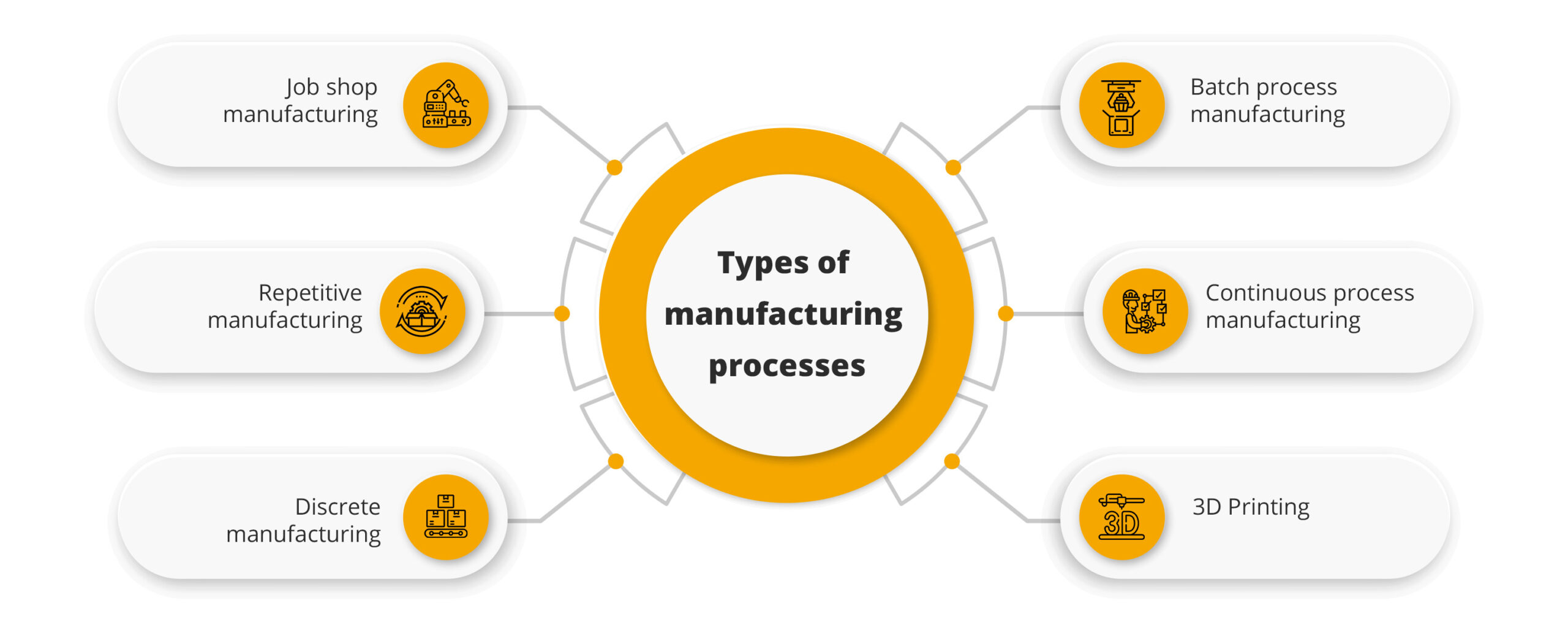
- The six types of manufacturing processes are job shop, repetitive, discrete, batch, continuous process, and 3D printing.
- Product volume, industry type, material availability, and budget are important factors used in selecting the right manufacturing process.
- Manufacturers integrate ERP software to standardize manufacturing processes, align resources efficiently, enhance inventory flows, and optimize production cycles.
6 Types of Manufacturing Processes
| Manufacturing Process | What It Is | Common Examples | Key Advantage |
|---|---|---|---|
| Job Shop Manufacturing | Produces customized goods in small batches using skilled labor and multiple workstations. | Custom furniture, specialized machinery | High flexibility for customized products. |
| Repetitive Manufacturing | Produces standardized products repeatedly in high volumes using an assembly-line process. | Automotive, electronics, semiconductors | High-volume production with lower per-unit costs. |
| Discrete Manufacturing | Produces individual, countable products with flexibility for product variations and changeovers. | Cars, computers, smartphones | Flexible production for different product configurations. |
| Batch Process Manufacturing | Produces products in specified quantities or batches, with each batch processed together. | Food & beverage, pharmaceuticals, chemicals | Good traceability, quality control and moderate customization. |
| Continuous Process Manufacturing | Produces goods continuously with minimal interruption, often using liquids, gases, powders or slurries. | Chemicals, fertilizers, pharmaceuticals, power generation | Large-scale production with high resource utilization. |
| 3D Printing | Creates products layer by layer from digital 3D models using additive manufacturing. | Industrial parts, medical devices, prosthetics | Complex designs, on-demand production and reduced material waste. |
Manufacturing processes can be broadly classified into six categories, namely, job shop manufacturing, repetitive manufacturing, discrete manufacturing, batch manufacturing, continuous process manufacturing and 3D printing. Let us explore every manufacturing process along with its advantages.
1. Job shop manufacturing
Job shop manufacturing is a manufacturing process to produce customized goods in small batches using skilled labor. It is often used in make-to-order manufacturing technique. Instead of a continuous assembly line, this method involves multiple workstations where every machine operator and worker individually adds value to the product before forwarding it to the next workstation. This approach is best suitable for custom manufacturing as it is a slower process
For example, if a business builds a custom wardrobe. It goes to each workstation for different processes, one will be sawing the lumber, another will be applying resin, the other will be designing it, and one will be polishing and varnishing it, and so on. The process continues till the product is ready.
- Advantage : Job shop manufacturing type Offers high flexibility to produce customized products. Process can be frequently modified at a relatively low setup cost to meet the technical specifications of multiple customers.
2. Repetitive manufacturing
Repetitive manufacturing is a continuous manufacturing process, especially used in make-to-stock scenarios, for producing similar products in high volume. Due to bare minimum product variations, the assembly line runs repetitively without needing many changes. Automated machinery and robots are frequently deployed here to increase output and efficiency.
A manufacturer relies on repetitive manufacturing to repeat the same process on the assembly line. This approach continuously repeats the manufacturing process 24*7 for all similar products with faster operation speeds.
Some of the industries that use repetitive manufacturing processes are electronics, automotive, semiconductor, and consumer durables. For example, it is common for car manufacturers to use sales forecasting for mass production or repetitive manufacturing of high-demand car models.
- Advantage : Good for mass production with highly standardized processes. Easy to reach economies of scale, which help reduce per-unit cost.
3. Discrete manufacturing
Discrete manufacturing is a manufacturing process where the end product is individual, countable product such as car, smartphone, etc. It is a flexible version of repetitive manufacturing, where we make frequent changes in assembly line to make diverse products. A configuration change in assembly is called a changeover, which affects cost of production.
In discrete manufacturing, especially for products like computers and laptops, frequent customizations require adaptable assembly lines. ERP for electronics manufacturing efficiently manages these changes, ensuring production agility while meeting quality standards and customer demands.
- Advantage : Variation in assembly and sub-assembly lines gives flexibility to produce customized products to cater to specific customer requirements
4. Batch process manufacturing
Batch manufacturing is a production method where products are made in specified quantities or batches. Here, the full batch is processed together on a workstation before moving it to the next workstation. It is suitable when manufacturers require flexibility in product variety and mass production is not needed. Industries that commonly use batch manufacturing processes are food and beverage, pharmaceuticals, furniture and chemicals.
- Advantage : Because products are made in batches, it enables high traceability and quality control of specific batches. Moderate customizations can be made cost-effectively without making significant changes to the assembly line.
5. Continuous process manufacturing
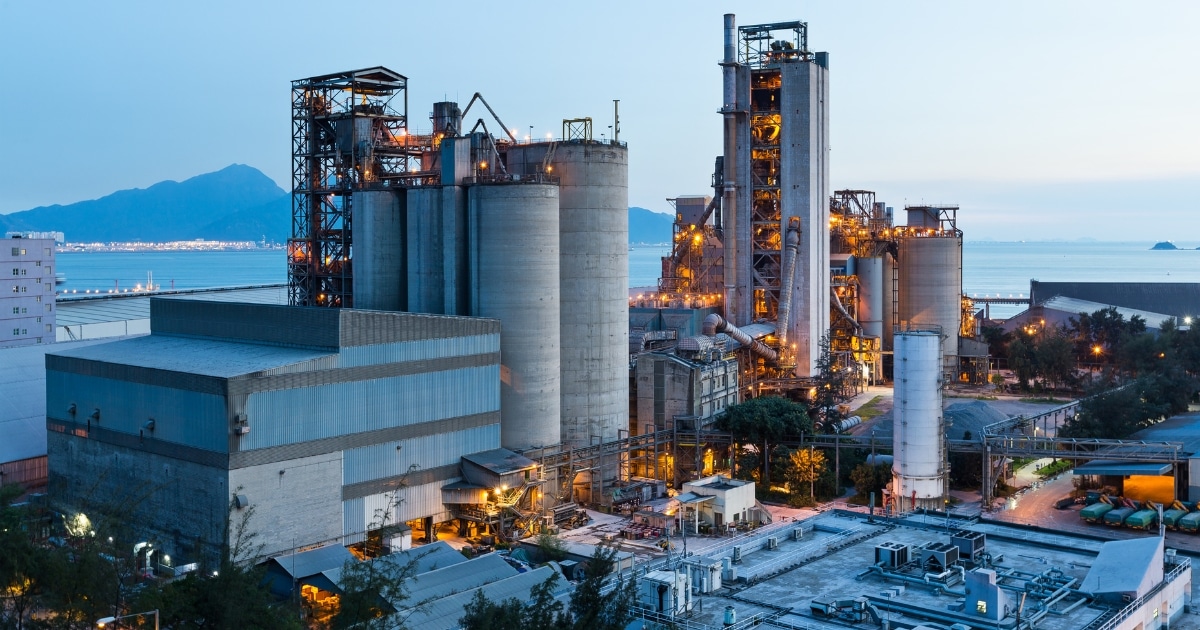
Continuous process manufacturing, also called flow production, is a manufacturing process where products are manufactured nonstop without any manual interruptions to the assembly line. It is similar to repetitive manufacturing as it involves high-volume production of goods. However, the raw materials used in continuous manufacturing primarily include gases, powders, slurries and liquids, instead of solid constituents used in repetitive manufacturing.
Some of the industries that use continuous process manufacturing are pharmaceuticals, power stations, chemicals, fertilizers, and furnaces.
- Advantage : Enables cost-effective production on a large scale. The production flow can go on 24X7 with minimum downtime, which improves resource utilization.
6. 3D Printing
3D Printing, also called additive manufacturing, is an advanced manufacturing process that utilizes digital three-dimensional models and CAD (Computer-Aided Design) software to easily manufacture complex products. In contrast to traditional models of manufacturing, where we remove material from large blocks through cutting and machining, additive manufacturing adds material layer by layer to construct a product.
A wide variety of products today are manufactured using 3D printing, such as industrial parts, shoes, prosthetic limbs, medical and dental devices, and more.
- Advantage : Supports on-demand production of goods. Complex geometric designs can be made quickly with relative ease. Ensures minimal waste as the material is only added when needed.
Classification of Manufacturing Processes
Manufacturing processes can be classified by their operation type into different categories, including casting and molding, metal forming, machining (subtractive), joining (fabrication), additive manufacturing, and surface treatment and finishing.
- Casting and Molding: This involves pouring liquid into a hollow mold cavity to cool and solidify with the intention of changing the shape of the material.
- Metal Forming: This involves using compressive or mechanical force. There is no addition or removal of any material at this stage.
- Machining (Subtractive): This involves using specialized tools to remove unwanted material with precise dimensions.
- Joining (Fabrication): This involves combining multiple parts. Heat, pressure, and other techniques are used for fabrication.
- Additive Manufacturing: This involves using various techniques such as 3D printing to build complex objects layer by layer.
- Surface Treatment and Finishing: This involves altering the outer layer of a component to make the material corrosion-resistant and improve the overall quality & durability.
Steps in Manufacturing Process
It is vital to know the steps or the stages of the manufacturing process for certain manufacturing processes and industries.
1. Create a product vision
It is vital to have a product vision, brainstorm with your team and develop a vision as it is the seed that will grow into a successful product. Understand your target audience, market size, the demand for the product, competitors, trends, funding requirements, and product roadmap.
2. Research your product niche
Before investing in the vision, research and gather insights about your niche. Find information on how you can make your custom product stand out, or if you prefer contract manufacturing and the different ways to market your product.
3. Design the product
In this stage, keep the end user’s needs in mind and design the product. Analyse the resources required, the lifespan of the good, accessories and the function of the product.
4. Finalise the design
After figuring out all the answers in the earlier step, finalise the design of your product. Create a bill of materials for all the resources which you will be using for the manufacturing process or working prototype.
5. Test the prototype
In this stage, test the product and examine if it will serve the customer demand. In this stage find all the issues with the design and solve them.
6. Manufacture the product
Develop a manufacturing plan comprising the details of raw materials, parts, components and the stages of the assembly process.
7. Get reviews and do more testing
Before launching the product in the marketplace, do more testing and get feedback. This avoids failures.
8. Launch the product
After finishing all the above stages, start with the marketing campaigns and launch the product.
Also Read: What is the difference between Manufacturing and Production?
What are the Key Manufacturing Techniques?
Manufacturing techniques are broadly classified based on when production begins in relation to customer demand. The key manufacturing techniques include Make to Stock (MTS), Make to Order (MTO), Make to Assemble (MTA), and Engineer-to-Order (ETO). They determine various operations from inventory management, product fulfilment, and the level of customisation.
1. Make to Stock (MTS)
Make to Stock (MTS) is a traditional manufacturing technique that heavily relies on demand forecasting. The company makes manufacturing decisions based on the demand estimates over a period of time. Extensive market research is performed, and data is collected from different sources to improve the accuracy of the demand. This also includes studying various macroeconomic conditions, collecting customer feedback, and competitor analysis.
Benefits:
- Faster fulfilment of customer orders
- Simple and stable production schedules
- Batch production helps reduce production costs
- Preplanned production schedules improve resource efficiency
- Increased revenue opportunities (especially during seasonal sales & promotional campaigns)
2. Make to Order (MTO)
Make to Order (MTO) technique involves closely working with a few customers and starting production activity only after receiving complete production specifications along with a letter of intent or a signed contract. This type of manufacturing technique is commonly adopted in the aerospace industry where specialized products are built after a formal purchase agreement.
Benefits:
- Stronger customer relationships
- Adopting lean manufacturing principles is much easier
- Personalized product offerings and stricter quality control
- Lower risk of over-stocking and minimal inventory storage costs
- Better cash flow position as the production is directly linked to purchase orders
3. Make to Assemble (MTA)
Make to Assemble (MTA) is a hybrid manufacturing technique where companies start partial production activity by building stock component parts until they receive customer orders. Final product assembly takes place only after they receive formal customer orders. Much like the MTS technique, they rely on extensive market research and demand forecasts.
Benefits:
- Better scope for product customisation
- Reduced risk of product obsolescence and over-stocking
- Lower operational costs and better potential for profitability
- Since products are partially manufactured, order fulfilment becomes easier and quicker
- Manufacturer is in a better position to respond to market changes and changing customer requirements
4. Engineer-to-Order (ETO)
Engineer-to-Order (ETO) is an on-demand manufacturing technique where goods are manufactured only after the manufacturer receives a custom order with exact specifications. This technique is especially common in industries that require deep precision & customisation and collaboration between the manufacturer & the customer.
Benefits:
- Higher-value business opportunities
- Continuous scope for improvement & innovation
- Lower risk of unsold inventory and better control over storage costs
- Higher customer satisfaction as products meet precise customer requirements
- Enables manufacturing of highly specialized products to maximize profit margins
Also Read : India’s Top 12 Manufacturing ERP Software in 2026
Conclusion
The manufacturing industry is vast and a complex business sector. Manufacturing processes vary depending on the type of industry. Relying on any manufacturing ERP software can ease the complex process and efficiently complete all the stages. Leveraging manufacturing systems will boost revenue, establish process control and helps in the growth of the business. It helps in staying relevant and competitive.
FAQs about Manufacturing Process
1. What is Industry 4.0, and why is it important for modern manufacturing processes?
Industry 4.0 (also known as the Fourth Industrial Revolution) utilizes advanced technologies such as IoT sensors, AI, ML, cloud computing, and robotics.
Here’s how Industry 4.0 transforms modern manufacturing processes:
- Internet of Things (IoT) Sensors: IoT sensors enable real-time sharing of machine temperature, performance logs, and faults.
- Artificial Intelligence (AI) & Machine Learning (ML): The use of AI & ML automates routine tasks and processing large volumes of data for strategic decision-making.
- Cloud Computing: Cloud computing helps achieve seamless collaboration between teams (for example, Cloud ERP)
- Robotics: Robotics helps boost total output, achieve better precision, and prevent injuries from heavy lifting.
2. Which are the Top Manufacturing Processes Industry?
Some of the top Manufacturing Processes Industry are Chemical, Pharma, Automotive, Food & Beverage, and glass Industry.
3. Which software solutions can help streamline manufacturing processes?
Here are the most popular software solutions that help you streamline manufacturing processes, automate workflows, and gain precise forecasting capabilities:
- Sage X3: A game-changing AI-powered solution with mission-critical features and native cloud integration. Sage X3 automates workflows, delivers AI-driven strategic insights, and accelerates digital transformation.
- Oracle NetSuite: Replaces several disconnected systems with a single, unified platform that provides real-time visibility across production processes and scales operations.
- SAP: Offers advanced scheduling, BOM & routing, and order management capabilities to prevent production bottlenecks and reduce costs.
- Cetec ERP: A cloud-based solution with shop floor control, production scheduling, and mobile warehousing features.
- Infor: Designed for complex businesses operating at a global level, especially aerospace and automotive companies.