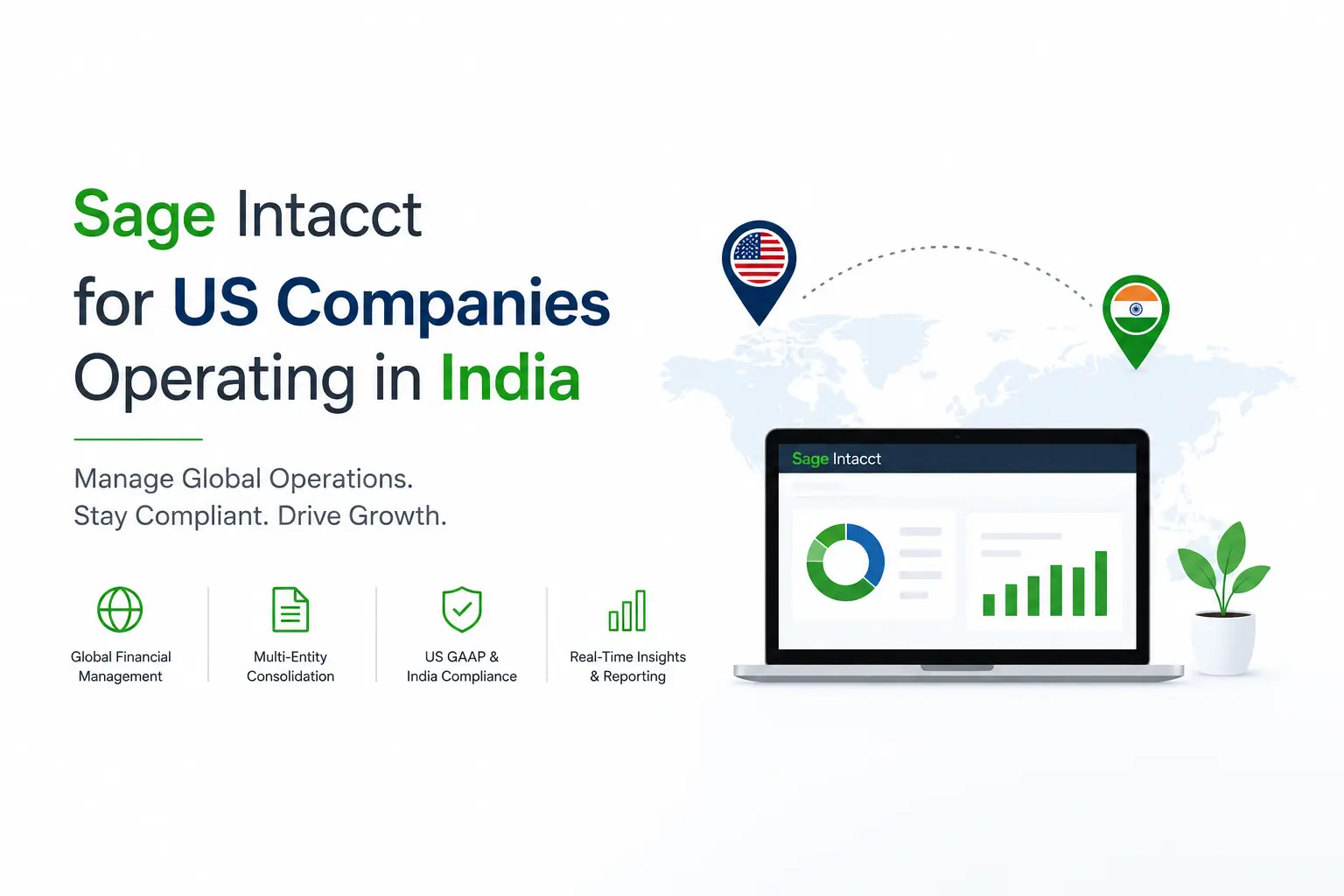
Operating a US parent company with subsidiaries or operations in India presents a unique financial puzzle. You have to satisfy two completely different financial frameworks: US GAAP or IFRS reporting requirements at the parent level, and Indian statutory requirements (GST & TDS) at the subsidiary level.
Sage Intacct handles this complex cross-border relationship through its Global Consolidations module alongside the India Localization Suite. This combination allows you to maintain real-time operational visibility while enabling faster global close cycles.
Sage Intacct for US Companies Operating in India
The Cross-Border Financial Architecture
To make consolidation seamless, Sage Intacct uses a Multi-Entity Shared Environment built on a single, shared Chart of Accounts (COA) but separated by distinct entity definitions.
-
Multi-Currency & Automated Consolidation
Instead of maintaining messy offline spreadsheet conversions, Sage Intacct handles the foreign currency translation automatically:
- Automated Daily Rates: The system pulls live daily exchange rates to translate the Indian subsidiary’s transactions from INR to USD.
- Translation Methods: Balance sheet accounts are translated using the Ending Spot Rate, while Income Statement accounts typically pull the Weighted Average Rate for the period.
- Cumulative Translation Adjustment (CTA): Any valuation gains or losses caused by fluctuating exchange rates are automatically calculated and pushed to a designated CTA equity account on your consolidated balance sheet.
-
The Intercompany Elimination Engine
US-India entities often share costs (e.g., US parent charging management fees to India, or India acting as a GCC/Captive R&D center billing back to the US).
- When the India entity records an Intercompany Receivable and the US entity records an Intercompany Payable, Sage Intacct flags these via Intercompany Account Mapping.
- During month-end, the Global Consolidations Journal automatically creates elimination entries, completely wiping out matching intercompany balances so your consolidated revenue and expenses aren’t artificially inflated.
Bridging the Compliance Gap: US GAAP vs. Indian Local Law
While the US parent cares about consolidated USD reports, the Indian entity must legally comply with local statutory mandates. Sage Intacct bridges this using a Multi-Book Architecture.
- The Local Book (INR): Tracks Indian compliance like localized GST and TDS.
- The Global Reporting Book (USD): Automatically layers on US GAAP adjustments for smooth roll-up to the parent.
You can also check : Sage Intacct Services in India
Handling Indian Localization Requirements
Sage Intacct handles strict Indian compliance utilizing the native India Localization Suite:
| Compliance Area | Requirement | How Sage Intacct Handles It |
|---|---|---|
| Goods & Services Tax (GST) | Dynamic multi-state taxation (CGST, SGST, IGST). | Automatically calculates taxes based on the shipping/billing destination state and vendor master data. |
| E-Invoicing Integration | Mandatory real-time B2B invoice registration with the government. | Connects directly to the Govt of India’s e-invoicing portal to auto-generate the required Invoice Reference Number (IRN) and QR Codes directly on Intacct invoices. |
| Tax Deducted at Source (TDS) | Statutory withholding tax on vendor payments based on specific spending thresholds. | Tracks vendor payment slabs automatically, deducts the precise tax percentage, and holds it in a withholding liability account for statutory filing. |

Best Practices for a US-India Setup
- Enforce Strict Vendor Customization: Set up your vendor onboarding in Intacct to require Permanent Account Numbers (PAN), Tax Deduction Account Numbers (TAN), and GSTINs for all Indian entities. Missing data here will break your local automation.
- Consolidate Continuously, Not Just at Month-End: Because Sage Intacct’s consolidation engine is cloud-based, you don’t have to wait until day 30 to see how India is performing. Run “interim consolidations” weekly to catch currency fluctuations or intercompany mismatches early.
- Utilize Dimensions for Cross-Border Tracking: Use standard dimensions (like “Project” or “Department”) globally. This allows the US executive team to slice global spend by department, even if the money was physically spent in INR out of the Bengaluru office.
Simplifying US-India Financial Operations
Sage Intacct helps US companies manage India operations with greater financial control and less manual effort. It automates multi-currency consolidations, intercompany eliminations, and Indian compliance requirements like GST, TDS, and e-invoicing. Finance teams gain real-time visibility across entities, faster month-end closures, and a single platform for both global reporting and local statutory compliance.