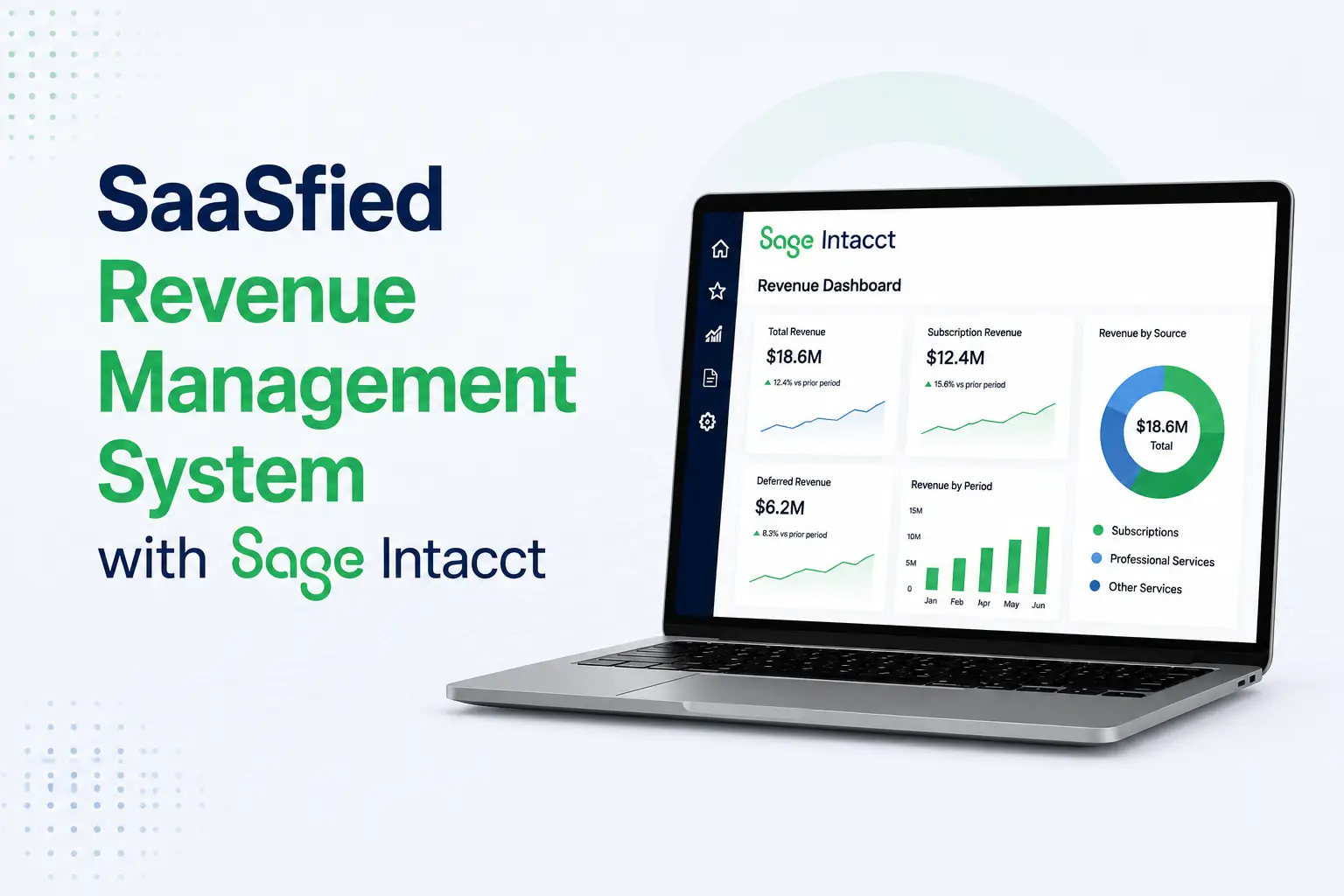
Why Sage Intacct is the Best Financial Management Tool for Companies with Complex Deferred Revenue?
For SaaS companies, subscription businesses, or any organization managing multi-year contracts, deferred revenue is more than an accounting entry. It directly impacts the accuracy of your financial reporting. Most general-purpose accounting tools struggle with the complexity of deferred revenue. Sage Intacct was built around it.
What Makes Deferred Revenue “Complex”?
Deferred revenue becomes complex when any of the following apply:
- Contracts have multiple performance obligations (eg, software license + implementation + support bundled together)
- Contract terms vary – monthly, annual, multi-year, with mid-cycle upgrades or cancellations
- Revenue recognition must comply with ASC 606 or IFRS 15
- You need real-time visibility into the gap between cash collected and revenue earned and recognized
Most mid-market ERP tools often depend on manual intervention or costly customization to manage this. Sage Intacct simplifies it with built-in automation.
How Sage Intacct Handles Deferred Revenue
Sage Intacct’s Contract and Revenue Management module automates the full revenue lifecycle:
- Automated revenue schedules: Defines recognition rules per contract, per performance obligation – no manual journal entries
- Multi-element arrangement support: Splits bundled contracts into separate obligations and recognizes each independently, fully aligned with ASC 606
- Real-time deferred revenue waterfall: Shows exactly what is deferred, what is recognized, and what is scheduled – by customer, contract, or cohort
- Mid-contract modification handling: Adjustments, upgrades, refunds, and cancellations are recalculated automatically without breaking the audit trail
- Audit-ready documentation: Every recognition event is logged with the rule that triggered it, reducing audit prep time significantly
This is a core part of the Sage Intacct architecture, not a workaround built on spreadsheet exports.
Key SaaS Revenue Metrics Sage Intacct Tracks Natively
For SaaS and subscription businesses, standard GAAP/IFRS financials tell only part of the story. Sage Intacct supports the following metrics as part of its reporting layer:
| Metric | What It Measures |
|---|---|
| ARR (Annual Recurring Revenue) | Normalized annual value of active subscriptions |
| MRR (Monthly Recurring Revenue) | Monthly contracted recurring revenue, excluding one-time fees |
| Deferred Revenue Balance | Total cash received but not yet recognized as revenue |
| Revenue Backlog | Future revenue committed under signed contracts |
| Churn Rate | Revenue lost from cancellations or downgrades in a period |
| Net Revenue Retention (NRR) | Expansion and contraction within existing customer base |
| Customer Lifetime Value (CLTV) | Projected total revenue from a customer over their contract life |
| Billings vs. Revenue Variance | Measures the gap between what was invoiced and what was earned |
Sage Intacct’s SaaS metrics dashboards provide real-time financial insights directly from the general ledger, without depending on spreadsheets that can quickly go out of sync.
Where Sage Intacct Has a Clear Edge Over Alternatives
- vs. Zoho / Xero: Neither supports multi-element ASC 606 recognition or contract-level deferred revenue tracking at scale
- vs. NetSuite: Sage Intacct’s revenue recognition module requires less implementation complexity for pure SaaS models and multi-year contracts for professional services companies
- vs. Salesforce Revenue Cloud: Powerful, but built for CRM-adjacent billing, not accounting-grade general ledger reconciliation, which is part of your financial reporting

The Bottom Line
For most SaaS businesses, revenue recognition rarely matches billing cycles. Managing that gap is critical for accurate financial reporting and compliance.
Sage Intacct is the only mid-market financial management platform where deferred revenue automation, ASC 606 compliance, and SaaS-native reporting are built into the core product.