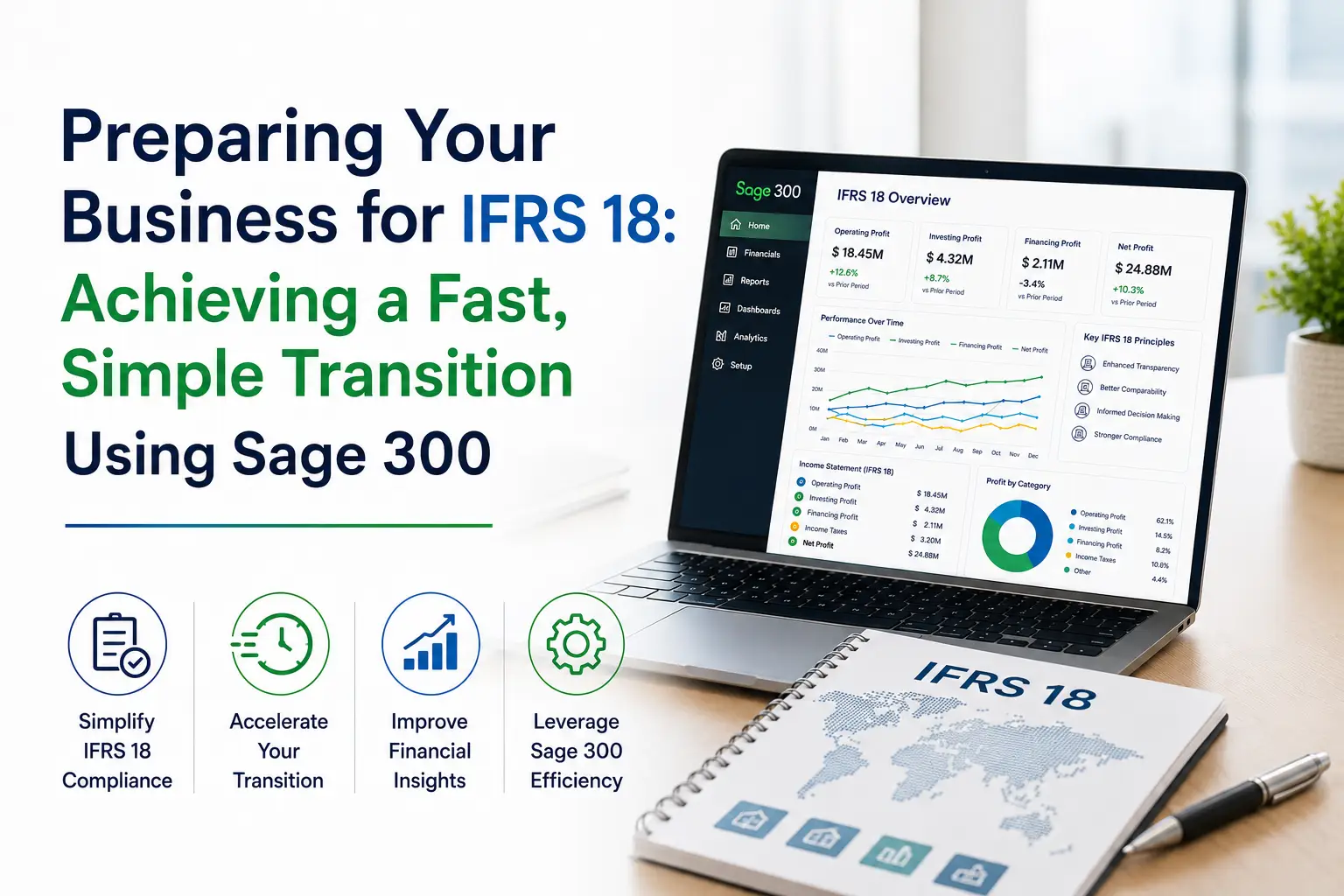
Navigating IFRS 18: How to Ensure a Seamless Transition in Financial Reporting
– And How Sage 300 Can Simplify & Speed Up the Transition
| Superseded Standard | Issued | Effective Date |
|---|---|---|
| IAS 1 — Presentation of Financial Statements | IFRS 18 — April 2024 | 1 January 2027 (retrospective) |
What Is IFRS 18?
IFRS 18 (International Financial Reporting Standard 18) is a new accounting standard introduced by the International Accounting Standards Board (IASB) that brings a standardized structure for the statement of Profit & Loss, improves transparency in the disclosure of Management-defined Performance Measures (MPMs), and promotes clearer grouping & labeling.
IFRS 18 replaces IAS 1, which is now obsolete in the modern business era that requires greater transparency, accountability, and standardization in the books of accounts. Effective from 1 January 2027, businesses across the world will have to adhere to the biggest makeover in decades, aiming to improve financial reporting
3 Reasons Why the Accounting World Needed IFRS 18
With IFRS 18, the IASB aims to close the transparency gaps and deliver a reporting upgrade that restores investor confidence across jurisdictions.
Here are the core reasons behind the most consequential accounting shift in decades:
1. Income Statement Structures That Differed Too Widely
IAS 1 afforded management considerable latitude in structuring the income statement. Companies chose their own subtotals, applied their own labels, and presented results in ways that made meaningful cross-company comparison almost impossible. IFRS 18 draws a firm line — introducing five mandatory income statement categories that apply uniformly across all IFRS-reporting entities, regardless of size, sector, or jurisdiction.
2. Non-Standard Performance Metrics With No Accountability
Many organisations published headline performance metrics — figures like “Underlying EBITDA” or “Normalised Operating Profit” — without any obligation to explain how they were calculated. Investors had no reliable basis for independent verification. IFRS 18 corrects this directly: any management-defined performance measure communicated publicly must be reconciled within the audited financial statements, bringing these figures under formal scrutiny for the first time.
3. Aggregated Expense Categories That Concealed Operational Detail
A third driver was the common practice of grouping materially different expenses under vague, catch-all headings. This approach obscured operational realities — sudden cost spikes, shifting cost structures, emerging liabilities — that should have been visible to stakeholders. IFRS 18 tightens the requirements around expense disclosure, demanding the kind of granularity that modern governance and comparability standards require.
The Three Pillars at the Heart of IFRS 18
1. Five Mandatory Income Statement Categories
Under IFRS 18, every item of income and expense must be classified into one of five defined categories: Operating, Investing, Financing, Income Taxes, and Discontinued Operations. This replaces the discretion previously afforded to management, who could largely determine how line items were labelled and grouped.
For many organisations — particularly those in financial services, real estate, or complex holding structures — reclassifying existing Chart of Accounts items into these categories will require a methodical, transaction-by-transaction review. Finance systems that lack dimensional flexibility will face significant reconfiguration costs.
- Operating: core business activities
- Investing: returns on investments not classified as associates or subsidiaries
- Financing: costs of financing the entity’s activities
- Income Taxes: current and deferred tax
- Discontinued Operations: separate from continuing activities
2. A Standardised Operating Profit Subtotal — No Exceptions
Perhaps the most immediately visible change for preparers is the introduction of a standardised, mandatory operating profit subtotal. Under IAS 1, entities could present operating profit — or omit it entirely — at their discretion, resulting in wildly different definitions across sectors and jurisdictions. IFRS 18 ends that ambiguity. Operating profit becomes a defined, non-negotiable line item in every IFRS-compliant income statement. Finance systems must be reconfigured to compute and present this figure in conformity with the IASB’s definition, not management’s preference.
3. Formal Disclosure Rules for Management-Defined Performance Measures
The most far-reaching provision targets Management-Defined Performance Measures (MPMs) — headline figures such as “Adjusted EBITDA” or “Underlying Operating Profit” communicated in earnings releases and investor presentations. Under IFRS 18, if an entity publicly communicates an MPM, it must be reconciled back to the closest IFRS-defined subtotal within the formal financial statements themselves, complete with the tax effect of each adjustment. MPMs that previously lived exclusively in investor packs — unaudited and unchallenged — must now be disclosed and reconciled within audited accounts.
| Topic | Under IAS 1 | Under IFRS 18 |
|---|---|---|
| Income Statement Structure | Flexible – management discretion | 5 mandatory categories |
| Operating Profit Subtotal | Optional/undefined | Mandatory & standardised |
| Non-GAAP Metrics (MPMs) | Unregulated disclosures | Must reconcile the statements |
| Comparative Periods | Standard restatement | Full retrospective application |
The Transition Challenge: More Complex Than Most Teams Anticipate
IFRS 18 requires full retrospective application — meaning entities must restate comparative periods. For a December year-end, that means 2026 comparatives must be restated under the new framework. Organisations that begin their transition assessment in late 2026 will face an unmanageable sprint.
The compliance challenge is not cosmetic. It requires finance teams to:
- Revisit and potentially restructure the Chart of Accounts
- Redesign financial reporting templates and layouts
- Establish new MPM disclosure and reconciliation workflows
- Restate comparative period figures with full supporting documentation
- Train finance staff and business stakeholders on the revised presentation
For organisations running legacy ERP software platforms with rigid reporting structures, the 2027 deadline is already approaching faster than it may appear.
How Sage 300 Equips Finance Teams for IFRS 18 Compliance?
Sage 300 — a proven, mature ERP platform trusted by mid-market and growing organisations across multiple industries — provides the operational depth and reporting adaptability needed to manage the IFRS 18 transition with confidence. Its architecture directly addresses each of the three IFRS 18 pillars.
1. A Configurable Chart of Accounts Built for Reclassification
Sage 300’s flexible General Ledger structure allows finance teams to segment and reclassify accounts in line with IFRS 18’s five mandatory income statement categories. Account segmentation capabilities mean that reclassifying transactions into Operating, Investing, and Financing categories can be handled through account reconfiguration — not a disruptive overhaul of your existing data structure. Historical transaction integrity is preserved throughout the process.
2. Tailored Financial Reporting Without IT Bottlenecks
Sage 300’s financial reporting tools enable finance managers to construct the precise income statement layouts that IFRS 18 mandates — including the mandatory operating profit subtotal — without routing every change through an IT queue. Report definitions can be updated and saved across multiple entities, supporting consistent presentation at the group level and simplifying the consolidation process.
3. Traceable Audit Trails for MPM Reconciliation
Reconciling management-defined performance measures under IFRS 18 demands a clear, auditor-ready trail from each adjustment back to the relevant IFRS subtotal. Sage 300’s drill-down reporting and transaction-level visibility make this process significantly more manageable, reducing the manual effort and spreadsheet dependency that have historically characterised MPM disclosure preparation.
4. Historical Data Retention for Comparative Period Restatement
Sage 300’s robust period management and historical data retention capabilities allow organisations to generate restated prior-period figures alongside current-year actuals. Comparative restatements — which are mandatory under IFRS 18’s retrospective application requirements — can be produced without rebuilding reports from scratch or relying on error-prone spreadsheet bridges that introduce reconciliation risk.
5. Industry Depth Tailored to Your Sector’s Reporting Demands
Sage 300 is deployed across a wide range of industries, including manufacturing, distribution, construction, services, and retail. Its sector-relevant functionality — job costing, project accounting, multi-currency, and intercompany transactions — means that IFRS 18 compliance work can be built on a foundation that already understands your business model, rather than adapted from a generic template.
Frequently Asked Questions
1. When does IFRS 18 become mandatory?
IFRS 18 is mandatory for annual reporting periods beginning on or after 1 January 2027, with full retrospective application. Early adoption is permitted. Most calendar-year-end entities will need restated 2026 comparatives ready by early 2028.
2. Does IFRS 18 affect revenue recognition under IFRS 15?
No. IFRS 18 replaces IAS 1, which governs the presentation and disclosure of financial statements. IFRS 15, the revenue recognition standard, remains fully in force and is entirely unaffected by IFRS 18.
3. What qualifies as a Management-Defined Performance Measure (MPM) under IFRS 18?
MPMs are subtotals of income and expense that are communicated outside the financial statements — for example, in earnings releases or investor presentations — that are not defined or required by IFRS. Under IFRS 18, any entity that communicates an MPM publicly must disclose and reconcile it within the formal financial statements, including the related tax effects.
4. How does Sage 300 support IFRS 18 compliance in practice?
Sage 300’s configurable General Ledger, flexible financial report writer, transaction-level drill-down, and historical period retention directly address the three pillars of IFRS 18: mandatory income statement categories, the standardised operating profit subtotal, and MPM reconciliation. As explained in detail in the Sage 300 brochure, finance teams can manage much of the transition work within the platform itself, reducing dependency on external spreadsheets and manual workarounds.
5. What is the most effective approach to transitioning to IFRS 18?
Begin with a structured gap analysis of your current Chart of Accounts against IFRS 18’s five mandatory categories. Then assess your reporting templates, identify which metrics qualify as MPMs, and map out the reconciliation requirements. Working with a certified Sage 300 implementation partner early in the process — well ahead of the 2027 effective date — will give your team the runway needed to restate comparatives accurately and without last-minute pressure.
The Bottom Line
IFRS 18 is not an incremental update — it is a foundational rethink of how financial performance is communicated under IFRS. The 2027 effective date may appear comfortable, but the need to restate 2026 comparatives means that preparation must begin now. Organisations that invest early in systems-readiness — leveraging platforms like Sage 300 — will not only achieve compliance but will emerge with more transparent, comparable, and decision-useful financial reporting.
The standard is clear. The timeline is fixed. The question is: Is your Sage 300 environment ready?
Author Bio
 Jitendra Somani is a senior finance and accounting professional with dual professional designations: Associate Chartered Management Accountant (ACMA) and Chartered Global Management Accountant (CGMA®) from the Chartered Institute of Management Accountants (CIMA), UK, and a member of the Institute of Public Accountants (IPA), Australia. With deep expertise spanning IFRS adoption, financial transformation, and ERP implementation — including Sage 300 — Jitendra advises organisations navigating complex accounting standard transitions. Connect on LinkedIn.
Credentials: ACMA • CGMA® (CIMA, UK) • IPA Member (Australia)
© 2025 Jitendra Somani. The views expressed are the author’s own and do not constitute formal accounting or legal advice.