SAP ECC6 was the ERP of choice for thousands of Indian companies throughout the 2000s and 2010s. It helped businesses bring finance, operations, inventory, procurement, and manufacturing onto a single platform and supported many years of growth. In 2026, however, the situation is changing. SAP’s focus has shifted to S/4HANA. Even though extended maintenance for SAP ECC6 is available until December 2030, mainstream maintenance is scheduled to end in December 2027.
For many companies, this creates a difficult decision. Continue investing in an aging ERP platform or undertake a major migration project. While S/4HANA is SAP’s recommended path forward, the investment, implementation effort, and business disruption can be significant. That’s why many Indian manufacturers and distributors are exploring alternatives that offer enterprise ERP capabilities without the cost and complexity of a large-scale ERP transformation.
This article examines why Sage X3 is increasingly being considered by businesses that have outgrown SAP ECC6 and are evaluating their next ERP platform.
What are the Real Problems with SAP ECC6?
If you are using SAP ECC6 today, these are the problems you are probably facing.
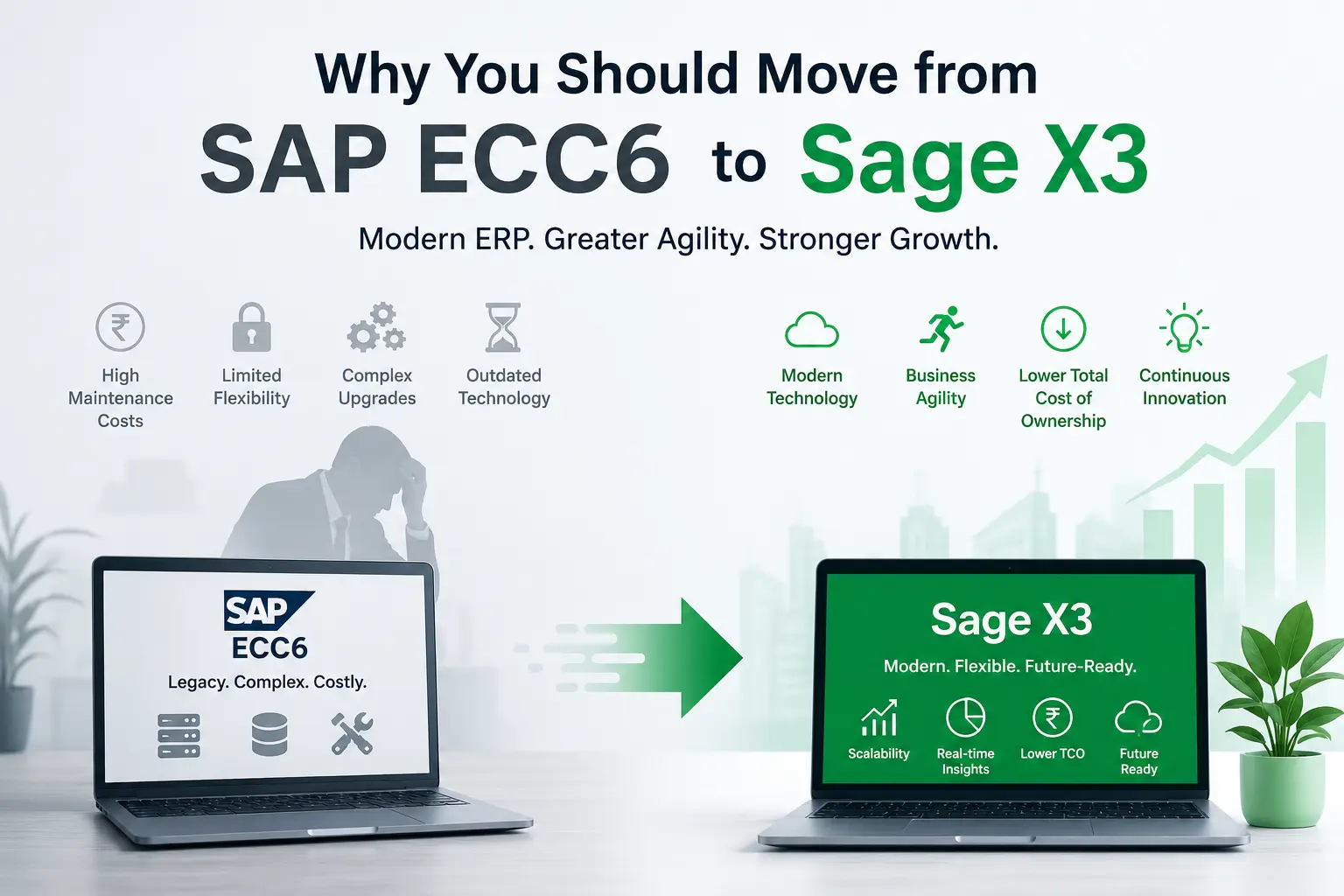
→ Rising maintenance and support costs: Making changes to reports, workflows, or compliance processes often requires specialized SAP skills. As a result, maintenance costs, support expenses, and ongoing system administration can become more expensive. Many companies find that a growing share of their ERP budget is spent maintaining the system rather than improving business processes.
→ GST compliance is becoming difficult: Despite the fact that SAP ECC6 supports GST compliance, it is common for businesses to rely on a mix of customizations, external solutions, and human intervention to manage e-invoicing, e-way bills, and return reconciliation. This can increase administrative effort and make compliance updates more difficult to manage.
→ Mobility often requires additional investment: Although mobile access is possible in SAP ECC6, it frequently depends on additional applications, integrations, or custom development. Thus, approvals and operational processes may remain tied to desktop workflows, making it harder for teams to respond quickly across plants, warehouses, and field operations.
→ Reporting, not without extra effort: Operational and financial reports can be generated using SAP ECC6, yet many users have to use Excel for profitability analysis, management reporting, and business performance reviews. As reporting requirements evolve, data extraction, consolidation, and manual adjustments can become a regular part of the process.
What is Sage X3 and How is it Different from SAP ECC6?
Sage X3 is an enterprise business management system built for manufacturing, distribution, and multi-location and global operations. It brings production, finance, and supply chain management into one connected system with real-time visibility across the business. Day-to-day administration, reporting, and business process changes can be managed more efficiently, reducing dependence on specialized ERP resources.
The core differences that matter are:
→ Greater control over your ERP environment: Teams can make routine changes, create reports, and adapt processes without waiting for lengthy development cycles. Finance and operations work directly in the system, allowing the business to respond faster as requirements evolve. For those moving from SAP ECC6, this increased agility is one of the biggest advantages.
→ Compliance management is more streamlined: GST, e-invoicing, e-way bills, and TDS are integrated into day-to-day business processes. This cuts down time-consuming tasks, allowing teams to manage compliance within a connected ERP environment.
→ Teams stay connected wherever they work: Production updates, order entry, approvals, and other day-to-day activities can be performed without being tied to a desktop. Whether teams are inside the plant or on the field, they can stay connected to the same system and information.
→ Faster reporting: As teams can access information in real time, the reports always reflect business reality. CFOs get a consolidated view of the business. Branch-wise, company-wise, and product-wise reporting can be generated from a single system rather than assembled through multiple spreadsheets.
→ Multi-entity and multi-location operations are easier to manage: Sage X3 enables businesses to manage multiple locations and legal entities from one place. Consolidated reporting and inter-company transactions are handled within the system, minimizing manual processes and improving visibility across the organization.
You May Also Like : Why Enterprises Choose Sage X3 Over Acumatica
SAP ECC6 to Sage X3 : How much does Sage X3 Implementation Cost?
Implementation costs depend on factors such as company size, number of locations, and operational complexity. However, Sage X3 requires a significantly lower investment than SAP ECC6 maintenance or S/4HANA migration. Ongoing maintenance and support costs are also less, as most routine administration can be managed by internal teams. This translates into a reduced total cost of ownership and ERP-related overhead.
How Long Does it Take to Implement Sage X3?
Many medium-size manufacturing and distribution companies are able to go live on Sage X3 within four to six months. Compared to most large-scale ERP transformation projects, Sage X3 implementation timelines are considerably shorter, helping organizations realize value sooner while minimizing disruption to day-to-day operations. Support for common Indian business and compliance requirements can further simplify deployment.
Is Sage X3 the Right Move for your Business?
A significant installed base of SAP ECC6 still exists in India, and many companies are now evaluating their long-term ERP roadmap as the 2027–2030 support window approaches.
If your business is running on SAP ECC6 and facing increasing complexity, rising support costs, or growing dependence on specialized resources, Sage X3 deserves serious consideration. It is particularly well-suited to companies that need stronger operational control without the overhead of a traditional enterprise ERP.
While S/4HANA remains a valid upgrade option, many companies find the investment, implementation effort, and operational interruption difficult to justify.
Sage X3 delivers enterprise-grade capabilities for manufacturing, supply chain, and financial management with faster implementation and better cost efficiency.
Want to know whether Sage X3 is the right fit for your business?
We can evaluate your current SAP ECC6 environment and provide a practical assessment of the costs, implementation timeline, migration considerations, and expected business outcomes of a move to Sage X3.