IFRS 18 is Here: Everything You Need to Know About It
— and How Sage X3 Drives a Seamless IFRS 18 Transition
An Overview of IFRS 18
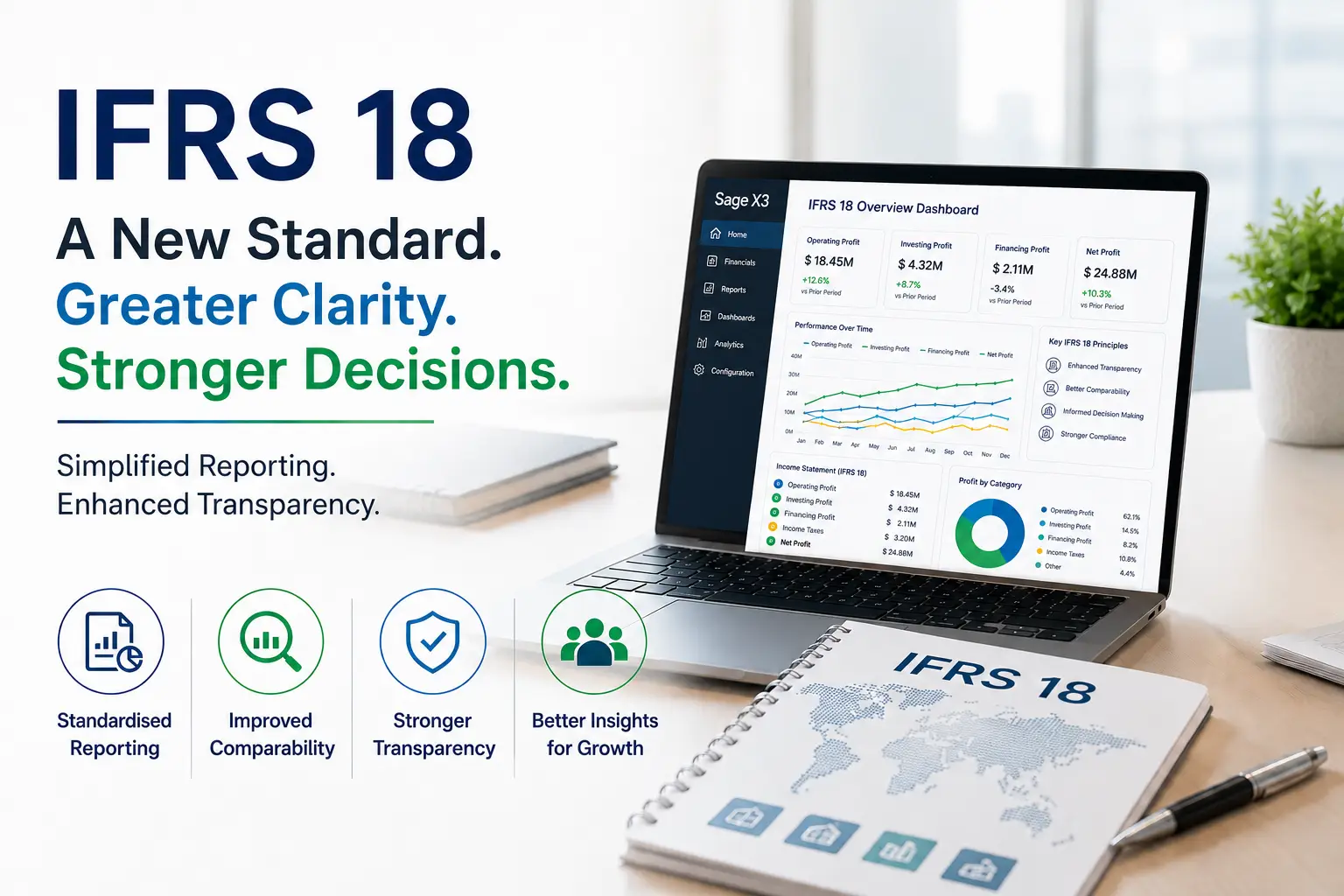
IRFS 18 stands for International Financial Reporting Standard 18, which is a new accounting standard introduced by the International Accounting Standards Board (IASB), replacing the previous IAS 1. As officially titled “Presentation and Disclosure in Financial Statements”, it introduces mandatory income statement categories, a standardised operating profit subtotal, and enhanced disclosure requirements for Management-Defined Performance Measures (MPMs).
For organisations operating across multiple entities, locations, and jurisdictions, the standard represents a significant shift in financial reporting structure and compliance expectations. Businesses relying on fragmented systems, spreadsheets, or rigid ERP software may face substantial operational and reporting challenges during transition. This is where Sage X3 provides a strategic advantage.
Why the Old IAS 1 Standard Was Replaced by IFRS 18?
There has been long demand from the investors for better clarity in the company’s financial performance and transparency in the MPM and grouping of financial information.
Here’s what drove this decision:
1. Inconsistency in Operating Profit Definitions
For decades, IAS 1 provided organisations with flexibility in how financial information was presented. But over time, that flexibility created inconsistency. Investors and analysts increasingly faced financial statements where operating profit definitions differed significantly between organisations, making comparison difficult and reducing transparency.
2. Rise of Custom Financial Metrics
Non-GAAP performance measures such as “Adjusted EBITDA” and “Underlying Operating Profit” also became widespread, often appearing outside audited financial statements with limited reconciliation to IFRS-defined figures.
3. Adoption of Global Presentation Standards
IFRS 18 addresses these concerns by introducing a more structured and standardised presentation framework designed to improve comparability, consistency, and transparency across global financial reporting.
Seamless Transition to IFRS 18 with Sage X3 : The Three Structural Changes Under IFRS 18
1. Mandatory Income Statement Categories
Under IFRS 18, organisations must classify all income and expenses into five mandatory categories, namely Operating, Investing, Financing, Income Taxes, and Discontinued Operations.
This requirement introduces a more standardised income statement structure across industries and jurisdictions.
For many organisations — particularly manufacturers, distributors, multinational groups, and businesses operating multiple legal entities — reclassifying financial data into these categories will require significant Chart of Accounts assessment and reporting redesign.
Legacy ERP systems with inflexible reporting structures may require substantial manual intervention and customisation.
2. Mandatory Operating Profit Subtotal
One of IFRS 18’s most important changes is the introduction of a mandatory operating profit subtotal.
Under IAS 1, operating profit definitions varied widely between organisations. IFRS 18 removes that ambiguity by standardising how operating profit must be calculated and presented.
Finance teams will need systems capable of generating compliant operating profit calculations consistently across entities, business units, and reporting periods.
3. Management-Defined Performance Measures (MPMs)
IFRS 18 also introduces new disclosure requirements for Management-Defined Performance Measures (MPMs).
Metrics such as “Adjusted EBITDA” or “Core Operating Margin” that are communicated publicly must now be formally reconciled to IFRS-defined figures in the audited financial statements, including disclosure of tax adjustment effects.
This significantly increases the need for audit trails, reporting transparency, and data consistency across the organisation.
Why the Transition to IFRS 18 is Harder Than You Think?
The transition to IFRS 18 is not simply a reporting adjustment. Because the standard requires retrospective application, organisations must restate comparative periods. Businesses with December year-ends will need 2026 comparative figures aligned with the new reporting framework before 2027 reporting cycles begin.
This impacts:
- Financial reporting structures
- Chart of Accounts mapping
- Group consolidation
- Reporting workflows
- Audit preparation
- Management reporting processes
- Internal finance controls
Organisations relying heavily on spreadsheets or disconnected systems may face increased compliance risk, manual reconciliation effort, and reporting delays.
How Sage X3 Simplifies the Transition to IFRS 18?
Sage X3 provides the operational flexibility, financial visibility, and reporting control required to support IFRS 18 readiness across complex organisations.
1. Easily Map Transactions to IFRS 18 Classifications
Sage X3 enables organisations to manage financial data across multiple entities, locations, business units, and dimensions within a unified ERP environment.
This flexibility allows finance teams to restructure reporting categories and map transactions to IFRS 18 classifications without disrupting operational workflows or historical data integrity.
2. Advanced Financial Reporting Capabilities
Sage X3 offers configurable financial reporting tools that help organisations build standardised income statement structures aligned with IFRS 18 requirements.
Finance teams can generate consistent operating profit calculations, group-level reports, and entity-specific financial statements while maintaining reporting accuracy and control.
3. Improved Audit Trail & Reporting Transparency
IFRS 18 places greater emphasis on transparency surrounding Management-Defined Performance Measures.
Sage X3’s integrated financial architecture provides traceability between operational transactions, financial reports, and management performance metrics, helping organisations simplify reconciliation and strengthen audit readiness.
4. Multi-Entity & Global Reporting Support
For organisations operating across multiple subsidiaries or international locations, Sage X3 supports consolidated reporting, multi-currency management, and centralised financial control within a single ERP platform.
This becomes increasingly valuable as organisations prepare comparative period restatements under IFRS 18.
5. Industry-specific Capabilities
Sage X3 is a feasible, scalable, and supportable solution that helps you meet today’s globalization challenges. This cloud-based software lets you manage complexities across different industries, including manufacturing, distribution, automotive, chemical, food & beverage, just to name a few.
The Bottom Line
IFRS 18 represents one of the most significant changes to IFRS financial statement presentation in decades. The move toward standardised operating profit reporting, mandatory income statement categories, and regulated performance measure disclosures will require organisations to reassess both reporting frameworks and underlying financial systems.
The transition timeline may appear manageable, but retrospective reporting requirements mean preparation cannot be delayed. Organisations that modernise financial reporting processes early — supported by scalable ERP platforms such as Sage X3 — will be better positioned to achieve compliance, improve reporting transparency, and strengthen decision-making across the business.
The standard is finalised. The deadline is approaching. The question now is whether your financial systems are ready.
Frequently Asked Questions
1.When does IFRS 18 replace IAS 1?
IFRS 18 becomes mandatory for annual reporting periods beginning on or after 1 January 2027, with retrospective application requirements.
2. Does IFRS 18 replace IFRS 15?
No. IFRS 18 replaces IAS 1 — Presentation of Financial Statements. IFRS 15 Revenue from Contracts with Customers remains unchanged.
3. What are Management-Defined Performance Measures (MPMs)?
MPMs are performance metrics communicated publicly by management that are not specifically defined under IFRS standards, such as Adjusted EBITDA or Underlying Profit. Under IFRS 18, these measures must now be formally reconciled within audited financial statements.
4. How does Sage X3 help organisations prepare for IFRS 18?
Sage X3 helps organisations manage complex financial structures, standardise reporting, improve audit visibility, support multi-entity operations, and streamline financial reporting processes required under IFRS 18. Refer to the Sage X3 Brochure for more information pertaining to the operational workflows.
5. How to ensure seamless transition to the IFRS 18 standards?
Sage X3 makes it easier to navigate IFRS 18 compliance. It standardizes your reports, improves audit transparency, and takes care of your intricate multi-entity structures. To ensure a smooth transition and maintain consistency across your data & other platforms, get hands-on user training through professional Sage X3 training services.