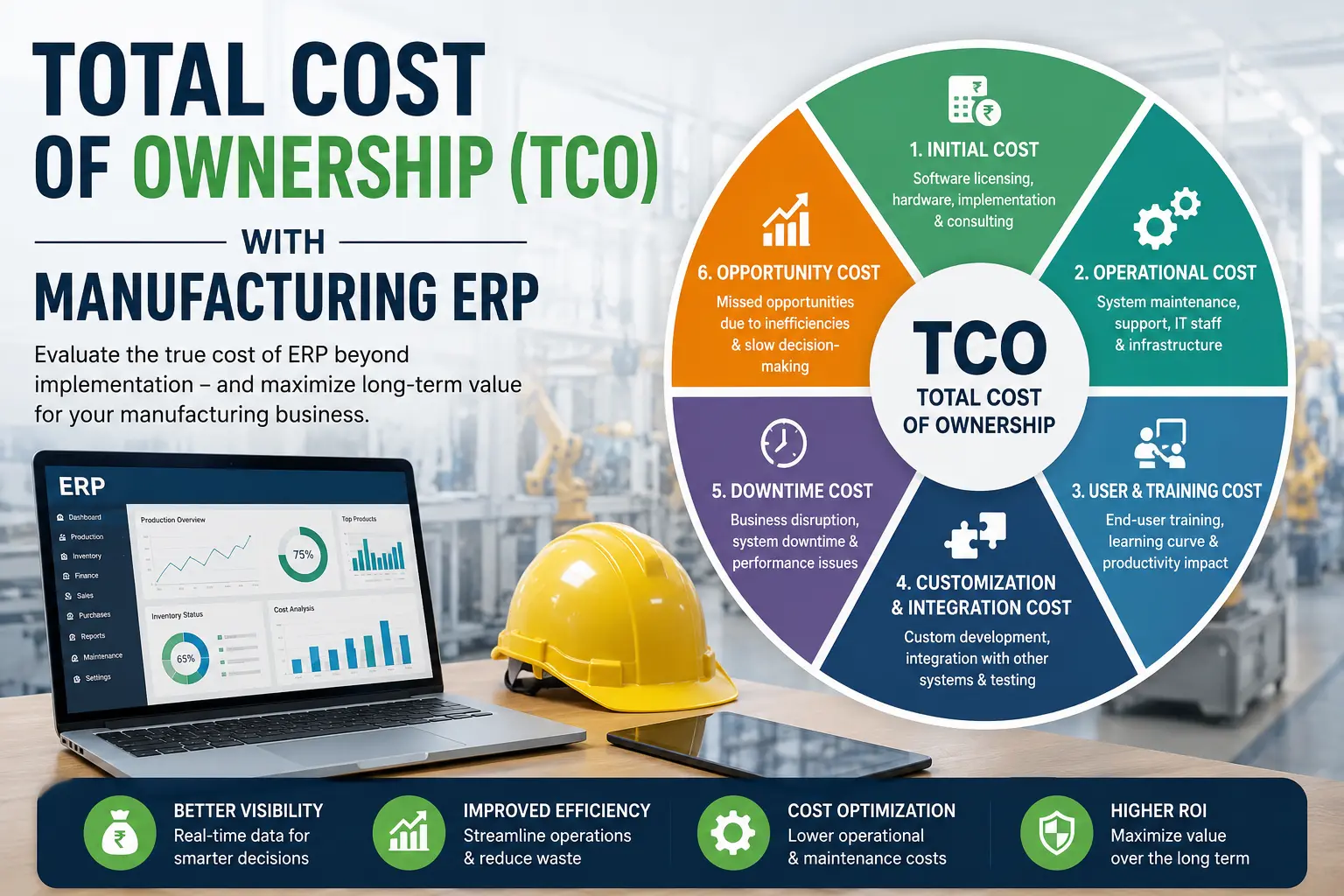
In today’s highly competitive environment, manufacturers are deploying a Manufacturing ERP to bring down their Total Cost of Ownership (TCO). This specialized software allows them to improve asset lifespan, prevent machine breakdown, reduce downtimes, and optimize their inventory costs.
What is the Total Cost of Ownership (TCO)?
Total Cost of Ownership (TCO) is a comprehensive financial assessment that considers all direct and indirect expenses related to the acquisition, implementation, operation, maintenance, and disposal of an asset. It goes beyond the initial purchase price, encompassing the full spectrum of costs incurred over the asset’s lifespan to provide a more accurate representation of its true financial impact.
The Asset Management module of ERP Software streamlines the activity of building a comprehensive database of your organizational assets with asset-specific details (such as their tags, location, and vendors), thereby allowing you to organize them through a unified interface for maximum efficiency and higher return on investments.
How to Calculate TCO?
Here’s the simple formula to calculate Total Cost of Ownership (TCO):
Total Cost of Ownership = Acquisition Costs + Operating Costs + Maintenance Costs + Disposal Costs − Residual Value
Key Components of TCO
The following are the key components of the Total Cost of Ownership (TCO) formula:
1. Acquisition Costs
These are the initial, upfront expenses related to asset acquisition, such as the purchase, shipping, installation, and setup fees.
2. Operating Costs
Operating costs are the ongoing expenses incurred during the asset’s normal use, such as energy consumption, fuel, supplies, and recurring licensing fees.
3. Maintenance Costs
Maintenance Costs cover the expenses associated with keeping the asset in optimal condition, such as routine servicing, repairs, upgrades, and replacement parts.
4. Disposal Costs
Disposal costs are the expenses incurred during asset decommissioning and removal, such as dismantling, recycling, and environmentally compliant disposal fees.
5. Residual Value
Residual value is the estimated worth of the asset at the end of its useful life. This represents the potential salvage value or resale price.
Also Read : ERP for Manufacturing Industry
How Sage X3 Manufacturing ERP Lowers the Total Cost of Ownership
Sage X3 ERP software brings down the Total Cost of Ownership in various ways, as outlined below:
1. Preventive Maintenance Scheduling
A Manufacturing ERP helps companies anticipate the need to conduct and schedule asset maintenance activities. Proactively anticipating maintenance needs of your equipment and machinery will result in improved asset health & performance and reduced wear & tear.
2. Extended Asset Lifespan
Manufacturing ERP provides complete control over your business assets. Incorporate breakdown maintenance plans, and formulate the best strategy to improve your asset’s longevity & long-term performance.
3. Streamlined Asset Compliance
An ERP software provides built-in tools for automated data tracking, collection, and reporting. It streamlines compliance tasks throughout the asset lifecycle from its acquisition to disposal, making your organization audit-ready.
4. Centralized Asset Information
An ERP software improves visibility into your organization’s assets by centralizing all the asset information in one place. This Single Source of Truth provides accurate insights into your assets, contributing to better asset utilization and strategic decision-making.
5. Accurate Depreciation
Manual calculation of depreciation can be complex and error-prone, leading to various discrepancies in the books of accounts. Thanks to ERP, the process of maintaining multiple assets is automated and digitized, ensuring transparent audit trails and completeness.
6. Reduced Downtime
ERP software integrates with IoT sensors, which actively track machine temperature, cycles, and noise. It helps avoid machine breakdown by automatically triggering alerts when something goes wrong, reducing instances of machine breakdown and production disruptions.
7. Optimum Inventory Management
ERP empowers businesses with robust inventory planning tools to prevent over-stocking and reduce unnecessary costs. Moreover, businesses can minimize spoilage, damage, or theft of their inventory.
8. Lower Procurement Costs
ERP software helps improve procurement decisions by building a comprehensive database of vendors and providing a historical snapshot of their performance, allowing decision-makers to make cost-efficient and strategically beneficial decisions.
Frequently Asked Questions (FAQs)
1. What is the full form of TCO?
The full form of TCO is Total Cost of Ownership.
2. Why TCO matters?
TCO plays an important role in business decision-making. Here’s why it matters:
- Insights into Hidden Costs: TCO unveils hidden costs such as excessive machine maintenance and high energy usage.
- Strategic Decision-making: TCO improves the decision-making process. For example, comparing suppliers based on total value rather than initial price.
- Accurate Budgeting & Forecasting: Improves the level of accuracy of budgeting and forecasting to control costs and mitigate financial risks.
3. What are some common mistakes in TCO Calculations?
Common mistakes in the calculations include:
- Overlooking Indirect Costs: Businesses may sometimes overlook indirect costs such as system downtime & transition costs, productivity loss, etc.
- Using Inaccurate Assumptions: If the base assumptions are incorrect, it can affect the quality of decision-making (such as expected machine lifetime)
- Failing to consider the entire asset lifecycle. Businesses may ignore substantial costs in the asset lifecycle, such as asset decommissioning and data migration.