Printing companies manage complex processes involving job estimation, raw material procurement, inventory, production scheduling, machine capacity, quality control, order fulfillment, and financial management. Managing these processes through spreadsheets and disconnected systems can result in production delays, material wastage, inaccurate costing, and limited visibility.
What is ERP for Printing Industry?
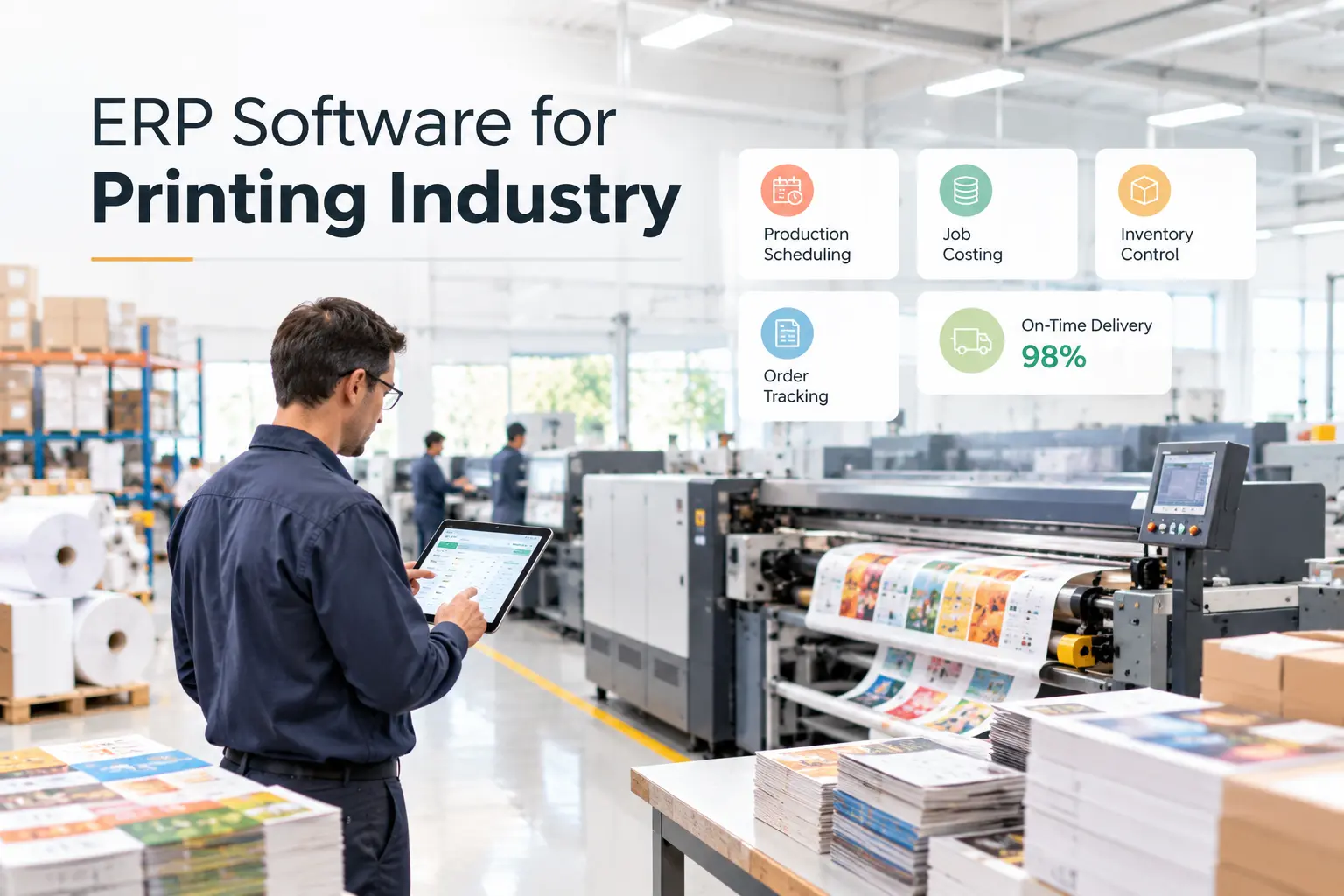
ERP Software for Printing Industry is a highly adaptable solution and a solid operational backbone for the printing and packaging industry, that encompasses all the features tailored to the specific needs of the industry, such as process automation, order management, job estimation, production scheduling, quality assessment, and resource optimization.
ERP software is a handy tool that offers a variety of advantages over legacy systems and spreadsheets. It provides cutting-edge technology that helps your business improve production volume, reduce downtimes, benefit from faster order lookups, and achieve strategic business objectives and visions. The software can be deployed in a variety of ways, such as on-premise, on the vendor’s cloud servers, or in a hybrid manner.
India Commercial Printing Market Size & Outlook, 2026-2033
The commercial printing industry in India was $30.9 million in size in 2025, Estimate $32.2 million in 2026. It is forecasted to reach $48.6 by 2033, growing at a 6% CAGR during the period of 2026-2033, according to a research report published by the Grand View Horizon. Among all the printing technologies studied, lithographic printing contributes the most, while digital printing is considered the most attractive segment.
Challenges Faced by the Printing Industry
Printing companies manage complex operations involving customer orders, job estimation, raw material procurement, inventory, production scheduling, quality control, dispatch, and finance. Managing these activities across spreadsheets or disconnected systems can result in inaccurate job costing, material wastage, production delays, inventory issues, and limited visibility into profitability. ERP software for the printing industry integrates these processes into a single system, enabling businesses to manage print jobs more efficiently, monitor paper and ink consumption, optimise production schedules, track costs, and maintain real-time visibility across operations. By connecting sales, production, inventory, procurement, and finance, an ERP system helps printing companies improve operational efficiency, reduce costs, meet delivery deadlines, and make informed business decisions.
1. Digital Disruptions
In today’s age of the Internet and technology, information is rapidly distributed electronically. Businesses increasingly favor electronic communication, data transfer, and online advertisements over letters, printed materials, and paper ads. As a result, the printing and packaging industry has seen a significant drop in demand.
2. Cash Flow Management Challenges
A high-volume business like printing often faces different cash flow challenges, such as higher amounts of accounts receivable and accounts payable. The amount of money flowing out of the business for different operational costs such as rentals, papers, inks, and printing plates outweighs the revenue coming in from customers.
3. Uncollectible Accounts Receivable
Printing businesses often have to extend credit to their customers, who are typically underfunded individuals and small businesses. It needs to take appropriate measures such as regular credit checks, collective collection efforts, and legal actions that are often time-consuming and expensive in nature.
4. Higher Capital Spending and Cost of Fixed Assets
Many businesses operating in the printing packaging industry are small and medium-sized enterprises (MSMEs). To effectively face the growing competition, they need to keep their printing equipment up-to-date with the latest technologies. However, these MSMEs are not well capitalized for higher capital spending. They often run out of profits during the seasonal drop in demand and economic slowdowns.
4. Debt & Solvency
To keep updated with the latest printing and technological innovations, the printing company has to make a significant investment in new equipment and capital assets. However, such large capital expenditures can increase the chances of underutilization due to lower demands and a large amount of debt. Higher debt can impact its relationship with suppliers.
5. Supply Chain Issues
The printing industry is often affected by supply chain issues. Shortages of raw materials, spiraling fuel costs, and the availability of ink can cause delays in supply. Businesses need to perform strategic planning to ensure an ongoing supply of raw materials at a competitive price to reduce the number of shortages, delayed deliveries, and poor customer experiences.
Benefits of ERP Software for Printing Industry
Ease of Managing Inventory
Print ERP builds a centralized system of information management that provides accurate inventory data for stock management, dynamic order confirmation, and stock-based updates. ERP for the printing and packaging industry provides a separate module Inventory Management System that facilitates instant communication between different business departments and avoids situations of under-stocking and over-stocking.
Precise Financial Reports
ERP for the printing industry provides a comprehensive picture of the company’s financial health and assists with various functions such as financial planning, budgeting, forecasting, tax management, and decision-making. It provides precise financial reports and an all-around view of financial data with higher transparency and precision. ERP for the printing and packaging industries eliminates human errors, erroneous data, inaccuracies, and inconsistencies.
Process Automation
The best ERP software in India streamlines various business processes such as invoice generation, inventory tracking, print management, and order management, which help employees eliminate manual work and focus on business-critical tasks. Ultimately, the business benefits from increased productivity, lower costs, reduced errors, enhanced customer service, and increased brand loyalty.
Actionable Insights into Business Operations
Printing ERP software integrates various aspects of the printing and packaging business and comes with various powerful tools for production planning and production scheduling that provide actionable insights into key business operations. Decision-makers will be in a better position to accurately identify market trends and areas responsible for hampering productivity, inefficiencies, and strained business growth.
Effective Sales Management
Print ERP is a handy tool that provides an intuitive user interface and plays an active role in the company’s marketing success. It enables businesses to build effective sales strategies, optimize pricing strategies and marketing campaigns, become customer-savvy, align with changing market trends, and grab new business opportunities. With printing business solutions, your business will be in a better position to take advantage of new market opportunities and peak sales periods. It can also frame customized pricing based on customer loyalty, customer segment, and purchase history.
Collaboration with External Stakeholders
The robust planning and management functionalities in ERP modules facilitate effective collaboration with external stakeholders, such as vendors of raw materials. Printing and packaging ERP builds a comprehensive database of various vendors, including their contact details, payment terms, and shipping information. It minimizes human interventions and automates routine vendor invoice activities using Accounts Payable Automation, which ultimately boosts vendor-business relations.
Significant Cost Savings
Cost reduction can be a great challenge for any business. Printing businesses are not an exception. The ERP implementation facilitates modern technologies and functionalities that reduce operational and administrative costs without sacrificing business performance. For example, the Procurement Management System provides an automated system that tracks real-time market prices and generates cost-effective purchase orders based on early payment discounts. With printing and packaging ERP, the business can achieve end-to-end financial control in various aspects such as asset management, sales, payroll, and taxation.
Streamlined Supply Chain
Printing and packaging ERP has built-in seamless and comprehensive supply chain management tools that facilitate order scheduling, real-time reporting, and collaboration. Printing and packaging ERP software also reduces supplier risks and makes the supply chain process simple, scalable, and efficient. With a seamless supply chain process, the organization benefits from lower costs, optimum resource utilization, timely order fulfillment, and higher customer satisfaction.
Also Read: How Sage X3 ERP is the Ideal Choice for Manufacturing Businesses of All Sizes
How ERP Software Streamlines the Printing Workflow?
Printing involves several connected stages, from receiving customer orders and preparing quotations to sourcing materials, scheduling production, completing printing and finishing, and managing dispatch and invoicing. ERP software for the printing industry connects these activities on a single platform, allowing teams to access real-time information and coordinate operations more efficiently. It helps businesses move seamlessly from order management and job estimation to material planning, production, quality control, inventory, dispatch, and financial management, reducing manual work, improving visibility, and minimising delays.
Typical printing workflow:
Customer Enquiry → Estimation & Quotation → Sales Order → Material Planning → Procurement → Production Scheduling → Printing → Quality Check → Finishing → Dispatch → Invoicing
With an integrated ERP system, each stage is connected to the next, helping printing companies track job status, monitor material consumption, control production costs, meet delivery schedules, and gain better visibility into overall profitability. This integrated approach enables businesses to manage more print jobs with greater accuracy while reducing operational inefficiencies.
How to Choose the Best ERP Software for the Printing Industry
Choosing the right ERP software for the printing industry requires more than comparing features and prices. Start by checking whether the ERP can support your specific business requirements. These may include job estimation and costing, production planning, paper and ink inventory, procurement, quality control, order management, and financial operations.
The ERP should be scalable enough to support your business as it grows. It should also integrate with your existing systems and provide real-time reports and business insights. Reliable implementation and ongoing support are equally important.
Companies should also consider deployment options, customisation, data security, and the total cost of ownership. The vendor’s experience in supporting printing and manufacturing businesses should also be evaluated. A thorough assessment helps you choose an ERP that fits your current workflow and can adapt to your future business needs.
Maximize Your ROI and Boost Profitability with Sage X3
The printing business is a high-volume business with higher capital spending and tight profit margins. Printing and packaging ERP helps it deal with various challenges, such as spiraling costs of raw materials, soaring input costs, cash flow challenges, and procurement and delivery issues. It includes a specific set of modules that automate the workflow, provide insights into business operations, and help decision-makers mitigate different challenges.
Sage X3 is a high-end ERP that provides a holistic view of your business operations and empowers it with the flexibility and agility to meet today’s printing business needs. It comes with an integrated order management and multi-channel management system that brings efficiency into your everyday operations with accuracy and assists it with data-driven production planning, material ordering, costing, and revenue tracking. Your business benefits from process optimization, reduced manual work, real-time analytical reports, and powerful dashboards and positions itself for long-term and sustainable growth.

Frequently Asked Questions (FAQs) about Printing ERP Software
1. What is an ERP software in printing industry?
ERP software for printing industry is customized to fit the specific needs of the printing industry and built with industry-relevant modules to boost efficiency, reduce costs, and gain deeper insights into profitability.
2. What are the major benefits of printing ERP software?
Printing ERP software offers a wide array of features. Here are the major benefits of deploying it:
- Manage print & track print job progress runs with a single, integrated platform
- Gain accurate insights into your stock levels
- Better efficiency in the procurement of materials, inks, glasses & plastics
- Track interactions with your clients and manage your contracts
- Operate efficiently, improve quality, and maintain competitiveness
- Forecast sudden drops and surges in demand for better responsiveness
3. Which is the best ERP software for printing industry in India?
Sage X3 is the best-in-class ERP solution for printing industry that empowers your business with greater accuracy, efficiency, and productivity. It empowers your business with cutting-edge technology to enhance your brand’s market credibility and capitalize on new opportunities.
4. What are the core features of a printing ERP software?
Here are the most demanded features of a printing ERP:
- Inventory Control: A robust inventory management system is in place to prevent raw material shortages and reduce waste.
- Quality Control: Enhance quality and improve customer satisfaction with built-in quality & compliance features.
- Production Scheduling: Automatically track machine availability and align it for better efficiency.
- Job Estimation & Costing: Calculate the costs for paper, ink, labor, etc.
- Web-to-Print Integration: One of the most demanded features for e-commerce order automation.
5. What is the difference between printing ERP and generic ERP software?
Printing ERP software is designed to support the specific requirements of printing businesses, such as job estimation and costing, production planning, paper and ink inventory, material wastage, and print job tracking. Generic ERP software provides broader business management functions but may require additional customisation to handle printing-specific processes.
6. How much does printing ERP software cost?
The cost depends on factors such as the number of users, business size, required modules, deployment model, customisation, integrations, implementation, and support. A detailed assessment is recommended to determine the total cost for a specific printing business.