Key Takeaways:
- A Facility Management System helps businesses manage facilities, equipment maintenance, and daily operations from a single, integrated platform.
- Restaurants, quick commerce & cloud kitchens in India increasingly need facility management to avoid downtime, stay compliant, meet customer expectations, and reduce operational costs.
- Facility management KPIs & reports allow businesses to measure equipment downtime, preventive maintenance compliance, hygiene audit performance, complaint resolution time, and energy costs.
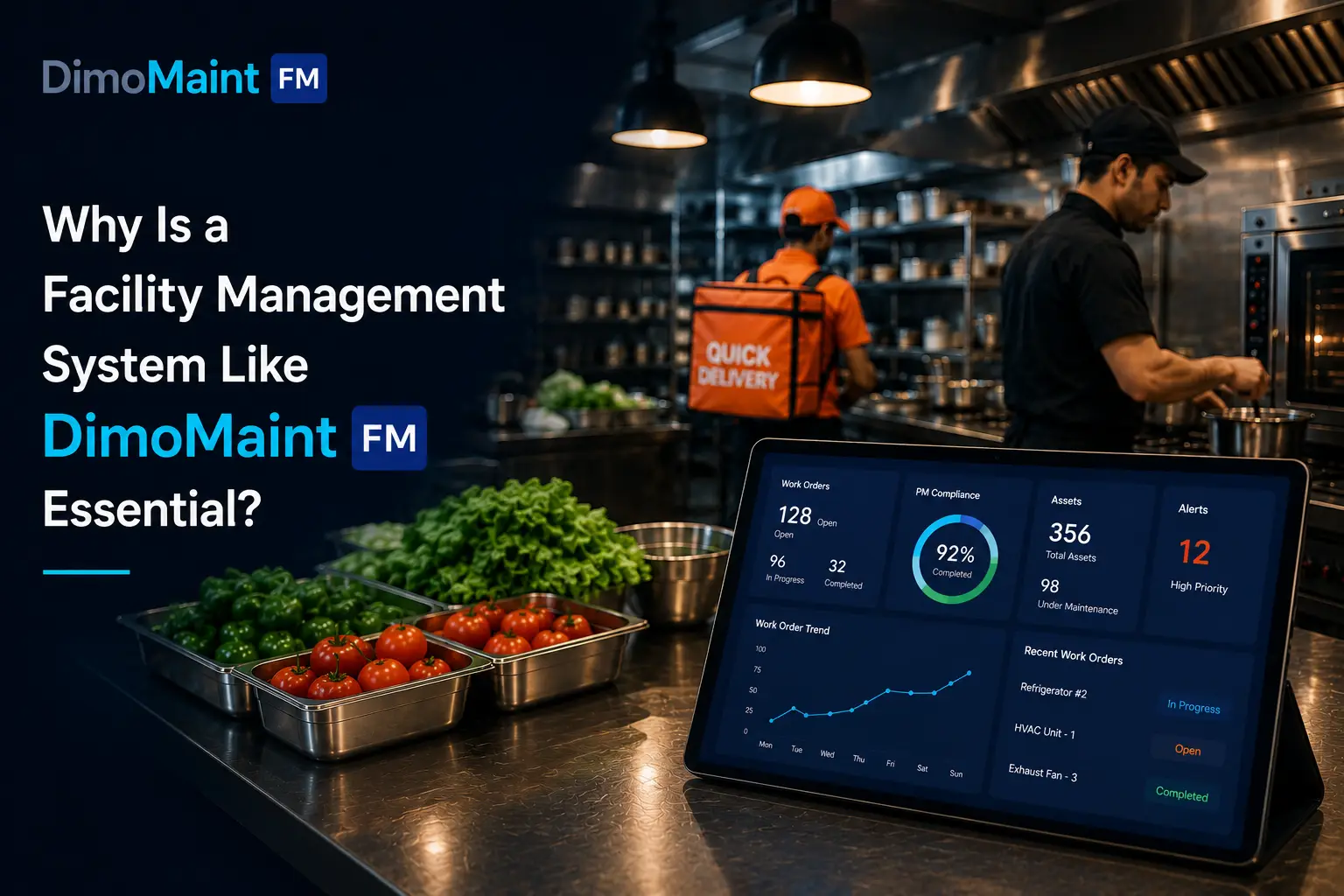
- DimoMaint FM provides multi-site asset tracking, equipment health monitoring, maintenance schedules management, streamlined work orders, and effective facility operations.
What is a Facility Management System?
A Facility Management System is an enterprise software that provides a centralised way to track, manage and optimise facility operations. It encompasses various functions to optimise site assets, automate recurring routines, track equipment maintenance, and manage maintenance spare parts.
DimoMaint FM is a popular facility management system that allows efficient work order & maintenance management, building digital checklists, and tracking maintenance budget consumption. It streamlines routine safety checks and preventive maintenance activities, while providing deep integration with third-party APIs for effective tracking, analytical and reporting purposes.
Why a Facility Management System Matters More Than Ever for Indian Food Businesses
With ever-increasing operational costs in the HORECA industry, business complexity, regulatory crackdowns, and rising consumer expectations, using a facility management software has become more important than ever.
From multi-site equipment monitoring and defining cleanliness parameters to handling sudden breakdowns on priority and scheduling preventive service, a facility management software redefines your maintenance approach.
A missed cleaning task, an overdue inspection, or poorly maintained equipment disrupts operations, affecting customer service and brand reputation.
If you have been managing restaurant maintenance via WhatsApp groups and spreadsheets, you cannot really be sure how much time and money your multi-site maintenance operations are actually costing you. Or, even how well you are managing your asset complaints and servicing routines.
Let’s look at the key factors that make a facility management system essential for food services entities.
1. Scaling Operations
Running one restaurant can be complex. Scaling it to 50, 100, or 500 outlets compounds that complexity. For a chain of restaurants and cloud kitchens, equipment like commercial refrigerators, deep freezers, deep fryers, combi-ovens, HVAC systems, and dishwashers requires constant monitoring to keep kitchens safe, clean, and operational.
Likewise, dark stores and warehouses operated via quick commerce platforms require constant maintenance of their cold storage equipment, among others, to keep food fresh and efficiently fulfill instant grocery orders.
Apart from kitchen and cold storage equipment, these facilities have an added responsibility to undertake building maintenance as part of overall facility management.
2. Cold Chain & Perishable Stock
Restaurants, quick commerce, and cloud kitchens handle perishable food items, such as meat, vegetables, and dairy products, that spoil fast if a refrigerator fails even for a brief moment, leading to spoiled inventory and financial loss. Food storage equipment needs continuous temperature control and preventive checks.
Notably, cloud kitchen-dependent brands that take orders via food aggregators like Swiggy and Zomato are at risk of order cancellation penalties and poor platform rankings if they fail to fulfill customer orders.
Aslo Read: Best Cold Storage ERP Software in India
3. Increased Operational Complexity
Cloud kitchens in India often have longer working hours with a huge order workload. Food aggregator companies promise instant delivery, which strains kitchen equipment. Setting up daily, weekly, and monthly maintenance schedules for every piece of equipment through automated asset tracking software improves efficiency and equipment performance while reducing downtime.
As food service chains expand across cities, maintaining hygiene and safety standards becomes increasingly difficult. Moreover, due to high staff attrition rate, new employees fail to follow basic maintenance protocols. Making SOPs a part of every asset and work order via a facility management system ensures standardised asset care regardless of staff attrition.
4. Multiple Service Vendors
With multiple maintenance contractors involved, each with unique annual maintenance contracts and service level agreements, the stakes are even higher. You need centralised oversight and tracking across locations to keep maintenance budgets in check.
Scheduling and verifying repair jobs, managing spare parts purchasing, and maintaining consistent service quality standards directly influences health, safety, and food quality, along with operational costs.
It is necessary to put in place standard operating procedures for maintenance, for which a centralised facility management system becomes crucial to implement.
5. Intensifying Regulatory Scrutiny
Some Indian states are witnessing sudden, unannounced inspections from regulatory authorities to enforce compliance.
For instance, FSSAI and state FDA require weekly deep-cleaning of exhaust systems and commercial dishwasher descaling to manage fire hazards and sanitation. Daily maintenance must include disinfecting cooking equipment, calibrating cold storage, and monitoring oil quality based on TPM limits, alongside monthly sanitisation of ice machines.
According to a news report, restaurants across Maharashtra are approaching food safety experts and third-party auditing firms to stay compliant. Non-compliance is no longer something that can be ignored. It can lead to irreversible reputational damage, financial penalty, and even license suspension.
6. Rising Consumer Expectations
India is witnessing a rapid shift in consumer expectations. Consumers increasingly prefer eateries with visible proof of hygiene, transparent sourcing, and higher quality standards.
Tech-savvy GenZ and millennials are quick to expose food quality lapses via social media reels, prompting immediate FSSAI raids that punish restaurants for poor storage and pest control. Interestingly, Swiggy runs a Seal Program that awards a quality badge to top-rated restaurants, using customer feedback to promote high standards in food hygiene and preparation.
7. Higher Operational Costs
With utility and energy costs increasing, businesses are looking for stricter cost control measures. Efficient facility management helps lower costs and maximise profit margins.
Apparently, power consumption is one of the highest operational expenses in commercial kitchens. Worn refrigerator door seals, unserviced compressor coils, or uncalibrated HVAC systems account for 15 to 20% more electricity. Continuous preventive checks reduce maintenance expenses and the need for early asset replacements.
Well-managed restaurants and cloud kitchens tend to keep their maintenance costs within a range of 1 to 2% of the revenue.
Why Should Food Safety Be a Facility Management Priority?
The success of facility management depends on maintaining food safety and ensuring a safe and hygienic environment. Efficient food safety management helps achieve the goals of facility management.
- Protect Consumer Health: Protect the health of your consumers from harmful contaminations, bacteria, viruses, chemicals, and allergens.
- FSSAI Compliance: Simplify FSSAI food safety compliance requirements by maintaining safe food handling practices and ensuring hygiene, safe storage & sanitation.
- Prevent Cross-contamination Risks: Maintain higher food standards and prevent cross-contamination risks during different activities of food processing.
- Maintain Brand Reputation: Enforcing strict food quality & safety standards will help avoid negative public backlash, customer distrust, product recalls, and reputational damage.
- Reduce Financial Losses: Prevent food waste & spoilage, batch rejection, and product recalls, effectively minimizing the risk of operational and financial losses.
What are the Best Practices for Facility Management Success?
Some of the best practices for facility management success include scheduling preventive checks, partnering with reliable vendors, using CMMS software, standardizing hygiene checklists, and optimizing space & layout.
1. Schedule Preventive Checks
Don’t let your critical equipment fail and ensure continuity in business operations. Schedule preventive equipment maintenance activities to find & fix flaws before they turn into a costly repair and an avoidable downtime.
2. Partner with Reliable Vendors
Regularly evaluate vendor performance, and build a network of trusted vendors for equipment repair, waste management, and pest control. Avoid partnering with vendors with unsatisfactory records, unclear budgets, missing deadlines, and poor communications.
3. Use a CMMS Software
A Computerized Maintenance Management System (CMMS software) is a mobile-friendly, cloud-based software that provides complete visibility into your asset health. It optimizes maintenance processes, and helps you efficiently maintain equipment, assets & facilities.
4. Standardize Hygiene & Safety Checklists
Document your food safety and hygiene standards and optimize workflows across different branches and franchises for easier tracking and compliance. Implement IoT-based thermometers and AI-assisted quality checks for proof of hygiene, consistent quality, and better customer experience.
5. Space & Layout Optimisation
The efficiency of quick commerce, restaurants, and cloud kitchens largely depends on the arrangement of items. Optimize your storage space & layout for fast picking, maintain adequate lighting, and upgrade your warehouse management technology.
How Food Safety Compliance Software Streamlines FSSAI & HACCP Readiness
A food safety compliance software such as DimoMaint FM helps businesses maintain digitally traceable records, comply with FSSAI inspection & audit rules, prevent sudden breakdown of critical equipment, maintain process standardisation, and identify recurring food safety issues.
1. Digital Traceable Records
Replace your paper-based inspection sheets with digital checklists. Keep traceable digital records containing your findings, event log date-time, lot codes, quantities, source details, and other relevant information. Reduce manual paperwork and ensure consistency in the safety inspection workflows.
2. Comply with FSSAI Inspection & Audit Rules
Clause 2.1.19 (Inspection and Audit) of the Direction Operationalising FSS (Licensing and Registration of Food Business) Amendment Regulations mandates third-party food safety audits and FSSAI inspection checklists for food service establishments. A food safety management system centralises strict hazard, hygiene, and traceability records, improving overall audit-readiness.
3. Prevent Sudden Breakdowns of Critical Equipment
One of the parts of restaurant compliance management is ensuring all critical equipment is running smoothly. A sudden breakdown of refrigerators, cold-storage units, freezers, or water systems can lead to significant food waste, degraded customer experience, and costly emergency repair or replacement. Preventive maintenance helps identify red flags early and prevent sudden breakdowns.
4. Process Standardisation
Standardisation is the foundation of Hazard Analysis Critical Control Point (HACCP) compliance. Maintaining standardisation in food quality & taste across all branches can be challenging. A food safety compliance system provides a single interface with standardised checklists, inspection processes, maintenance schedules, and other critical aspects of the business, enforcing standardisation throughout the process.
5. Identify Recurring Food-Safety Issues
Food safety compliance software provides an easy way to track device calibration schedules for different factors such as temperature sensors, thermometers, and weighing equipment. This allows managers to perform detailed inspections, identify recurring issues early, take preventive measures, and comply with the seven main rules of the HACCP.
5 Ways DimoMaint FM Helps Restaurants, Quick Commerce & Cloud Kitchens
DimoMaint FM is a feature-rich software that offers centralized preventive maintenance, digital audit trails, multi-site asset tracking, and real-time equipment failure alerts. Here’s more about it:
1. Centralized Preventive Maintenance
DimoMaint enables scheduling and tracking of maintenance operations for backup power, refrigeration, and cloud kitchen equipment. It integrates everything on a single platform, eliminating the need for deploying multiple disconnected systems.
2. Maintain Audit Trails
The Food Safety & Standards Authority of India (FSSAI) runs a Hygiene Rating Scheme wherein food companies undergo self-assessment and third-party audits with ratings visible to the public. DimoMaint FM eliminates traditional paper-based compliance checklists with digital timestamped records, making the complex food safety & hygiene process easier than ever.
3. Multi-site Asset Tracking
DimoMaint provides a single platform to oversee operations across multiple sites or franchises. Build tailored views, generate intelligent reports, and get quick insights into personalized dashboards. No more switching from one app to another!
4. Real-time Equipment Failure Detection
A popular global cuisine restaurant in Mumbai reduced annual equipment breakdowns by 13% with DimoMaint. Set up automated alerts that trigger every time a critical piece of equipment (such as power backup, refrigerator, or kitchen equipment) fails. Don’t let a sudden equipment failure cause food wastage, spoilage, or a food quality & safety issue.
5. KPIs and Asset Maintenance Reports
DimoMaint automatically generates end-to-end asset maintenance reports for internal performance analysis and review. Monitor your ongoing asset maintenance records, spot recurring machine failures, identify faults early, and forecast future repair or replacement costs.
Conclusion
As India witnesses a rapid expansion of restaurants, quick commerce and cloud kitchens, the need for integrated facility management has grown tremendously. Effective facility management helps businesses improve service quality, achieve faster problem resolution, enhance safety compliance, and increase customer satisfaction.
Businesses are adopting advanced technology-driven solutions such as Cloud CMMS and IoT-based sensors, to automate facility management operations and get intelligent insights at their fingertips. The use of these modern technologies is reshaping the future of facility management with cost reductions, improved productivity, better performance tracking, and lower downtimes.
Frequently Asked Questions (FAQs)
1. What are the Five Pillars of Facility Management?
People, place, process, technology, and data are the five pillars of facility management.
- People: The human labor responsible for regular asset repair & maintenance
- Place: The location such as a site or franchise hosting your physical assets
- Process: Asset maintenance workflow (including steps and checklists) that a team must follow
- Technology: The CMMS software used for asset performance tracking & maintenance
- Data: Data obtained from regular reports and customized dashboards
2. What is a KPI in Facility Management?
A KPI (Key Performance Indicator) is a measurable value in facility management. It is used to track the effectiveness of facility management.
Examples of common KPIs used in facility management:
- Hygiene Audit Pass Rate: Percentage score of food safety & hygiene evaluations, which helps improve accountability among the facility
- Equipment Downtime Rate: Tracks total hours per month an equipment was unavailable for production
- Preventive Maintenance Compliance Rate: Percentage of scheduled maintenance tasks completed within a duration of time.
- Customer Complaint Resolution Time: Total time taken to resolve customer complaints, including wait times, testing, and final fixes
- Energy Cost Per Outlet: Electrical expenditure per retail outlet, which helps compare energy efficiency across different outlets
3. What Is FM and CAFM Software?
Facility Management (FM) refers to an organisational function that integrates people, place, and processes to support and improve business operations. CAFM software is a comprehensive solution used to plan, manage, and optimize facility-related operations such as work orders, preventive & corrective maintenance, and equipment tracking, among others.
4. How are HACCP and Facility Management related?
HACCP stands for Hazard Analysis Critical Control Point, a system designed for food safety compliance. It looks for biological, chemical, and physical dangers in food starting from the farm. Both HACCP and facility management are related because they focus on extensive food safety & restaurant compliance management. While HACCP primarily focuses on identifying hazards at the farm level & establishing controls on their prevention, facility management focuses on cleanliness, maintenance, and monitoring of the facility to stay compliant with food safety laws.