
- e-Invoicing
Netherlands e-Invoicing Add-on for Sage ERP
Netherlands’ most trusted Dutch NLCIUS-compliant e-invoicing add-on for Sage ERP. Automate every aspect of e-invoicing, from Peppol BIS Billing 3.0, UBL 2.1 XML invoice generation, Peppol Network integration, and secure API connectivity & authentication to Digipoort integration. Stay aligned with Dutch and European EN 16931 e-invoicing standards.
Get in touch
What is e-Invoicing in Netherlands?
Starting July 1, 2030, the Netherlands will make e-invoicing mandatory for B2B transactions nationwide. E-reporting for domestic transactions will become mandatory a year later, on July 1, 2031. Further, the Dutch Government has published the official invoice requirements, clarifying the required contents of e-invoices for government organisations. The Dutch government plans to implement the European EN 16931 e-invoicing standards, which establish a standardised framework for e-invoicing systems across the European Union (EU).
The Dutch Government released a press release on Sept 11, 2026, stating it is in the process of developing a national legislative proposal for e-invoicing, as part of implementing the EU directive ‘VAT in the Digital Age’. It will be applicable to both businesses sending or receiving invoices from other businesses as well as those in other EU nations. Businesses will have to mandatorily adopt a fixed European standard for issuing e-invoices, containing structured data for invoice processing.
How Does Netherlands e-Invoicing Work in Sage ERP?
The e-invoicing Netherlands solution works through 6th Corner – a specialised extension facilitating local tax compliance directly inside the Sage platform. From Peppol network integration, Peppol BIS Billing 3.0 compliance, secure API connectivity & authentication, and EN 16931 European E-Invoicing Standard compliance, to adhering to Dutch VAT invoice requirements, it makes every task easier while you focus on what truly matters – your business growth.
Now, let’s discuss the process step-by-step:
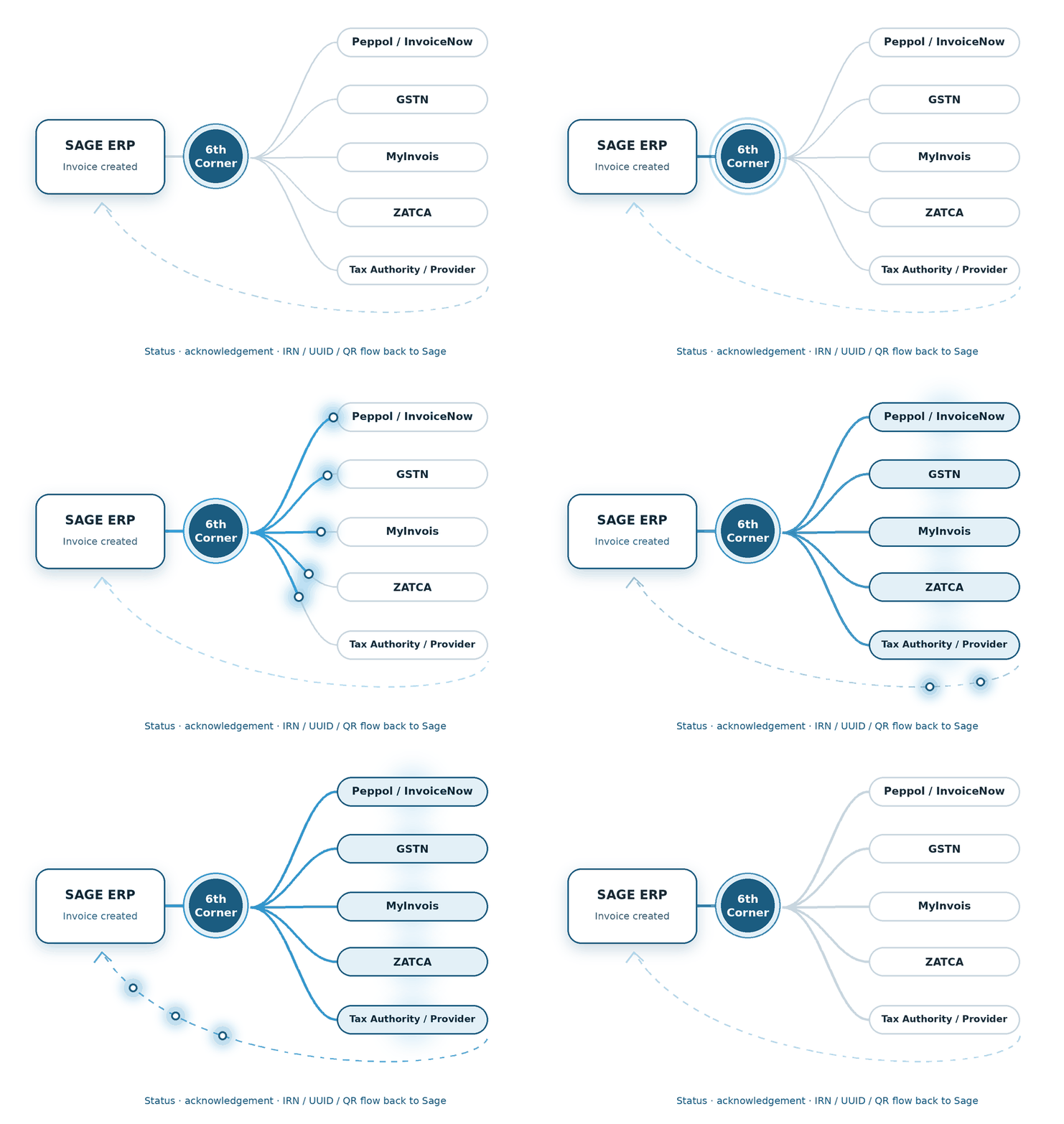
1 - Invoice Generation
First things first, you generate a taxable invoice in Sage ERP.
2 - XML Generation
The invoice data is converted to the UBL 2.1 XML Invoice Format as required by the Dutch NLCIUS and EN 16931 European E-Invoicing Standard.
3 - e-Invoice Submission
A secure connection is established to the Dutch NLCIUS servers. Your e-invoice is in the process of clearance.
5 - Update Invoice Status
Once a response is received from the Dutch Government portal, the same is updated in the Sage ERP platform in real-time.
4 - Invoice Validation
The Government portal validates your invoice and checks whether it meets the Dutch VAT Invoice Requirements.
Supported Sage Products
Our Netherlands e-Invoicing solution supports wider integration across the Sage ecosystem, facilitating a faster way to send and receive invoices and comply with the Dutch Govt mandate.
We build the connection between financial transactions and the country-specific compliance journey.
We shape the e-Invoicing flow around the processes already running through Sage X3.
We connect the required e-Invoicing steps with the Sage 300 transaction flow.
Features of e-Invoicing Netherlands Add-on for Sage ERP
Here are the most prominent features of the Netherlands e-invoicing add-on for Sage ERP:
Peppol Network Connectivity
Supports native integration with the Peppol Network, allowing secure and real-time transfer of invoicing data electronically.
Supports UBL 2.1 XML Formatting
E-Invoicing in the Netherlands supports the Dutch Govt mandated structured formats such as UBL 2.1 XML, replacing PDF documents.
Automated Error Validation
Catches missing tax details and calculation & formatting errors before e-invoice submission to avoid potential rejections.
Bi-Directional AP Automation
The Accounts Payable module automatically captures e-invoice status directly, eliminating the need for manual intervention.
Transmission Status Tracking
Track invoice status in real time (such as delivery, acceptance, or rejection) in a single platform with dynamic status codes.
Dutch VAT Invoice Compliance
Ensure complete adherence to the Dutch VAT invoice requirements, NLCIUS requirements, and the EN 16931 e-invoicing standard.
Multi-Currency Capabilities
Streamline complex multi-currency transactions across multiple entities and branches and reduce potential human errors.
Dutch Data Retention Compliance
Ensure complete audit-readiness by securely storing your transaction data according to the Dutch statutory record requirements.
ERP Master Data Sync
Seamlessly consolidates data from different sources and synchronises it into one platform, avoiding potential duplicate entries.
Benefits of Automating e-Invoicing in Sage ERP
E-Invoicing for Sage ERP in Netherlands benefits with quick invoicing, reduced rejections, improved cash flow, and lower processing costs.
Quick Invoicing
Send, receive, and process invoices quickly.
Avoid Invoice Rejections
Automatically catch errors before official submission.
Improved Cash Flow
Avoid cash crunch and improve cash flow position.
Reduced Processing Costs
Digital e-invoicing reduces paperwork costs.
How We Implement e-Invoicing for Sage ERP
Here’s the step-by-step process we use to implement Netherlands e-Invoicing for Sage ERP
Evaluating Client Requirements
Our team performs an initial evaluation of the customer’s requirements and plans the further course of action.
Data Mapping
The next process is mapping your products, transactions, customers, and taxation data into a single system.
Secure Connection to Govt Server
A secure connection is established to the Dutch NLCIUS server for invoice data submission and validation.
Invoice Validation
Netherlands e-Invoicing for Sage ERP performs real-time invoice validation and testing for incorrect data, mismatches, and errors.
Implementation & Ongoing Support
Finally, it’s time to implement the system. Once implemented, our team carefully monitors it for any issues and provides ongoing support.
FAQs on The Netherlands e-Invoicing
Is e-invoicing mandatory for supplying goods or services to government bodies?
Yes, e-invoicing is mandatory for businesses selling goods or services to government bodies. Your e-invoice must contain the invoice date & number, description of goods & services, order number, VAT rate, and Organisation Identification Number (OIN).
Which Sage ERP versions are compatible with the e-Invoicing in the Netherlands add-on?
Sage X3, Sage 300, and Sage Intacct are compatible with the e-Invoicing in Netherlands add-on.
How long does the e-Invoicing in Netherlands add-on take to deploy?
The exact deployment time for the Netherlands e-Invoicing for Sage Intacct add-on may vary. However, the add-on typically takes about 2-3 weeks depending on various factors, including your business size, industry, data cleanliness, etc.
What is the retention period for Dutch e-invoice records?
According to the official documentation, businesses are required to keep their invoice records for 7 years. In the case of invoices relating to immovable property, they need to be kept for a period of 10 years.
How does the Netherlands e-Invoicing for Sage Intacct add-on integrate with our existing workflow?
The e-Invoicing for Sage Intacct in Netherlands add-on directly integrates with the Sage platform, providing real-time information about the e-invoice status and automating every aspect of the procedure.
Which standard formats does the Netherlands e-Invoicing for Sage X3 add-on support?
The add-on for e-Invoicing for Sage X3 in Netherlands supports the following standard formats:
Peppol BIS Billing 3.0: A pan-European interoperable European standard.
UBL 2.1: Universal Business Language (UBL 2.1) for European e-invoicing compliance and aligning with EN 16931 norms.
Does the Netherlands e-Invoicing for Sage 300 add-on convert outgoing invoices into validated XML structures?
Yes, the Netherlands e-Invoicing for Sage 300 add-on automatically takes care of the invoice conversion and validation process, freeing up your staff for more strategic operations and reducing potential delays.