Key Takeaways:
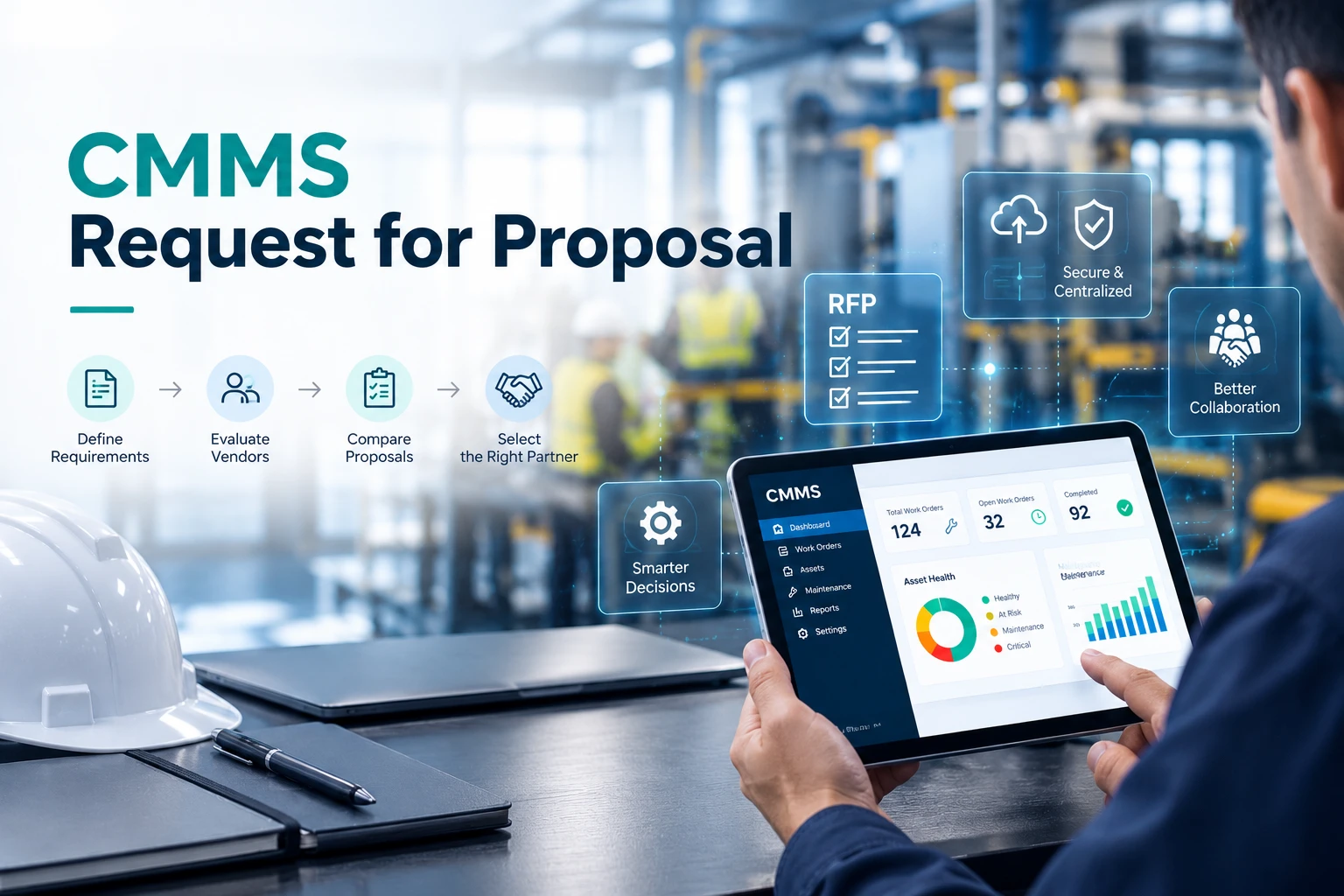
- A CMMS Request for Proposal (RFP) is a procurement document to communicate your maintenance requirements to CMMS vendors. It makes vendor proposals easier to compare.
- Use an RFP when your software selection involves multiple sites, high asset volume, and complex maintenance requirements.
- Ensure your RFP covers operational requirements, project scope, and vendor evaluation criteria.
- Follow the complete RFP lifecycle from identifying maintenance challenges to selecting a suitable vendor.
- Evaluate vendor responses systematically using predefined weights and scores rather than subjective opinions.
What is a CMMS Request for Proposal?
CMMS Request for Proposal (RFP) is a document sent to shortlisted CMMS vendors that specifies the buyer’s detailed maintenance requirements in order to obtain customized vendor responses. A CMMS RFP primarily seeks information on project deliverables, timeline, and scope for the installation and implementation of a Computerized Maintenance Management System (CMMS).
Through an RFP, you want the vendor to explain how well they can fulfill your operational and technical requirements, along with their implementation plan and pricing. A vital part of the procurement cycle, an RFP also describes vendor evaluation criteria and instructions for submitting a proposal.
Why use a CMMS RFP
There are multiple ways in which a CMMS RFP helps a buyer.
- First, it offers a standardized way for buyers to compare CMMS vendors as they reply in the same format to the same set of questions.
- Secondly, the document brings key decision-makers to the same table where they share inputs about what their ideal CMMS should look like.
- Third, it serves as written proof of why the vendor was chosen. It is used to gain company-wide approvals, follow best practices of procurement, and conduct audits.
And most importantly, RFP comparisons potentially reduce the risk of purchase by identifying vendor limitations and Total Cost of Ownership (TCO) differences.
When do you need a CMMS Request for Proposal (RFP)?
For a CMMS purchase, an RFP is generally useful when you need to evaluate how well each system fits your maintenance processes, along with other factors like implementation, integration, usability, compliance, and total cost.
Creating a comprehensive CMMS RFP takes effort and time as you diligently list your maintenance requirements in the document. Not every company in search of top CMMS software creates an RFP.
The need for an RFP really depends on organizational and procurement complexity.
Here are three compelling reasons why an RFP makes sense for your business:
- Multiple departments must approve the CMMS procurement
- Multiple sites, multiple assets, and complex maintenance requirements
- Your maintenance operations are highly regulated and frequently audited.
Request for Information vs Request for Quote vs Request for Proposal
While RFI is a preliminary information-seeking document to ascertain what solutions exist in the market, RFP evaluates how the CMMS vendor will cater to maintenance requirements through product features and implementation approach. RFQ, in contrast, is focused on detailed pricing for finalized product specifications.
Like any enterprise software procurement, CMMS software also follows a systematic purchase process using appropriate documents at different procurement stages. The core objective is to save time and money through progressive filtering of information and narrow down the search for the right vendor.
| RFI (Request for Information) | RFP (Request for Proposal) | RFQ (Request for Quotation) | |
|---|---|---|---|
| Objective | Understand available vendors, solutions, and market capabilities. | Evaluate CMMS solutions against business requirements. | Obtain binding price quotes for highly specific, predefined requirements. |
| Document Contains | Questions about general vendor capabilities, software capabilities, and relevant experience. | Operational and technical requirements, evaluation criteria, and instructions for submitting the proposal. | Exact item specifications, user counts, service delivery rules, and price sheets. |
| Use It When | You are exploring the market or still defining your operational requirements. | You need to compare vendors on functional fit, technical capability, implementation, and total cost. | Your requirements are finalised, and price is the primary deciding factor. |
Note – Because enterprise software pricing depends on user counts, API integration, customization, and other factors, RFQs are often skipped. An RFP acts as an all-in-one document that covers both technical requirements and pricing.
What does a CMMS RFP include?
The sections below are a practical guide to preparing a CMMS Request for Proposal. The information sought from vendors will vary depending on your maintenance needs and existing systems.
| RFP Section | What to Include |
|---|---|
| Company and Plant Profile | Plant locations, asset types and counts, number of users, and existing maintenance tools and approach. |
| Objectives | Current maintenance issues and specific desired outcomes. |
| Functional Requirements | Asset hierarchies, work order management, preventive maintenance, spare parts inventory, reporting dashboards, automated notifications, escalation workflows, and mobile access. |
| Technical Requirements | CMMS deployment model (cloud or on-premises), server specifications, network and hardware compatibility, user authentication methods, role-based access controls, activity audit logs, data security standards, automated backups, disaster recovery protocols, incident response procedures, APIs, integration capabilities, and offline data synchronization. |
| Data Migration | Asset registries, spare parts inventories, vendor lists, and historical work order records. Supported import formats, as well as data cleansing, migration, and validation responsibilities. |
| Implementation and Acceptance | Project scope, target timelines, roles and responsibilities, software configuration, system testing, User Acceptance Testing (UAT), training, go-live strategy, and acceptance criteria. |
| Support and Maintenance | Technical support operating hours, response times, post-go-live hypercare support, and ongoing support. |
| Commercial Terms | Pricing details, subscription or licence fees, upfront implementation costs, recurring charges, additional user charges, payment schedules, Annual Maintenance Contract (AMC) terms, and any other additional charges. |
| Evaluation Criteria | Software selection factors, weighted scoring methodology, and strict proposal submission deadlines. |
Specific busness requirements you can include
You can customize your RFP by adding these unique requirements in the relevant RFP sections.
- Mobile and offline access – A dedicated mobile app with offline data synchronization, field photo attachments, and breakdown request logging with precise date & time stamps
- Maintenance activity tracking – Tracking configurations for breakdown, corrective, preventive, predictive, and improvement activities
- Asset identification – QR/barcode generation and scanning to access asset records and historical repair logs via smartphone
- Performance reporting – KPI dashboards, MTBF, MTTR, equipment availability and downtime reporting
- Safety procedures – Configurable safety checklists, and mandatory Lockout-Tagout (LOTO) validation gates required before work order closure
- Inventory management – Real-time stock levels, minimum/maximum threshold triggers, multi-location tracking, and low-stock alerts for critical spares
- Special requirements – AMC registers by asset/vendor with renewal reminders; and calibration registers with due-date reminders
- Integrations – Integration with IoT/condition-monitoring sensors for automated fault triggers and predictive maintenance. Integration with ERP software system.
- Infrastructure and recovery – Server sizing specifications, automated backup routines, and disaster recovery protocol for on-premise deployment
- Access and licensing – Local login configurations, Active Directory (AD) or Single Sign-On (SSO) integration, complete user activity audit trails, and clear pricing clarity regarding named versus concurrent user license models
Also read: Total Productive Maintenance (TPM): 8 Pillars, Benefits & More
6 Stages of the CMMS RFP Process
A well-prepared CMMS RFP helps you compare vendors as per your actual maintenance needs, technical requirements, and budget. The key is to go beyond a list of software features. Clearly mention what your expectations from the system are and how vendors will be evaluated.
Follow these steps to prepare an RFP that makes vendor proposals easier to evaluate and compare.
Step One – Identify maintenance problems and desired outcomes
Document recurring breakdowns, overdue preventive maintenance, spare-parts shortages and reporting gaps. Define the improvements you expect from the CMMS.
Step Two – Prioritise your requirements
Gather inputs from all departments that influence CMMS purchase, such as finance, IT, maintenance, production, inventory, etc. Classify requirements as essential, preferred or future needs.
Step Three – Note your operational and technical ecosystem
Keep account of your asset and user counts, existing systems, infrastructure, data to be cleansed and migrated, and integration needs. Include any hosting preferences and operational constraints.
Step Four – Prepare the RFP
Here you actually start writing the RFP document. List functional and technical requirements, project scope, objectives, implementation approach and timeline, assumptions, testing, training, support, commercial terms, and CMMS vendor evaluation and acceptance criteria. Mention any additional considerations you may have, such as offline access, QR code scanning, or safety checklists.
Step Five – Send RFPs and manage clarifications
Send the RFP to suitable CMMS vendors. Set a submission deadline and specify how vendors can submit questions about the RFP. Share clarifications with all participating vendors in line with your procurement process.
Step Six – Evaluate vendors based on your requirements
Compare proposals and check if they match your priorities. Assess total costs and ask shortlisted vendors to demonstrate important workflows. Test scenarios as applicable to your maintenance operations. Note the reason why you selected a particular CMMS vendor.
Also Read: What is MRO Software in CMMS?
How to write requirements that vendors can answer?
Write CMMS RFP requirements in terms of specific tasks and expected outcomes, rather than broadly naming the features. For each requirement listed, instruct the vendors to mention if it is supported out-of-the-box, via configuration, customization, or third-party integration, or if it is not supported.
For example, avoid asking whether the CMMS supports AMC management. Ask if it can maintain an AMC register for each asset and automatically send renewal reminders before contract expiry. Do so only for your main requirements. Leave the rest for later. This makes it easier to identify if the vendor can meet your expectations.
Follow these additional best practices to perfect your document.
- Scale and deployment model – Clarify the scale of your operations, like sites and expected users. Also, mention whether you prefer a cloud or on-premises CMMS, because corresponding requirements will significantly differ.
- Compare vendors using predefined criteria – Set the evaluation criteria, weights, and scoring scale before reviewing proposals. This prevents personal bias or low prices from influencing your decisions.
- Prioritize objectives over features – Mention your objectives clearly in the beginning. This sets the tone and lets vendors cross-verify if their answers and proposed solutions are in line with the stated objectives.
- Draft the RFP with stakeholders – Involve maintenance supervisors and technicians, the ground-level users, from the start along with your internal IT team and other department heads from procurement and inventory.
How to compare CMMS Vendor Responses
Use a weighted scorecard to compare RFP responses on the same criteria. Assign a weight to each criterion based on its importance to your operations. For example, functional fit may carry more weight than ease of use if meeting maintenance requirements is your main priority. The weights across all criteria should add up to 100%.
For each criterion, score each vendor based on how well their CMMS meets your requirements, such as on a scale of 1 to 5. Define what each score means in advance. A score of 5 could mean the vendor meets the requirement fully, while a score of 3 could indicate that it meets the requirement partially.
For example, if the broad functional fit category, which evaluates individual features like preventive maintenance scheduling, carries a weight of 40%, and a vendor scores 4 out of 5. Convert the score to a percentage of the maximum score (4 ÷ 5 = 80%), then apply the weight (80% × 40 = 32). The vendor earns 32 out of the 40 points available for functional fit. Repeat this calculation for each criterion and add the points to obtain the vendor’s total weighted score.
Check critical requirements separately from the overall score. A high score should not compensate for a vendor’s failure to meet a critical requirement. Make a note of these gaps and clarify them before making your final decision.
Conclusion
A CMMS Request for Proposal is a structured document that elicits better responses from vendors when created with sound planning. Make your RFP exercise effective and fruitful by describing the project scope and requirements in detail while clearly mentioning how you want vendors to respond.
Give your maintenance operations a whole new dimension with DimoMaint MX, a leading cloud-based CMMS. Get real-time asset insights and preventive maintenance tools to manage your multi-site operations with remarkable ease. Not only does it reduce costs through planned maintenance execution, it prolongs the life of your assets by keeping them in optimal working condition.
FAQs
1. What does RFP mean in software?
An RFP is a Request for Proposal document that defines software requirements and requests vendors to share suitable solutions.
2. What does CMMS stand For?
CMMS stands for Computerized Maintenance Management System. It helps businesses manage assets, maintenance work orders, corrective and preventive maintenance, technicians, and spare parts.
3. How can we keep CMMS vendors aligned during the RFP process?
Appoint one contact person to handle vendor queries. If a question reveals an unclear requirement, update the RFP and inform all participating vendors of the change.
4. Can I use a template to create a CMMS Request for Proposal (RFP)?
Yes. Starting with a template saves time and ensures you do not miss key RFP sections when listing your maintenance requirements and software expectations. Adapt the template to your facility’s needs and unique operational challenges.