Key Takeaways:
- Total Productive Maintenance (TPM) establishes shared responsibility by training machine operators to handle routine minor maintenance tasks
- TPM methodology aims to achieve zero unplanned breakdowns, zero defects, and zero accidents
- The 8 pillars of TPM are Autonomous Maintenance, Early Equipment Management, Education & Training, Focused Improvement (Kaizen), Planned Maintenance, Quality Maintenance, Safety, Health, and Environment, and TPM in Administration.
- TPM implementation benefits the organization in various ways, including improved equipment efficiency, reduced downtimes, lower per-unit manufacturing costs, enhanced production capacity, and better workplace safety
- Businesses use a dedicated CMMS Software such as DimoMaint MX to effectively implement TPM and achieve their objectives
What is Total Productive Maintenance (TPM)?
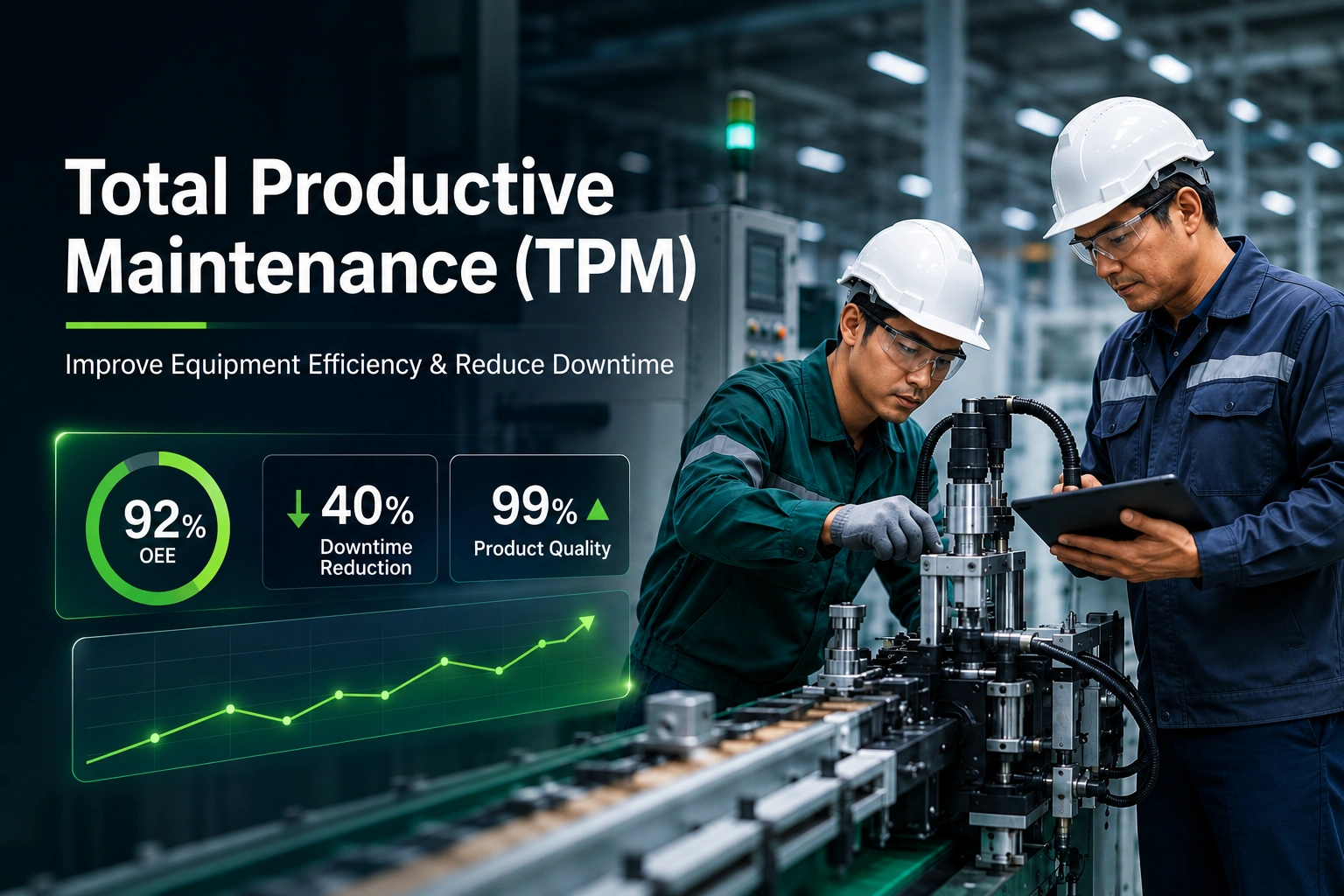
Total Productive Maintenance (TPM) is a proactive methodology that aims to prevent costly production outages by empowering everyday machine operators with the right skills & training to perform simple repair operations such as fixing machine oil & air leaks, noisy & vibrating motors, etc.
TPM makes machine maintenance a shared responsibility and focuses on zero unplanned breakdowns, zero defects, and zero accidents. Companies implement CMMS software alongside the TPM to track machine maintenance history, streamline work orders, and effectively achieve the objectives of TPM.
8 Pillars of Total Productive Maintenance (TPM)
The eight key pillars of TPM are Autonomous Maintenance, Early Equipment Management, Education & Training, Focused Improvement (Kaizen), Planned Maintenance, Quality Maintenance, Safety, and TPM in Administration.
| Pillar | Primary Stakeholders Responsible | Focus/ Purpose |
|---|---|---|
| Autonomous Maintenance | Operator | The operator is responsible for routine maintenance (such as cleaning, lubricating, and inspection) |
| Early Equipment Management | Engineering Team | The focus is on collecting detailed maintenance history for designing new equipment |
| Education and Training | Human Resource (HR) | Employee training & seminars are conducted to develop skills for routine maintenance |
| Focused Improvement (Kaizen) | Cross-functional Teams | The cross-functional teams proactively look for recurring problems |
| Planned Maintenance | Maintenance Team | The maintenance dept schedules maintenance activities to avoid sudden, costly downtimes |
| Quality Maintenance | Q&A Team | Extensive quality checks are performed to identify and fix root quality defects |
| Safety, Health, and Environment | All Depts/ Teams | Identifying hazards, developing emergency plans & protocols, and proactively reporting unsafe conditions |
| TPM in Administration | Customer Support Team | The core focus is on enhancing efficiency in the company’s administrative operations |
What are the 6 Big Losses in TPM?
TPM targets six main drivers of manufacturing losses, namely equipment failures (breakdowns), setup and adjustments, idling and minor stops, reduced speed, process defects, and reduced yield. They are further classified into three main categories, namely availability losses, performance losses, and quality losses.
A. Availability Losses (Downtime)
Availability losses, or simply downtimes, occur due to unexpected machine interruptions that arise from sudden machine breakdowns or technical glitches. For example, overheating can cause machine components to fail, leading to a sudden halt in operations.
1. Equipment Failure (Breakdowns): This includes technical and mechanical faults at the machine level
2. Setup and Adjustments: This includes machine setup and adjustments, such as changeovers and calibrations
B. Performance Losses (Degrading Machine Speed)
Performance losses usually do not require immediate machine repair or replacement. However, they can degrade your production capabilities and impact productivity. For example, a machine runs without interruptions. However, the machine speed (performance) has declined significantly due to ineffective sensors that require replacement.
3. Idling and Minor Stops (Small Stops): This includes brief, operator-cleared production interruptions that usually don’t require thorough maintenance
4. Reduced Speed: Reduction in the machine speed & performance due to different underlying issues such as mechanical wear, lack of lubrication, material jams, etc.
C. Quality Losses (Defects)
When a machine faces quality issues, it fails to produce or deliver a product matching the quality standards. The manufacturer may notice a range of symptoms such as defects in the manufactured product, increased waste, or abnormalities in the shape, color, or functionality of the products.
5. Process Defects: Examples include uneven paint, variations in sizing, and misaligned circuit boards
6. Reduced Yield (Startup Rejects): Includes material waste during the initial machine warm-up phase
What are the Benefits of Total Productive Maintenance (TPM)?
Adopting TPM improves equipment effectiveness, reduces downtimes, lowers per-unit manufacturing costs, improves production capacity, and leads to an empowered workforce.
1. Improved Overall Equipment Effectiveness (OEE)
The core focus of Total Productive Maintenance (TPM) is to eliminate defects, minor stops, setup/ adjustments, and process defects, thereby maximizing the utilization of your equipment for greater efficiency.
2. Reduced Downtimes
A chemical manufacturer in Indore, Madhya Pradesh, used TPM alongside Maintenance Management Software for real-time machine monitoring and predictive analytics, achieving a reduction in unplanned production outages by 7%.
3. Lower Per-unit Manufacturing Costs
The Ministry of Micro, Small & Medium Enterprises (MoMSME), Govt of India, incorporated TPM in its Lean Manufacturing Competitiveness Scheme (LMCS). According to a report released by the Ministry, Indian manufacturing units gained 25% tangible benefits or savings and lowered their per-unit manufacturing costs.
4. Increased Production Capacity
Reduced interruptions and downtimes result in optimum use of resources and increased production capacity. This results in cost savings as the company doesn’t have to invest in procuring new machinery.
5. Zero Defect Manufacturing (ZDM)
Adopting TPM helps businesses lower the machine degradation rate, resulting in a significant reduction in scrap rates, rework, and customer returns. It helps businesses achieve Zero Defect Manufacturing (ZDM) that aims to eliminate all waste & defects.
6. Better Workplace Safety
One of the core pillars of TPM is dedicated to workplace safety, health, and environment. It focuses on maintaining a safe and healthy working environment, leading to a significant reduction in workplace injuries and accidents.
7. Empowered Workforce
Companies empower their operators with the necessary skills, resources, and authority to fix strange noises and unexpected stops in the machine. It helps establish a proactive problem-solving culture and cross-departmental collaboration between teams.
How Does CMMS Software Support Total Productive Maintenance?
A CMMS (Computerized Maintenance Management System) tool builds the fundamentals required to support the core pillars of the TPM. It captures machine logs & other relevant data in real-time and offers insights for developing preventive maintenance strategies.
DimoMaint MX CMMS captures machine breakdown data in real-time. It automates reminders, work order generation, spare parts management, and machine performance monitoring, leading to better coordination, improved equipment lifespan, and lower downtimes.
Frequently Asked Questions About TPM
1. What is the full form of TPM?
The full form of TPM is Total Productive Maintenance.
2. Define the TPM meaning in simple words
Total Productive Maintenance is a concept that changes the traditional way businesses work. Whenever equipment breaks down, the operators don’t wait for the maintenance specialists to step in. Instead, they troubleshoot the problem on their own (such as clearing jams, oiling gears, or fixing glitches). The company provides the necessary training & support required.
3. What is the OEE in TPM?
OEE (Overall Equipment Effectiveness) is an important key metric used in TPM to measure the effectiveness of your equipment’s utilization. A higher OEE score is preferred, as it indicates better utilization of planned production time, minimal defects, and reduced downtime.
4. What are the 5 goals of TPM?
Here are the 5 important goals of TPM:
- Zero Equipment Failures: Eliminating unexpected downtimes by implementing proactive & routine maintenance strategies with Predictive Maintenance Software
- Zero Product Defects: Early detection of defects through extensive analysis of the root cause and preventive strategies at every level
- Zero Accidents: Continuous risk management, routine hazard identification, and safety planning to prevent accidents
- Zero Waste: Implementing Just-in-Time (JIT) inventory and real-time inventory tracking using a dedicated inventory management system to eliminate waste.
- Full Employee Involvement: Pan-organizational employee involvement across teams to foster a culture of continuous improvement and increase success rates.
5. What are TBM and CBM in TPM?
TBM and CBM are two core strategies used in the TPM. Businesses can choose a strategy based on the criticality of their equipment, usage pattern, and budget.
- TBM (Time-Based Maintenance): The maintenance is performed at fixed calendar intervals, such as replacing the machine battery every 2 months and changing the oil in the machine every 84 hours.
- CBM (Condition-Based Maintenance): This type of maintenance is performed periodically based on the data obtained from the equipment’s sensors. For example, replacing the machine bearing when the temperature exceeds the safety limits.