Key Takeaways:
- Food and beverage ERP software integrates operations, manage food formulations, get data-driven insights, reduce costs, and streamline quality & safety.
- Consider budget, ERP functions, integration support, deployment type, and vendor experience before choosing a food ERP software.
- Sage X3 is positioned as the top food ERP, built for India’s fast-moving food and beverage sector.
- Sage X3 gives a holistic view of food processes, with forecasting tools and predictive analytics to align production with changing market demand.
Food and beverage manufacturers in India face a multitude of challenges – demand uncertainties, frequent stock-outs, food spoilage & waste, complex formula management, and compliance with ever-changing food safety standards. In a highly-regulated and stiffly competitive industry like food, companies must leverage new technological solutions and innovation to stand a higher chance of capturing new opportunities and building customer trust. That’s where an ERP Software comes into the picture.
An ERP for food industry empowers Indian food manufacturers with business-critical modules to get a granular view of their business operations and effectively tackle the real-world challenges. Whether it is pinpointing the source of a taste variation, maintaining quality excellence, or minimizing frequent machine downtimes, it’s an all-encompassing solution to your business’s growth and success.
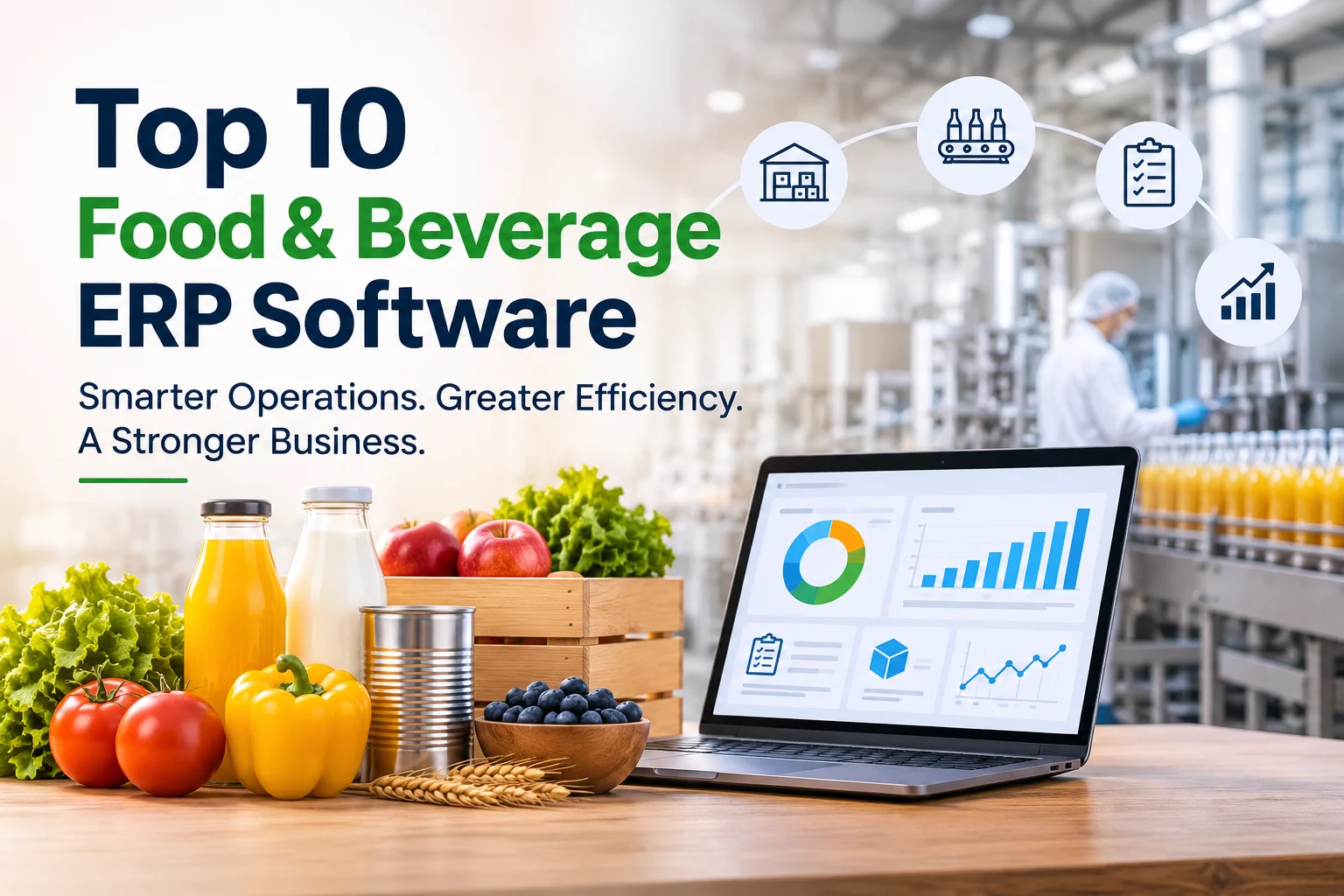
Top 10 Food and Beverage ERP Software in India 2026
We have compiled the top 10 food and beverage ERP software in India based on their target business size, key features, and potential limitations.
| Food and Beverage ERP Software | Target Business Size | Key Features | Potential Limitations |
|---|---|---|---|
| Sage X3 | Medium to Large Enterprises |
|
|
| Oracle NetSuite | Medium to Large Enterprises |
|
|
| Aptean | Small to Large Enterprises |
|
|
| QAD | Medium to Large Enterprises |
|
|
| BatchMaster | Small to Medium Enterprises |
|
|
| SYSPRO | Small to Medium Enterprises |
|
|
| Acumatica | Small to Large Enterprises |
|
|
| Absolute ERP | Small, Medium, and Large Enterprises |
|
|
| Deacom | Medium to Large Enterprises |
|
|
| Plex Systems | Medium to Large Enterprises |
|
|
Let’s explore the list of top 10 Food and Beverage ERP Software in India that cater to your complex food manufacturing needs and help you excel in the food business.
1. Sage X3
Sage X3 is an exceptional solution that automates highly specialized processes in the food business and provides endless customizations. This highly popular, flexible and versatile solution offers robust integration with third-party tools and brings digital transformation to achieve sustainable growth.
Features:
- Integrated inventory management system, shelf-life management, and ingredients management with expiration date control
- Reduce food spoilage & contamination, enhance quality & longevity, and achieve operational excellence
- Optimize warehouse storage and improve efficiency with a dedicated warehouse management system
- Streamline financial tasks, reduce fines & penalties, and mitigate non-compliance risks
- Adapt to ever-changing food industry protocols and packaging & labelling requirements
- Robust sales management system powered by deep analytical insights, and demand planning & forecasting features
Limitations:
- The implementation process can take a longer time depending on the size of your business
- Employee training is required to ensure efficient use of its powerful features
2. Oracle NetSuite
Oracle NetSuite is another popular ERP for food and beverage industry that brings efficiency to food production and supply chain operations. It provides up-to-the-minute insights and customized reports to help decision-makers make strongly data-driven decisions.
Features:
- Evaluate market segments using Profitability Analysis using various parameters
- Real-time Sales Reports, Customer Order Report & Stock Management
- Integrated Customer Relationship Management module for lead management
- Multi-lingual, multi-currency, and multi-country
- Audit trail visibility and tax management features
Limitations:
- Requires an extensive budget for setup, training, and add-on implementation
- The prices of the subscription plans may change at any time
3. Aptean
Aptean is another future-proof solution that consolidates data from different business departments and eliminates the need for different systems. It contains end-to-end industry-specific features from production management, inventory management, and supply chain to financial management.
Features:
- Fully cloud-based solution. No need to upgrade hardware or pay upfront fees.
- Integrated Document Tracking, Bill of Materials (BoM) & Project Management
- Reduce operational pitfalls and improve returns on investments
- Quickly adapt to changing business requirements & evolving business needs
- Manufacture scheduling and shop floor management features
Limitations:
- Difficult interface
- Limited integration with third-party applications
4. QAD
QAD is an adaptive ERP that primarily targets mid to large-sized organizations. It caters to different industries, from food and beverage, automotive, and industrial manufacturing, to consumer products. It is a fast, flexible, and reliable solution for anyone looking to scale up their business operations.
Features:
- Robust demand planning and logistical control
- Cash Flow, Shop Floor Management & Global Procurement Management
- Access your data remotely with a Web-based interface
- Embedded role-based access to sophisticated reports and dashboards
- Integration with third-party applications for extending program capabilities
Limitations:
- QAD implementation can be difficult for small organizations
- Incurs ongoing costs for maintenance, support, and upgrades
5. BatchMaster
BatchMaster is an integrated ERP for food & beverage companies that are looking to optimize their production and distribution processes. It offers robust quality control mechanisms at different levels of production and solid formula management features.
Features:
- Ensure traceability & complete quality management with QC tests
- Multi-warehouse routing and asset management capabilities
- Highly flexible and customizable user interface
- Purchase Requisitions, Purchase Order Management, and Invoice Management
- Multi-channel inventory syncing
Limitations:
- Implementation complexities
- Regular employee training may be required to get the best out of it
6. SYSPRO
SysPro is another popular ERP that is available as an on-premise, cloud, and hybrid option. It offers various industry-specific functionalities and mostly focuses on Small & Medium-sized Businesses (SMBs). It covers different modules relating to inventory, warehouse, assets, and finance, among others.
Features:
- Automated SQL triggers upon successful completion of a transaction
- Powerful planning & forecasting features
- Mitigate over-stocking/ under-stocking issues
- Monitor the implementation progress using KPIs
- Align organizational resources to improve efficiency & productivity
Limitations:
- Limited scalability
- Additional training, support & customization costs
7. Acumatica
Acumatica is a highly reliable cloud ERP that offers a robust array of features, including production, distribution, payroll, e-commerce management, and financial management, among others. You can also install it on a Virtual Server (which will be entirely dedicated to your organization) or a load-balanced environment (in which resources are shared between different organizations, and it is comparatively economical).
Features:
- Integrated document management & collaboration features
- Offers cross-device compatibility with mobile, computer & tablet
- Integrated backup and restore
- Advanced role-based access control
- Scales and adapts to businesses of all sizes
Limitations:
- Doesn’t offer a Free Trial for demonstration purposes
- Acumatica is currently available only as a web interface app
8. Absolute ERP
Absolute ERP is a cloud-based ERP that targets small, medium, and large companies. It offers a holistic view of business operations through a centralized system of information management. It is available for different industries such as food & beverage, printing, rubber, automotive, mining, and footwear, among others.
Features:
- Track product defects at all levels to reduce returns/ replacement costs
- Align organizational resources for profit maximization
- Integrated inventory optimization & sales planning & forecasting features
- Track and manage fixed assets
- Work Order Management to lower asset downtime
Limitations:
- Complex deployment and implementation process
- Unavailability of the on-premise version
9. Deacom
Deacom is a single platform where you get a wealth of features. It helps you track the procurement of raw materials and to conversion to finished goods. It has a unique pricing model. Apart from the food & beverage industry, it supports the health, chemical, and pharma industries.
Features:
- Comprehensive Lot tracking with batch number & barcodes
- Business Intelligence, Customized Reports & Dashboards
- Sales Order Management, Production Planning with stringent Quality Control checks
- Automated invoice generation and customization
- Product Shelf Life Management
Limitations:
- Requires a deep learning curve
- It is expensive compared to other rivals
10. Plex Systems
Plex Systems has in-house features such as Material Requirements Planning (MRP), unique product pricing, business intelligence, and lot tracking to help your business achieve operational excellence. It comes with a comprehensive set of modules such as customer relationship, sales management, human resources, accounting, and product management, among others.
Features:
- Track product expiry dates and define quantity according to the specific conditions
- Invoice Customization to set yourself apart from the competing firms
- Track & effectively manage leads, and reduce customer churn
- Track orders from suppliers using supplier management
- A centralized platform to manage & optimize organizational resources
Limitations:
- Difficult user interface
- Requires a deep learning curve
Future-Proof Your Food Business with Sage X3
Food and beverage manufacturers in India face a multitude of challenges, from limited shelf life, food safety & quality, and increasing procurement costs, to compliance with labeling laws. Many food companies still use many disconnected legacy systems, but they break down as the business grows in size and transaction volume.
Built for the fast-moving food sector in India, Sage X3 integrates different business processes and plays a crucial role in managing the complex nature of your food business. It provides a holistic view of the organisation-wide processes while offering superior forecasting tools & predictive analytics to align your production with changing market requirements.
Frequently Asked Questions (FAQs)
1. Why is an ERP essential for a food and beverage business?
Here’s why food and beverage businesses need ERP software:
- Integrate Business Operations: ERP integrates production, quality control, sales, customer support, warehouse, and finance operations.
- Strategic Decision-Making: ERP offers data-driven insights at your fingertips, facilitating quick & smart decision-making.
- Efficient Resource Allocation: Manage & allocate business resources efficiently to save costs and enhance efficiency.
- Improved Quality & Safety: Manage food formulations, automate food quality checks and labelling, to ensure consistency in quality and safety.
2. How does Food ERP ensure compliance with FSSAI standards?
Food businesses in India have to follow FSSAI’s Food Safety Inspection Checklists that outline sector-specific inspection criteria. A food ERP provides bi-directional Lot traceability, automated quality control, food expiration management, FSSAI labelling compliance, and recall management, ensuring end-to-end compliance with the regulatory standards.
3. Why do we need a food industry-specific ERP?
A food ERP addresses the unique challenges faced by a food and beverage business. It provides tailored modules to manage food formulations, lot & batch traceability, food labelling, recall management, generation of audit-ready food safety reports, and compliance.
4. What factors should I consider while choosing the top food and beverage ERP software?
Here are some factors that you can consider:
- Budget: Make sure the new ERP aligns with your current budget. Take everything into consideration, including implementation, consulting, upgrade, and training costs.
- Functions: Don’t go with an ERP that offers plenty of features. Instead, choose an ERP that offers the unique features needed for your business.
- System Integration: If you’re using legacy systems or tools, it’s worth checking whether your ERP offers integration with them.
- Deployment Type: Modern-day cloud ERP software helps you manage your business without being physically present in your office.
- Vendor Experience: Does the vendor have adequate experience working in your industry?