Key Takeaways:
- Material Requirements Planning software ensures the right materials are available at the right time, at the right place for continuous production activity.
- MRP software help improve production efficiency, lower inventory & production costs, reduce customer lead times, and avoid resource shortages.
- MRP vs ERP: An MRP system is focused on material planning, inventory control, and production scheduling, whereas an ERP focuses on company-wide visibility, resource planning, and decision-making.
- Sage X3 provides a dedicated MRP module to estimate the requirement for materials, get insights at every level of the procurement & production process, and optimise inventory levels.
What is Material Requirements Planning (MRP)?
Material Requirements Planning (MRP) is a system that estimates the requirements for raw materials by combining data from procurement, inventory, and purchase orders with production systems. It aims to ensure availability of the production resources at the right time at the right place to ensure continuity in the production activity, avoid shortages, and improve production efficiency.
ERP software supports Material Requirements Planning by automating demand forecasting, production planning & capacity management, inventory planning, replenishment management, and supplier coordination. By integrating different organisation-wide processes, it builds a structured foundation for a seamless MRP process.
Benefits of Material Requirements Planning Software
With an MRP system in place, your business benefits from improved production efficiency, reduced inventory costs, reduced customer lead times, lower production costs, and avoiding resource shortages.
1. Improved Production Efficiency
MRP systems integrate different processes such as raw materials procurement, production planning, and packaging. By aligning production materials with your production schedules, they ensure continuity in production operations.
2. Reduced Inventory Costs
MRP software help reduce your inventory costs through inventory planning and demand forecasting. With an MRP software in place, you can employ Just-In-Time (JIT) and similar inventory strategies.
3. Reduced Customer Lead Times
MRP systems reduce delays in the procurement and manufacturing operations, facilitating quicker delivery of finished goods to your customers. With reduced customer lead times, your business benefits from a loyal customer base and better market reputation.
4. Lower Production Costs
By reducing delays in the procurement of raw materials and ensuring continuity in the production operations, your business benefits from lower waste, better leverage position, and reduced production costs.
5. Avoid Resource Shortages
ERP software align your production schedules with sales forecasts. It helps with effective coordination between different teams for optimum shop floor capacity planning and better resource optimisation.
How Material Requirements Planning Works (Step-By-Step Process)
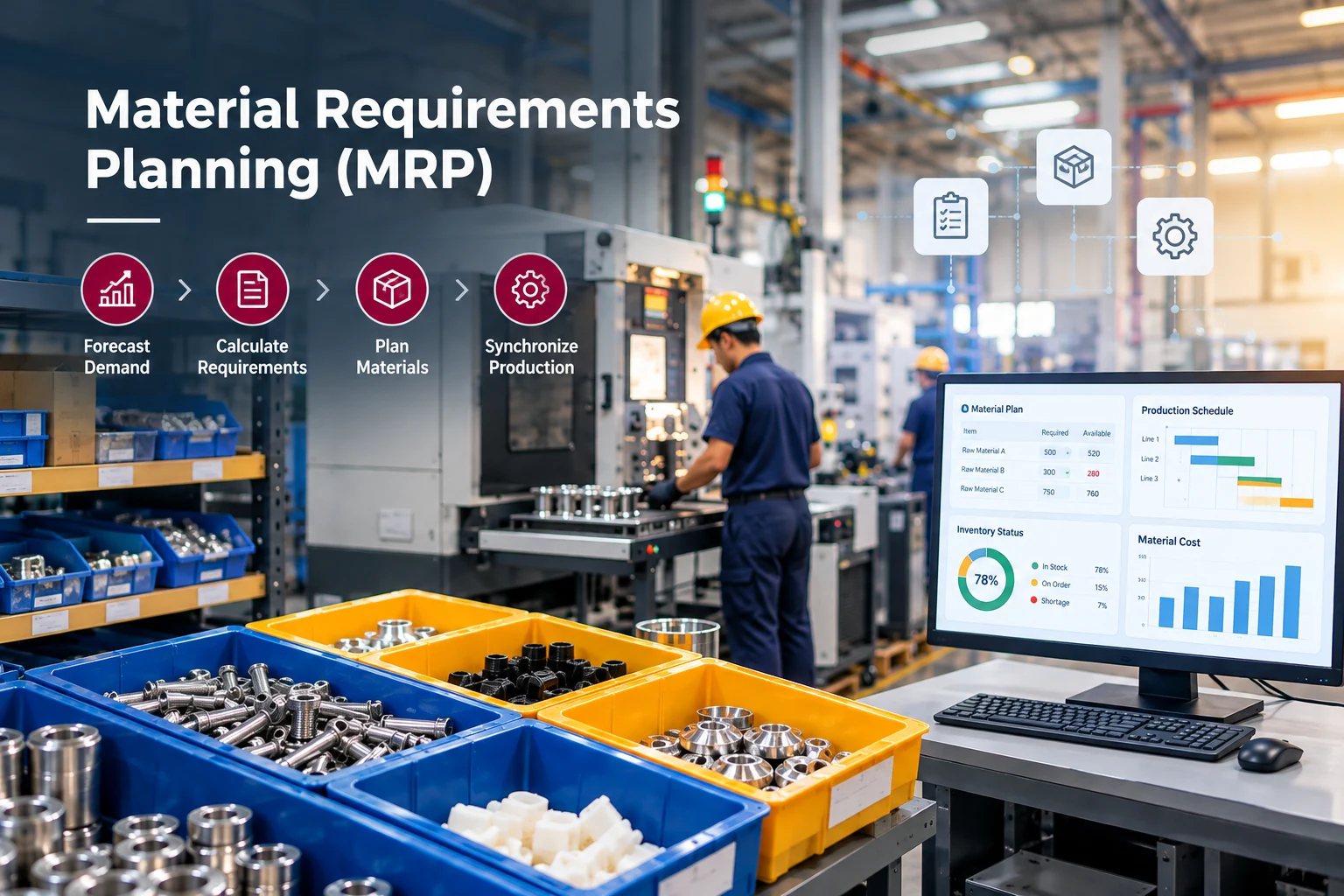
The MRP process consists of four main phases – identifying material requirements, analysing inventory & production resources, production scheduling, and generating plans & reports.
- Identify Material Requirements: First things first, start by identifying the requirements for new materials by analysing your customer orders, demand forecasts, and past sales data.
- Analyse Inventory & Production Resources: Analyse your current inventory levels and production resources. The inventory management software will allocate them appropriately for better efficiency, waste reduction, and lower customer lead times.
- Production Scheduling: Estimate the requirement for labor and production resources. Automate various production-specific processes such as Work Order & Purchase Order generation for better efficiency.
- Generate Exceptional Plans & Reports: Last but not least, your MRP system generates plans for production efficiency and flags potential delays, giving you complete control over the entire process.
Difference Between MRP and ERP (MRP vs ERP)
Here’s the key difference between Material Requirements Planning (MRP) and Enterprise Resource Planning (ERP):
| Comparison Factor | Material Requirements Planning (MRP) | Enterprise Resource Planning (ERP) |
|---|---|---|
| Definition | An MRP system plans material requirements for manufacturing. | An ERP system integrates core business operations into a single platform, providing visibility across processes. |
| Primary Focus |
|
|
| Objective | Ensures the right materials are available at the right time to meet production requirements. | Supports strategic decision-making, reduces inefficiencies, and improves coordination across departments. |
| Key Functions |
|
|
| Scope | Focuses on manufacturing and material requirements planning. | Covers organisation-wide processes across multiple departments. |
| Data Management | Uses data from inventory records, bills of materials (BOMs), and production schedules. | Integrates data from different departments, business functions, and branches. |
| Integration | Can operate as a standalone system or as a module within a broader ERP system. | Connects business functions and can integrate with tools such as CRM software and e-commerce platforms. |
| Example Reports |
|
|
| Best Suited For | Manufacturers that need to manage material availability and production requirements. | Medium and large enterprises that need to manage and integrate multiple business functions. |
| Example | Calculates the quantity of raw materials needed to manufacture 1,000 units. | Connects material planning with purchasing, production, sales, inventory, and financial accounting. |
How is Material Requirements Planning MRP used in Manufacturing?
MRP in manufacturing environments help decrease inventory through more efficient scheduling, purchase planning, and demand forecasting. MRP will focus on what materials are required to complete manufacturing jobs and when they need to be sourced. This is helpful to minimize stock-outs and reduce excess stock.
One of MRP’s most critical inputs is the bill of materials, or BOM. The BOM is a detailed list of needed raw materials, components, and assemblies in order to manufacture a product. Bill of materials are usually created via order entry systems, reading current inventory levels, and viewing master production schedules.
Bill of materials (BOM) includes hierarchical lists with a top-level representing the finished product and subassemblies below it. BOMs can also have two levels of assembly. One example could be a clock that includes the internal clockwork as well as the outer casing. Usage of MRP in manufacturing, primarily via a clear and understood bill of materials process, will help you complete each manufacturing job while eliminating waste in materials and better coordinating machine usage and labor.
Difference Between MRP and MRP II
Material Requirements Planning (MRP) and Manufacturing Resource Planning (MRP II) are planning approaches that help manufacturers manage production more efficiently. While MRP primarily focuses on calculating material requirements and managing inventory, MRP II takes a broader approach by incorporating additional manufacturing resources, such as labor, machine capacity, production scheduling, and financial planning. Understanding the difference helps businesses choose the right approach for their manufacturing operations.
| Comparison Factor | MRP (Material Requirements Planning) | MRP II (Manufacturing Resource Planning) |
|---|---|---|
| Primary Focus | Material planning and inventory management. | Comprehensive manufacturing resource planning. |
| Main Objective | Ensures materials are available when needed for production. | Coordinates materials, labour, machinery, and other production resources. |
| Key Inputs | Master production schedule, bill of materials (BOM), and inventory records. | MRP inputs, production capacity, labour availability, and additional operational data. |
| Inventory Management | Calculates material quantities and replenishment requirements. | Integrates material planning with broader manufacturing operations. |
| Capacity Planning | Limited capacity planning, often handled separately. | Includes capacity planning for machinery and labour. |
| Production Scheduling | Plans material availability around production schedules. | Supports comprehensive production scheduling and resource coordination. |
| Financial Integration | Limited financial planning capabilities. | Can incorporate manufacturing costs and financial planning. |
| Business Scope | Primarily focuses on material and production requirements. | Covers broader manufacturing planning across operational resources. |
| Best Suited For | Manufacturers focused on material availability and inventory planning. | Manufacturers seeking integrated planning of materials, capacity, and production resources. |
MRP focuses on what materials are needed and when, whereas MRP II expands this approach to consider the broader resources required to manufacture products efficiently. Modern ERP software can extend these capabilities further by connecting manufacturing with procurement, finance, inventory, and other business functions.
Final Thoughts: Sage X3, Smarter Material Planning and Improved Production Efficiency
Material requirements planning software allows businesses to align materials with production schedules, optimise inventory levels, and improve production efficiency. Small, medium, and large businesses use this dedicated system to get deeper insights into the procurement & production operations to lower inventory carrying costs, reduce customer lead times, and drive long-term growth.
Sage X3 encompasses a dedicated MRP module that facilitates seamless data flow, reduces production bottlenecks, and provides actionable insights for improving your production efficiency. It provides powerful demand forecasting tools that provide accurate predictions, reducing the risk of costly stockouts & over-stocking. If you’re looking for a single, integrated system to manage your business operations, look no further and deploy Sage X3!
 FAQs on Material Requirements Planning MRP
1. What are the three primary inputs required for MRP?
The following are the three primary inputs required for MRP:
- Master Production Schedule (MPS): How many units need to be produced, how many are currently available, and the production resource capacity details.
- Bill of Materials (BOM): A comprehensive list of raw materials, components, and instructions for production purposes.
- Inventory Status File (ISF): Real-time record of current inventory levels, allocated materials, reserved quantities, and scheduled deliveries.
2. How MRP supports Just-in-Time (JIT) and Just-in-Case Inventory Management
Material requirements planning software are fully customisable. Manufacturers can choose their risk tolerance and desired inventory strategy, such as Just-In-Time (JIT) and Just-In-Case, to meet their unique business and industry needs.
3. How does MRP support Production Requirements Scheduling?
With an MRP software, manufacturers can discover the need for required raw materials, quantities, and timing of production, which helps with broader production requirements scheduling and faster customer order fulfilment.
4. What are the common challenges with MRP software?
Here are the most common challenges associated with material requirements planning software:
- Inaccurate Data: The MRP software will not produce accurate results if the input data is inaccurate or incomplete, leading to unreliable inventory & production reports.
- Implementation Costs: Some MRP softwares can be expensive to implement and maintain.
- Technical Difficulty: Your employees may need training to effectively use the MRP softwares.
- Legacy Integration Issues: It can be difficult to get the material requirements planning software to communicate with other systems in a way that produces accurate results.
5. What is the difference between MRP and MRP II?
MRP focuses primarily on calculating material requirements and planning inventory and production schedules. Manufacturing Resource Planning (MRP II) expands on these capabilities by incorporating additional manufacturing resources, including labor, machine capacity, production planning, and financial considerations.
6. How Does ERP Software Improve Material Requirements Planning?
ERP software improves material requirements planning by connecting production schedules, inventory data, procurement, and other business processes within an integrated system. This helps manufacturers access consistent information, identify material shortages, coordinate purchasing, and make better production planning decisions.