Key Takeaways:
- Margin of safety in cost accounting is the difference between current sales and breakeven sales.
- There is an inverse relationship between margin of safety and the risk of business failure.
- A higher margin of safety means lower risk when demand or prices fall.
- Margin of safety formula is Margin of safety (rupees) = Current sales – Breakeven sales. It can also be expressed as a percentage or in units.
- Margin of safety helps with risk assessment, product pricing, production planning, investment decisions, and budgeting.
- Margin of safety can be improved by cutting costs or increasing revenue, and it should be calculated regularly
What is Margin of Safety?
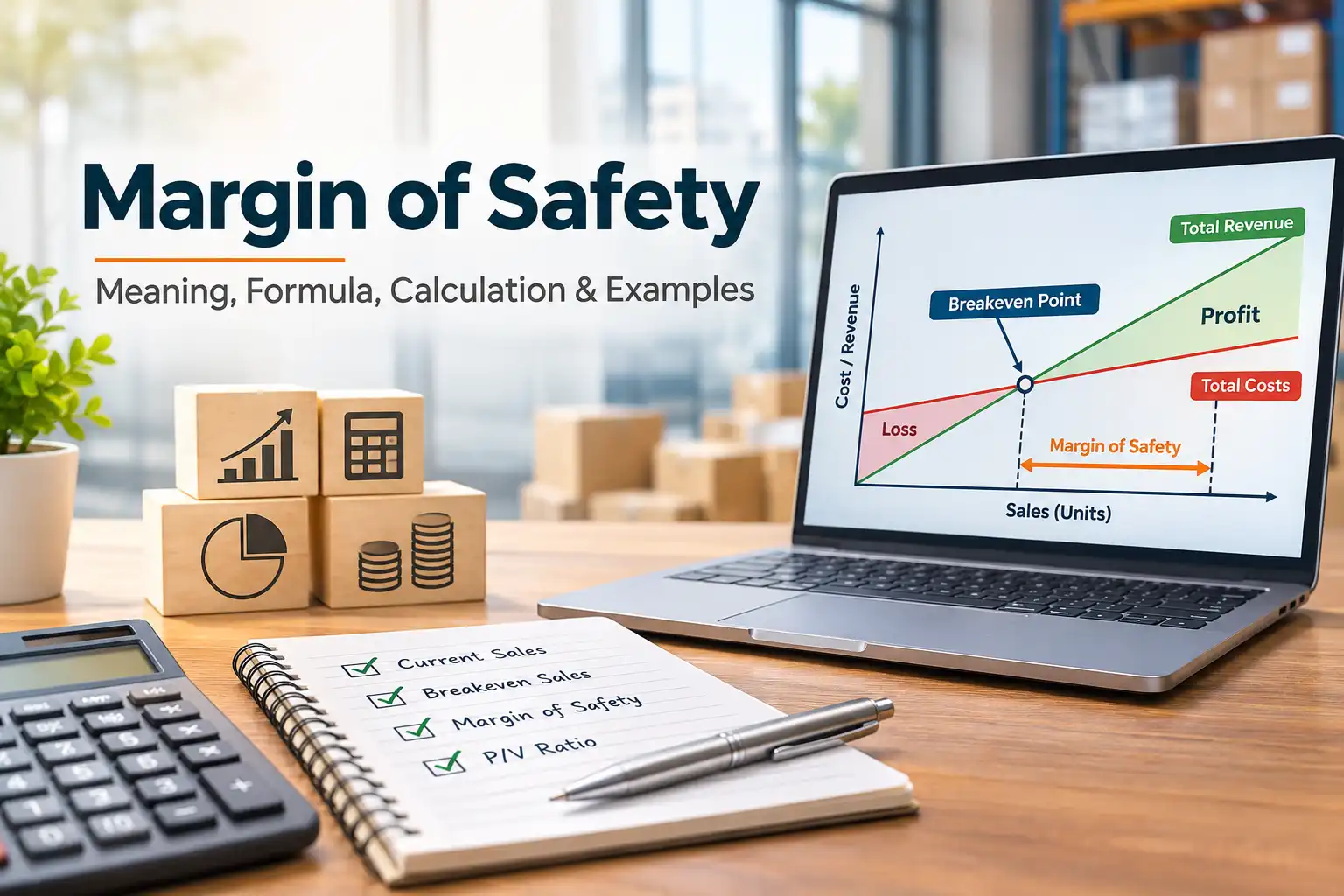
Margin of safety is the difference between current sales and breakeven sales. It indicates how much your sales can decline before your business reaches its breakeven point. In other words, this is your safety cushion after which your business stops making a profit and starts incurring a loss.
The higher your margin of safety, the lower the chance that a sudden drop in sales or a spike in raw material cost will lead to business losses. Your ERP software automates margin of safety calculations by providing you with real-time data like sales revenue, breakeven point, fixed costs, variable costs, and selling price per unit.
What is the Margin of Safety Formula?
In corporate finance and cost accounting, margin of safety is frequently used alongside variance analysis for business risk management. There are three ways to determine margin of safety.
Here are the commonly used formulas for margin of safety.
1. Margin of Safety in Rupees
This MoS formula shows the absolute cushion you have in rupee terms.
Margin of Safety (Rs) = Current Sales – Breakeven Sales
Alternate formula:
Margin of Safety (Rs) = Profit ÷ P/V Ratio
where P/V ratio stands for Profit-Volume ratio.
2. Margin of Safety in Percentage
To express margin of safety as a share of your sales, use this formula. It makes it easy to do comparisons across months, products, branches, or even companies.
Margin of Safety in % = (Current Sales – Breakeven Sales) ÷ Current Sales × 100
3. Margin of Safety in Units
This formula helps manufacturers to determine how many units can be left unsold before the business reaches its breakeven point.
Margin of Safety in Units = Current Units – Breakeven Units.
Alternate formula:
Margin of Safety in Units = (Current Sales – Breakeven Sales) ÷ Selling Price per Unit
Components of Margin of Safety Formula
To use the formula correctly, you need to understand the figures that go into it.
Current Sales
Current or actual sales is the revenue your business earns in a given period. Use current sales if you are reviewing past performance, and budgeted sales if you are planning ahead.
Breakeven Sales
Breakeven sales is the level of sales at which your total revenue equals your total costs, a no-profit, no-loss scenario. It is calculated as:
Breakeven Sales (Rupees) = Fixed Costs ÷ P/V Ratio
The P/V Ratio or Profit-Volume Ratio is the percentage of sales revenue that remains after covering all variable costs.
Alternate formula:
Breakeven Point (Units) = Fixed Costs ÷ Contribution per Unit
Contribution per unit is the selling price minus the variable cost of making one item.
Contribution and P/V Ratio
Contribution is the amount left after paying your variable costs, which you use to cover your fixed costs and then generate profit.
Contribution = Sales – Variable Costs
P/V ratio = (Contribution ÷ Sales) × 100
A high P/V Ratio indicates that your variable costs are a small percentage of your selling price. As a result, the business can retain a good proportion of every rupee earned from sales to cover overheads and generate profit.
How to Calculate Margin of Safety Step by Step
Although the margin of safety calculation can be automated using your ERP software, here is a simple math that goes behind it.
- Check your sales figures – Check the current sales value from your software. If you are planning for the next quarter, use budgeted sales.
- Separate fixed and variable costs – Fixed costs do not change with volume, whereas variable costs like raw materials do. Make sure the costs are classified.
- Calculate breakeven sales – Divide total fixed costs by the P/V ratio.
- Apply the margin of safety formula – Subtract breakeven sales from current sales, then express the result in rupees, percentage, or units as needed.
Margin of Safety Calculation Examples
1. Margin of Safety in Rupees, Percentage, and Units
Let us take an example of a manufacturing company, XYZ Industrial Corporation, which sells 5,000 units a month at Rs. 800 each. Its variable cost is Rs. 480 per unit, and its fixed costs are Rs. 8,00,000. Using the above formulas, the following are the values you get.
| Particulars | Amount (Rs.) |
|---|---|
| Sales (5,000 units × Rs. 800) | 40,00,000 |
| Variable Cost (Rs. 480/unit) | 24,00,000 |
| Contribution (P/V ratio 40%) | 16,00,000 |
| Fixed Costs | 8,00,000 |
| Profit | 8,00,000 |
| Breakeven Sales (8,00,000 ÷ 40%) | 20,00,000 |
| Margin of Safety (Rs.) | 20,00,000 |
| Margin of Safety (%) | 50% |
| Margin of Safety (Units) | 2,500 units |
Thus, the company can afford a 50% drop in sales, which equals Rs. 20,00,000 or 2,500 units, before it starts losing money.
2. Visualising Margin of Safety: How a Drop in Sales Impacts Profitability
| Fall in Sales | Sales (Rs) | Contribution (Rs) | Fixed Costs (Rs) | Profit / Loss (Rs) |
|---|---|---|---|---|
| 0% | 40,00,000 | 16,00,000 | 8,00,000 | 8,00,000 |
| 10% | 36,00,000 | 14,40,000 | 8,00,000 | 6,40,000 |
| 20% | 32,00,000 | 12,80,000 | 8,00,000 | 4,80,000 |
| 30% | 28,00,000 | 11,20,000 | 8,00,000 | 3,20,000 |
| 50% | 20,00,000 | 8,00,000 | 8,00,000 | 0 |
| 60% | 16,00,000 | 6,40,000 | 8,00,000 | -1,60,000 |
The table above shows that XYZ Corporation remains profitable until its sales fall by up to 50% or Rs. 20,00,000. A fall beyond that pushes the business into a loss.
Thus, margin of safety is the percentage drop in sales a business can handle until it stops being profitable.
How Much Margin of Safety Does Your Business Need?
In the manufacturing industry, fixed costs like machinery loans and labor wages stay the same even if production slows down. Since you cannot reduce your fixed costs due to a slow down in order booking, tracking your margin of safety is vital.
Your margin of safety target depends entirely on your cash cycle. If your customers pay you strictly within 30 days, you can survive comfortably on a tighter 20% margin of safety. But if your customers follow a 90-day credit cycle, you need a higher margin of safety of around 40% to ensure adequate working capital.
What Are the Benefits of Margin of Safety in Business?
Margin of safety gives businesses a realistic view of risk and helps optimize decisions on product pricing, production volume, expenses, and borrowing.
1. Better Cost Control
Tracking the margin of safety regularly ensures steady monitoring of costs. It also shows which product line or subsidiary is reducing your overall margin of safety. Early intervention is necessary to maintain a comfortable safety cushion.
2. Smarter Pricing Decisions
If your margin of safety is low, you may need to increase your product prices or focus on products that have a better margin. But if it’s higher, you can consider promotional pricing to gain market share without fearing losses.
3. Adequate Production Volume
Margin of safety helps you find the optimal production level. Excess production increases inventory holding costs, while producing less can lead to lost sales opportunities. Knowing your breakeven units helps you plan better.
4. Informed Expansion Decisions
Before buying expensive equipment to increase production, find out how the investment changes your fixed costs and breakeven point. A healthy margin of safety indicates the investment carries less risk.
5. Risk Assessment
A high margin of safety is a sign that your business or a particular product can absorb a fall in sales without incurring loss. A lower value signals that even a brief slowdown has a tendency to hurt your business.
6. Stronger Credit Position
Banks and NBFCs want to be sure that you can continue repaying loans when business slows down. Showing a strong margin of safety with supporting numbers from your business intelligence software instills confidence among creditors.
7. Accurate Budgeting
As the margin of safety gives you a fair knowledge of how much your sales can fall before you make losses, it allows you to make realistic budgets and set sales targets. This makes your annual forecasts far more reliable.
How Can Businesses Improve Margin of Safety?
Ideally, a business can increase its margin of safety by increasing revenue and reducing costs. You can achieve higher revenue by raising selling price, selling more, and having a better product mix. Costs can be reduced by lowering your variable costs and improving resource utilization.
- Raise sales price – Higher selling price increases profit and reduces the breakeven sales volume, provided demand and costs remain unchanged.
- Sell more – Strengthen marketing and distribution, and use cross-selling and upselling to generate more sales.
- Better product mix – Focus on products with stronger demand to maximize net profit without tying up cash in slow-moving stock.
- Reduce costs – Negotiate better terms with vendors, minimize waste, and use economies of scale to reduce per unit cost.
Limitations of Margin of Safety
Margin of safety is a powerful tool, but it is important to know its limitations. In a real world scenario, margin of safety is dynamic in nature as it changes with change in costs, prices and product mix. That’s why tracking margin of safety regularly through real-time data analysis in your ERP system becomes crucial to stay as realistic as possible.
Another limitation is that margin of safety does not account for cash flow. For instance, a business might look profitable on paper with a decent margin of safety but may face a liquidity crunch. Shorter customer credit cycles and favorable government policies like relaxed input tax credit rulesgive manufacturers more liquidity to pay their suppliers on time.
Conclusion
Margin of safety is an essential business metric that reflects your financial resilience. By identifying in advance how much sales drop your company can tolerate without facing losses, it helps in setting prices, controlling costs, and exploring revenue opportunities to mitigate risks. Even lenders prefer using this metric to be sure if it is safe to give you loans.
Sage X3 is a next-gen ERP software that brings a host of benefits that contribute towards an improved margin of safety. It helps you reduce variable costs, optimize inventory levels, boost production output, and gain real-time financial visibility for timely intervention. Take your business to the next level with lean and clean operations using Sage X3.
Margin of Safety FAQs
1. What is the Difference Between Margin of Safety and Breakeven Point?
Breakeven point is the bare minimum sales you need to cover your costs at no profit, no loss. Margin of safety is the extra sales buffer you have above that minimum before you start losing money.
2. Is a Higher Margin of Safety Always Better?
Ideally, yes, as it indicates lower risk. However, an extremely high margin of safety may also signal that you are not investing sufficiently in growth or your pricing is too high. It should be seen along with cash flow and market conditions.
3. How Often Should I Calculate Margin of Safety?
At least once a month and whenever there is a major change in costs and prices, or when you invest heavily in expansion. This gives you a realistic picture of your margin of safety.
4. Is Margin of Safety the Same As Profit Margin?
No. Profit margin is profit as a percentage of sales, whereas margin of safety represents how much your sales can fall before your business stops making profit. A business can have a decent profit margin but a dangerously low margin of safety if its fixed costs are very high.