Key Takeaways:
- The glass manufacturing industry is evolving with growing demand for architectural, automotive, solar, and specialty glass, making efficient production, quality control, sustainability, and digital management increasingly important.
- ERP Software for Glass Manufacturing Industry helps manufacturers manage production, inventory, procurement, sales, quality, and finance on a single platform.
- ERP software for glass industry helps businesses manage challenges such as rising raw material costs, production complexity, supply chain disruptions, and changing customer demands.
- Integrated ERP capabilities improve quality control, batch tracking, traceability, and compliance across glass manufacturing operations.
- Modern glass industry software uses automation, AI, IoT, and analytics to make manufacturing more connected, efficient, and data-driven.
- A scalable ERP for glass industry such as Sage X3 can help manufacturers streamline operations, improve decision-making, and support long-term business growth.
What is ERP Software for Glass Manufacturing Industry?
Glass industry software is a highly versatile Enterprise Resource Planning (ERP) solution that streamlines glass manufacturing operations and provides a single integrated platform to manage business activities, right from the procurement of raw materials to the delivery of finished goods.
ERP software for glass industry enables businesses to plan material requirements, schedule production activities, automate purchase and sales orders, track order delivery schedules, and reduce time-to-market. It also helps businesses maintain quality and consistency across batches while supporting compliance with modern industry standards. With intuitive charts, reports, and customized dashboards, decision-makers can gain better visibility into operations and align the company’s time, resources, and capital with long-term strategic objectives.
Glass Industry in India Market Overview
According to a news report in Business World, India’s glass manufacturing market is estimated to be Rs. 24,000 crores in size. It is expected to reach Rs. 40,000 by the year 2028. There are several factors believed to contribute to the growth of the glass industry.
In the domestic scenario, the construction and electronics sectors are the two major driving forces. India is witnessing a surge in the demand for residential, commercial, and industrial glass products, and a growing adoption of solar power plants. Furthermore, there is a growing demand for Indian glass products internationally, thanks to India’s competitive pricing and higher product quality. Domestic glass traders are well-positioned to capitalize on this lucrative opportunity.
Challenges in the Glass Manufacturing Industry
Glass manufacturers face a range of operational challenges driven by complex production processes, fluctuating raw material costs, strict quality requirements, dimensional product variations, and the risk of material waste:
Increasing Cost of Raw Materials
The glass industry in India is a capital-intensive industry in which raw material prices keep increasing due to growing demand from the construction and automation industries. The shrinking profit margins often force merchants to hike product prices for the final customer.
Changing Industry Trends
The glass manufacturing and construction industries are highly interlinked. In recent years, the construction sector has witnessed a sudden shift from the demand for float and pattern glasses to alternate materials such as metal and plastic. The lower demand for certain types of glasses has led to reduced sales, lower revenues, and a higher financial strain on glass traders.
Strengthened Govt Regulations
The glass manufacturing process contributes to greenhouse gas emissions and climate change. As a result, the Government of India has strengthened regulations and imposed carbon taxes. It has forced glass fabricators to reconsider their expansion plans due to the increased risk of litigation, higher compliance costs, delays in product development, and reduced innovations.
Transportation Challenges
The glass industry in India is divided among various small and medium-sized glass manufacturers. The lack of dedicated freight corridors, infrastructure facilities, and poor road condition causes congestion, delayed deliveries, damaged goods, accidents, and fatalities. Moreover, the companies suffer from other transportation costs such as tolls, taxes, and increased fuel prices.
Intense Competition
The Government has relaxed the regulations for setting up glass manufacturing plants. With the introduction of new domestic and international players, the competition has become intense. International players use modern technologies, to automate various tasks, making it difficult for Indian companies to compete with them. These international players often have more capital due to strong financial backing and global reach. The increased competition has forced domestic players to slash prices, leading to lesser profit margins and financial difficulties.
8 Core Features of Glass Industry ERP Software
- Production Planning & Scheduling: Plan production efficiently based on customer orders, demand, available capacity, and delivery timelines.
- Furnace & Batch Management: Manage batch recipes, furnace operations, production cycles, and batch-level traceability for consistent output.
- Dimensional Inventory Management: Track glass by size, thickness, grade, type, and quantity for accurate inventory visibility and better material utilization.
- Material Requirement Planning: Calculate material requirements and align procurement with production schedules to avoid shortages and excess inventory.
- Order Management & Tracking: Manage quotations, customer orders, production requirements, delivery schedules, and order status from a centralized platform.
- Quality Control & Traceability: Monitor quality throughout production and trace raw materials, batches, and finished products to maintain consistent standards.
- Costing & Financial Management: Track material, production, energy, and operational costs to improve cost control and understand product profitability.
- Real-Time Reporting & Analytics: Access real-time insights into production, inventory, sales, quality, costs, and overall operational performance.
Benefits of Using ERP Software for Glass Industry
ERP for glass industry connects production, inventory, orders, quality, and finance to improve efficiency, reduce waste, and support better business decisions.
Enhanced Agility
Business intelligence tools interconnect all modern business processes for real-time and accurate data sharing. They support industry-specific production processes from recipe management, batching tracking, production planning, historical demand analysis, demand forecasting & production scheduling, inventory management, and financial management. Glass software facilitates quicker decision-making so that businesses can address problems swiftly and promptly respond to changing market trends & consumer behaviors.
Electronic Data Transfers with Stakeholders
ERP system offers intelligent software solutions for glass producers that facilitate streamlined electronic data transfers with various stakeholders such as suppliers, carriers, and final customers. It results in real-time exchange of information, accurate data sharing, reduced paperwork, and fosters more responsive and enhanced communication. Effective communication with all stakeholders using ERP for manufacturing industry helps build trust, improve morale, and boost productivity & efficiency.
Data Standardization
ERP software centralizes all data into one place in a consistent format and structure, rather than being dispersed across multiple departments in dozens of spreadsheets or databases. It reduces duplicity of information, human errors, and discrepancies caused due to varying data formats and terminologies. The standardized data can be easily aggregated, integrated with Internet of Things (IoT) devices, and analyzed to generate meaningful insights and generate reports.
Material Requirement Planning
Material requirement planning is a crucial step that offers multiple advantages such as better recipe management, optimized inventory levels, improved traceability, reduced over-stocking, and under-stocking situations, and timely production activity. Manufacturing ERP software helps the glass manufacturing industry with better material planning to meet changing market demands, and consumer expectations.
Order Tracking
In this age of globalization, there is increasing competition, and meeting customer demands on time is essential. Software for managing business makes order tracking simpler from start to finish. It automates shipping label generation, shipment tracking, customer notifications, batch tracking, and other tasks. The automated report generation feature helps reduce delays in shipping, saves time, and helps meet customer demands on time.
Retain Customer Contentment
High-quality materials are used to produce superior-quality glasses. The quality assessment tools in glass software enable your business to meet the highest quality standards, keep consistency throughout production, retain customers’ contentment, and meet your corporate objectives. The reduced production defects save money on repairs, replacement, and material costs, and ensure better customer relations.
Single Source of Truth
ERP for glass manufacturing industry maintains the supply, logistics, distribution, and accounting management from one portal. The Sales Module is used for effective lead management, sales forecasting, opportunity management, and order management. The Purchase Order module is used to track order purchases, order requisition, quotation management, and Purchase Order (PO) management. The Warehouse Module is used for extended warehouse management of materials. Accounting Management is used to automatically generate & manage invoices, and ap automation. Furthermore, it can also help with the ar automation, budgeting, and taxation simplifications.
Future Trends in the Glass Industry
Adoption of Smart Manufacturing Technologies
The glass industry is increasingly adopting digital technologies to improve production efficiency, product quality, and operational visibility. Smart glass, automation, IoT-enabled equipment, AI, and advanced analytics are helping manufacturers make faster, data-driven decisions. At the same time, ERP software for glass industry is becoming an important part of digital transformation by connecting production, inventory, procurement, sales, and finance on a unified platform.
Growing Demand for Impact-Resistant and High-Performance Glass
Demand for stronger and more durable glass is growing across automotive, construction, commercial, and safety applications. Laminated, tempered, and other impact-resistant glass products offer improved strength, safety, and protection compared with conventional glass. Manufacturers are therefore focusing on developing products that combine durability, performance, energy efficiency, and application-specific requirements.
Greater Focus on Sustainability
Sustainability is becoming a major priority for glass manufacturers as the industry works to reduce energy consumption, emissions, and manufacturing waste. The use of recycled glass, energy-efficient production methods, lightweight products, and renewable energy can help reduce the environmental impact of manufacturing. Improving resource utilization and minimizing production waste will also remain important areas of focus.
Rise of the Solar Glass Market
The expansion of renewable energy and solar power is creating new opportunities for specialized glass manufacturers. Solar glass plays an important role in photovoltaic panels by protecting solar cells while allowing efficient transmission of sunlight. As solar installations continue to expand, manufacturers are likely to see increasing demand for high-performance, durable, and energy-efficient solar glass products.
Increasing Shift Toward Customized Glass Products
Another important trend is the growing demand for customized glass solutions across architecture, automotive, interiors, and specialty applications. Manufacturers need greater flexibility to handle different specifications, smaller batch sizes, and customer-specific requirements. This is increasing the importance of connected production planning, inventory management, quality control, and order tracking.
Who Can Benefit from ERP for Glass Industry?
ERP solutions are suitable for glass businesses of different sizes and manufacturing models. Whether you manufacture standard glass products, process customized glass, or produce specialized products, an integrated system can help connect production, inventory, sales, procurement, and quality processes.
Float Glass Manufacturers
Float glass producers can use ERP to coordinate raw material planning, production schedules, furnace-related operations, inventory, quality checks, and finished-goods management while maintaining better control over production costs.
Container Glass Manufacturers
Manufacturers of bottles, jars, and other glass containers can manage material requirements, production planning, product specifications, quality inspections, packaging, inventory, and dispatch through a connected ERP system.
Architectural and Processed Glass Manufacturers
Businesses producing customized architectural and processed glass can manage customer-specific orders, cutting and processing requirements, production stages, inventory, and delivery schedules while improving order visibility.
Specialty Glass Manufacturers
Specialty glass manufacturers can use ERP software to manage complex production requirements, multiple product specifications, quality standards, raw materials, inventory, and traceability across different manufacturing processes.
Why Choose Sage X3 ERP for Glass Industry?
Glass industry software helps glass merchants streamline their industry-specific production processes, enhance the supply chain, manage sales and inventory, and bring visibility into business operations. The decision-makers can make strongly data-backed strategic business decisions that lead to better competitiveness, growth, and sustainability.
Sage X3 is a robust tool that offers state-of-the-art technology to help glass merchants cut production and overhead costs, foster innovation, grow sales, adapt to changing market trends, and achieve long-term value creation, profitability, and strategic business workflow. It’s scalable and customizable so that you can reshape it to your unique needs for faster speed & agility. It offers breakthrough features and a complete solution that help your business seize new opportunities, mitigate risks and improve profitability.
Ready to transform your glass manufacturing operations?
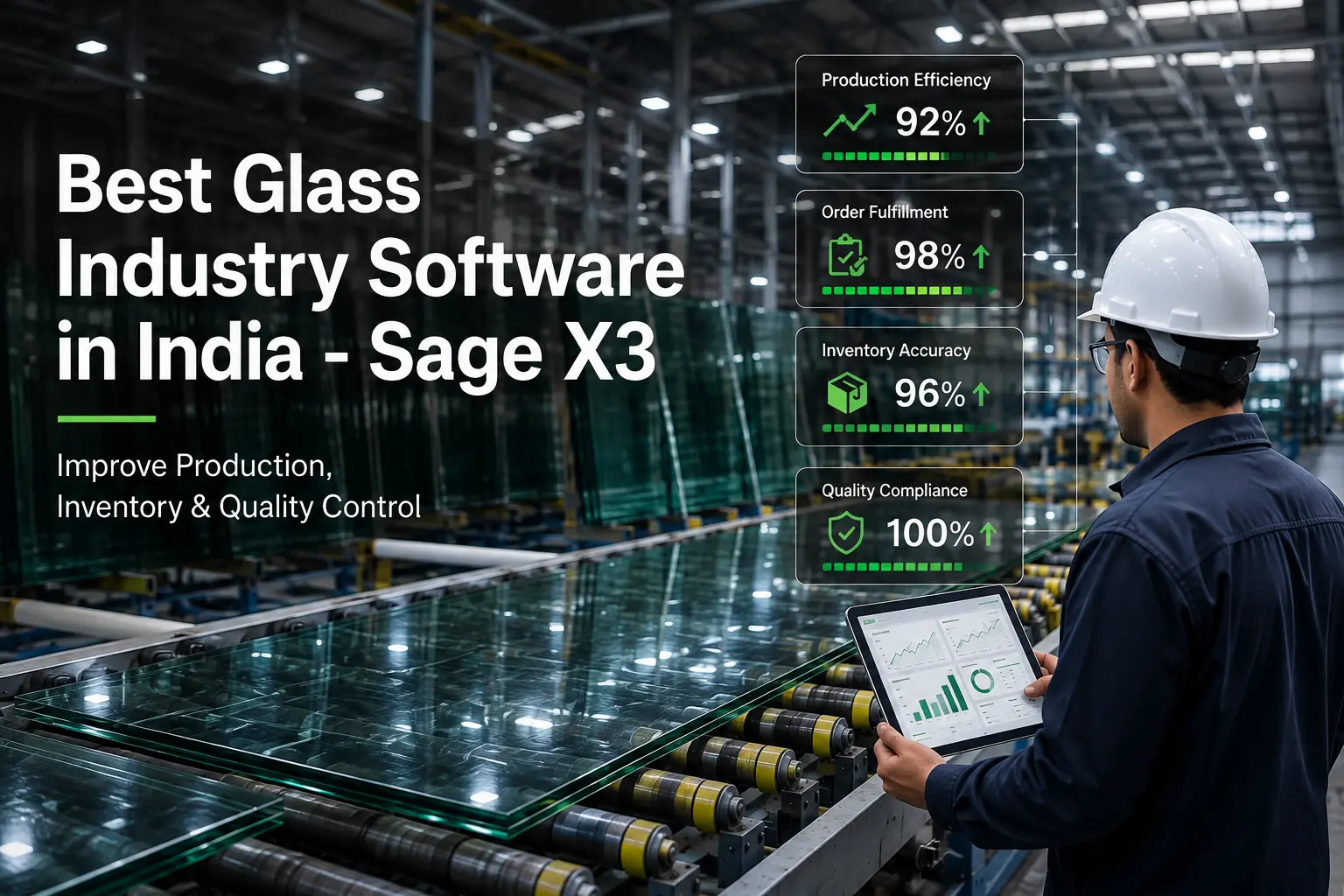
Improve efficiency. Reduce costs. Maximize ROI. Sage X3 connects production, inventory, procurement, sales, and finance on one platform, helping glass manufacturers streamline operations and grow profitably.
Frequently Asked Questions About Glass Manufacturing Software
1. What is Glass Manufacturing Software?
Glass Manufacturing ERP Software is an enterprise-level solution that provides a unified platform to coordinate industry-specific activities such as glass design & production, quality control, supply chain, distribution, and customer support. It provides extensive customization options and a wide range of features to meet the unique needs of glass manufacturers.
2. Which is the mostly used ERP in glass manufacturing industry?
The right ERP for glass manufacturing business depends on its production processes, inventory requirements, supply chain complexity, reporting needs, and growth plans. Sage X3 is one option for manufacturers looking for an integrated ERP platform covering manufacturing, supply chain, inventory, and financial management.
3. What are the common features of Glass Industry ERP?
Here are the common features of Glass Manufacturing ERP Software:
- Centralization: Centralized business operations and enhanced visibility
- Scalability: Meet your growing business needs without resource limitations
- Cost Management: Save costs and never exceed your budgets
- Demand Forecasting: Accurately predict demand for your products
- Supply Chain: Optimize your logistics for faster & smoother delivery
4. What are the key benefits of ERP for Glass Industry?
The following are the key benefits of using ERP for Glass Industry:
- Improved Competitiveness: Reduce costs, improve efficiency, and enhance competitiveness
- Quality Excellence: Real-time production monitoring with quality control at every stage of the production activity
- Real-time Data Insights: Get real-time insights into your data and stay agile with changing market dynamics.
- Get Rid of Disconnected Systems: Eliminate multiple disconnected systems and sync data in real-time for data-backed & informed decision-making.
- Market Responsiveness: Gain agility in operational and financial activities and improve your market responsiveness.
5. What is the role of AI in glass manufacturing ERP?
AI in glass manufacturing ERP can help manufacturers improve demand forecasting, production planning, inventory management, quality monitoring, predictive maintenance, and business decision-making by analyzing operational data.
6. How to choose the right glass industry software?
Choose glass industry software based on your production processes, inventory requirements, quality management, scalability, integration needs, reporting capabilities, and support. The right solution should align with your specific manufacturing workflows and business goals.
7. How Much Does Glass ERP Software Cost?
The cost of glass ERP software varies based on business size, number of users, modules, deployment model, customization, and integration requirements. Businesses with complex production, dimensional inventory, quality control, and financial processes may require a more comprehensive ERP system. A detailed assessment of your operational requirements is the best way to determine the right solution and total implementation cost.