Imagine a bakery shop that sells fresh bread with a golden crust and a soft, warm inside. The baker can only make great products if they buy only good-quality ingredients. Without quality flour, fresh yeast, butter, and salt, the baker may not make great products within budgets or deliver them on time at a good profit margin. By establishing a direct procurement framework, they ensure the shop buys ingredients at the right quantity, right quality, right price, right time & place, and right source. That’s how important direct procurement is!
Key Takeaways:
- Direct procurement is an activity focused on purchasing raw materials and components used for direct production activity and conversion into finished goods.
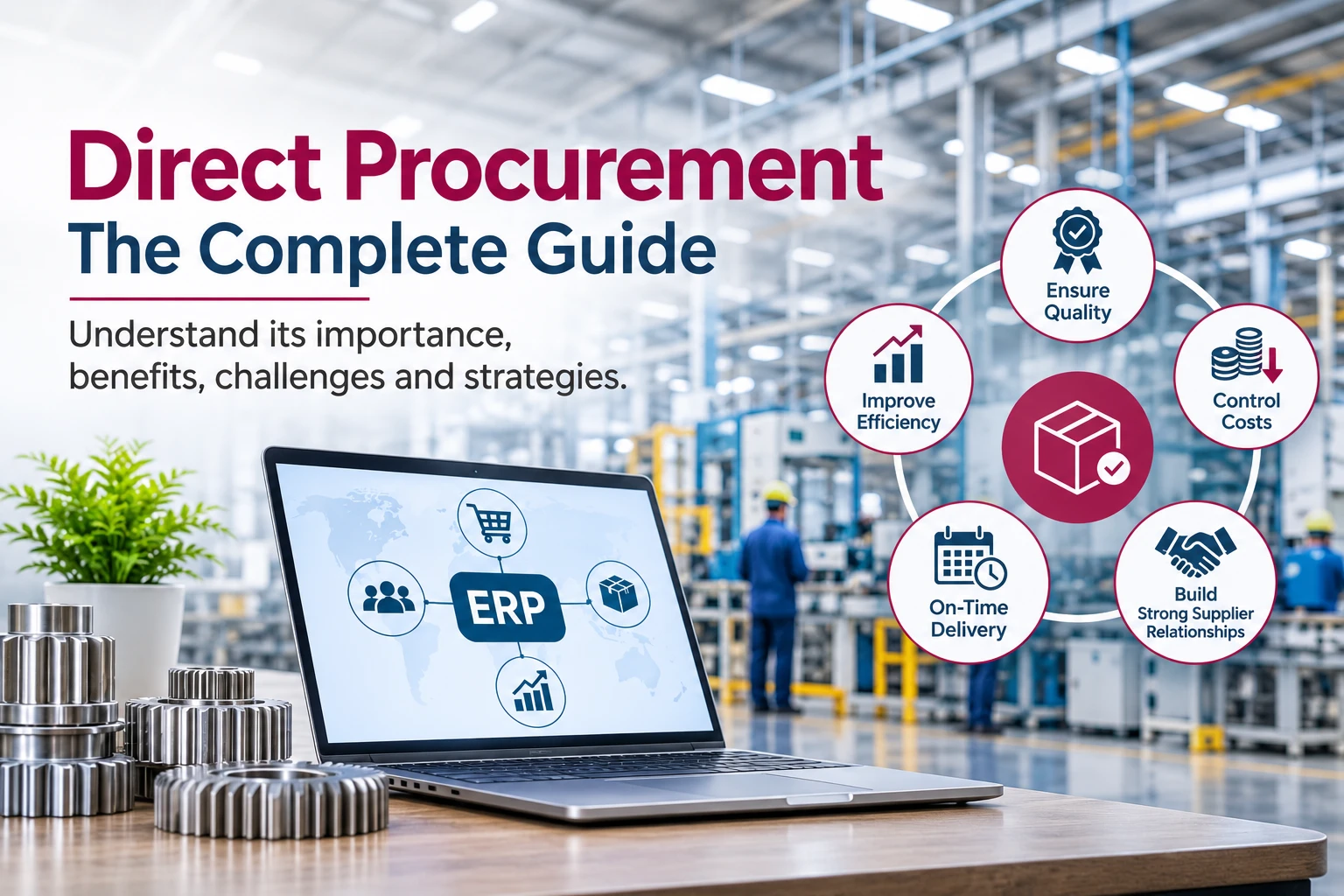
- Direct procurement is important for ensuring uninterrupted production activity, reducing material costs, maintaining product quality, strengthening supplier relationships, and improving inventory management.
- While direct procurement focuses on purchasing production-related materials, indirect procurement focuses on goods & services used for routine business operations.
- Sage X3 streamlines direct procurement by centralising supplier information, automating purchase orders & invoice processing, improving demand forecasting, and reducing manual errors.
What is Direct Procurement?
Direct Procurement is the process of purchasing raw materials, ingredients, and components needed to manufacture a company’s core products. These purchases are converted into finished goods, which makes them integral to the company’s core manufacturing operation and more significant than indirect ones.
ERP software centralises the entire procurement activity from requisitions to approvals, providing visibility at all levels. It streamlines material requirements planning, production planning, inventory tracking, supplier management & supplier performance evaluation, Purchase Order (PO) generation, and budgeting & cost control. As a result, businesses can reduce potential delays and keep up with their manufacturing schedules.
Why is Direct Procurement Important for Manufacturers?
Direct procurement is important to ensure uninterrupted production activity, lower material costs, ensure quality control, maintain better supplier relationships, and improve inventory management.
Uninterrupted Production Activity
With direct procurement, manufacturers can focus on continuous production activity without disruptions and ensure on-time delivery of their finished goods.
Reduced Material Costs
Developing impactful direct procurement strategies helps businesses negotiate better pricing, lower procurement costs, and improve profit margins.
Quality Control
Manufacturers work with reliable vendors who adhere to the company’s strict quality standards, ensuring consistency in product quality and an improved brand reputation.
Better Supplier Relationships
With direct procurement, manufacturers manage stronger relationships with their suppliers and benefit from favorable payment terms and lower pricing.
Better Inventory Management
Manufacturers procure materials on time without delays, which helps avoid inventory shortages and excess inventory.
Common Challenges in Direct Procurement
Manufacturers face a range of direct procurement challenges, including unexpected increases in material costs, additional costs, material quality issues, procurement delays, and compliance difficulties.
- Unexpected Increases in Material Costs: Unexpected increases in material costs due to inflation, geopolitical conditions, changes in weather conditions, and natural disasters can disrupt a procurement team’s budget and drive up the cost of finished goods.
- Additional Costs: Procurement teams can also run into budget overruns because of additional costs such as penalties, freight or logistics surcharges, material storage costs, product quality issues, supplier switching costs, and depreciation costs.
- Material Quality Issues: Sometimes, suppliers may supply low-quality materials, such as a lower-grade or recycled plastic blend that cracks easily. It can degrade the quality of finished goods, drive negative customer experience, and impact their brand reputation.
- Procurement Delays: Small manufacturers often rely on a single supplier, which makes them vulnerable to delays in the procurement cycle and further disruptions in the production schedules. Such disruptions can drive them out of stock, pushing their customers towards rivals.
- Local & Global Compliance Challenges: Small companies face another significant challenge: Keeping up with local and global compliance requirements and managing complex Bill of Materials (BOMs) while procuring large quantities of materials.
5 Proven Best Practices for Optimising Direct Procurement
Here are the five proven ways for optimising direct procurement activity:
- Process Standardisation: Standardise the entire procurement procedure across different product lines.
- Avoid Supplier Dependence: Instead of relying on a single supplier, build a network of multiple suppliers as a backup strategy.
- Supplier Segmentation: Classify your suppliers into different categories such as High Risk, High Impact, and Low Risk, Low Impact.
- Implement ERP Software: Use the Material Requirements Planning (MRP) module of the ERP software to get complete visibility and automate tasks.
- Key Performance Indicators (KPIs): Use various KPIs to track supplier performance, quality benchmarks, and order fulfilment time.
Direct vs Indirect Procurement: What Is the Difference?
Now, let’s dive deep into the key difference between direct and indirect procurement.
| Direct Procurement | Indirect Procurement | |
|---|---|---|
| Meaning | Direct Procurement is an activity that involves purchasing raw materials and components that are used in the direct production activity. | Indirect Procurement is an activity that involves purchasing goods and services that support routine business operations but are not directly part of the core production activity. |
| Objective | To ensure uninterrupted production and faster fulfilment. | To support smooth business operations. |
| Examples | A pharmaceutical manufacturer purchasing active pharmaceutical ingredients and chemicals for drug production. | The same manufacturer purchasing computers, office furniture, internet services, and housekeeping supplies. |
| Procurement Items |
|
|
| Impact on Production | Directly affects production capacity, product quality, and delivery schedules. | Indirectly affects productivity, operational efficiency, and employee performance. |
| Procurement Frequency | Typically aligns with production schedules. | Aligns with operational needs. |
| Budget Category | Production or Cost of Goods Sold (COGS) | Operating Expenses (OPEX) |
| Cost Management | Prime focus is on reducing production and material costs. | Prime focus is on reducing operational costs. |
Also Read: Difference between Procurement and Purchasing
Important KPIs Used in Direct Procurement
On-Time Delivery (OTD) Rate, Incoming Quality Rate, Purchase Price Variance (PPV), Supplier Concentration Ratio, Supplier Lead Time, and Spend Under Management (SUM) are some common KPIs used in direct procurement.
| Key Performance Indicator (KPI) | What does it measure? |
|---|---|
| On-Time Delivery (OTD) Rate | Measures the percentage of orders delivered on or before the promised date. |
| Incoming Quality Rate | Measures the quality of raw materials and components procured from the supplier. |
| Purchase Price Variance (PPV) | Measures the difference between the standard/budgeted product price and the actual purchase price. |
| Supplier Concentration Ratio | Measures a company’s dependency on a set of suppliers. |
| Supplier Lead Time | Measures the time between Purchase Order placement and actual material delivery at the company’s facility. |
| Spend Under Management (SUM) | Measures the percentage of a company’s total external spending managed through approved suppliers, procurement policies, and formal contracts. |
Also Read: 9 critical parts of the procurement process
How ERP Software Improves Direct Procurement?
ERP software automates procurement activity, delivers intelligent AI insights, streamlines compliance, and reduces supplier dependency, supporting direct procurement activity.
Centralised Procurement Platform
ERP software replaces several disconnected systems, making the direct procurement process easier, consistent, and straightforward. With complete visibility into production schedules & quality requirements, it paves the way for effective collaboration.
Game-Changing Automation
ERP eliminates manual work in Purchase Order (PO) generation, invoice processing, and payment authorisation, allowing employees to focus on strategic activities rather than routine manual tasks that drive operational costs.
Intelligent AI Insights
A food manufacturer in Shimla, Himachal Pradesh, used AI in Sage X3 to analyse historical demand patterns & supplier lead times, reducing overall procurement costs by 27%. Such valuable insights help establish a framework for reducing various costs and improving business strategy.
Streamlined Compliance
Your procurement software standardises the procurement procedure and maintains detailed audit trails, ensuring end-to-end compliance with industry standards and local & global regulatory bodies.
Reduced Supplier Dependency
Reduce your procurement costs and avoid dependence on a single supplier. ERP software lets you build a comprehensive supplier database and evaluate vendor performance to develop effective cost-cutting strategies.
Enforce Five R’s of Procurement
The Department of Expenditure, Ministry of Finance, Govt. of India, has published a rulebook, “Manual for Procurement of Goods, Second Edition (2024)” that discusses the “Five R’s of Procurement,” namely right quality, right quantity, right price, right time & place, and right source. ERP software helps enforce those rules automatically.
Conclusion: Future of Direct Procurement Starts with Sage X3
Direct procurement in manufacturing plays a critical role across industries such as automotive, healthcare, and other industries where there is a need for continuous production activity and delivering high-quality products to customers. In today’s highly-complex & competitive business environment, it is becoming increasingly crucial to ensure availability of critical materials and achieve sustainable growth.
If your procurement team is juggling multiple disconnected tools and spreadsheets, it’s time to upgrade to Sage X3. Centralise supplier data, get rid of workflow inefficiencies, and drive ROI & agility while maintaining compliance with changing regulatory requirements. Sage ERP takes care of everything from Purchase Requisition creation, supplier performance evaluation, PO generation, and invoice matching & routing, to payment processing, reducing the need for manual human intervention and expediting the entire process from start to finish.
Frequently Asked Questions (FAQs)
1. What are the types of procurement?
Direct, indirect, and services procurement are the three types of procurement:
- Direct Procurement: Procurement of raw materials and components used in the production activity and converted into finished goods.
- Indirect Procurement: Procurement of goods and services necessary for day-to-day business operations, except for core production activity.
- Services Procurement: Procurement of external services (such as external labor, contracts, support, and consulting) for achieving specific objectives or targets.
2. What’s the main difference between direct and indirect procurement?
Direct procurement focuses on the purchase of raw materials required for direct production activity, whereas indirect procurement focuses on the procurement of goods & services required for smooth business functioning.
3. What are some examples of direct procurement across industries?
Here are the examples of direct procurement across different industries in India:
- Automobile Industry: An automobile company purchases steel, aluminium, rubber, glass, etc.
- Food Industry: A bakery shop purchases whole wheat, jaggery, milk, ghee, cashews, etc. for producing sweet & savoury bakery products.
- Furniture Industry: A carpenter procures wood or timber to build luxurious furniture.
- Pharmaceutical Industry: A pharma manufacturer purchases – Binding agents, blister packs, glass vials, and safety seals.
4. How is AI reshaping direct procurement?
Here’s how modern technologies such as Artificial Intelligence (AI) are reshaping direct procurement:
- Data Insights: Get data-driven insights for smart & faster decision-making.
- Reduce Errors & Fraud: Reduce the likelihood of costly errors and frauds.
- Better Risk Management: Proactively manage supplier risks and ensure continuous production activity.
- Avoid Budget Overruns: Negotiate efficiently, avoid rogue spending, and stay aligned to your budgets.
- Precise Demand Forecasting: Reshape your procurement decisions and avoid excess inventory costs.