Key Takeaways:
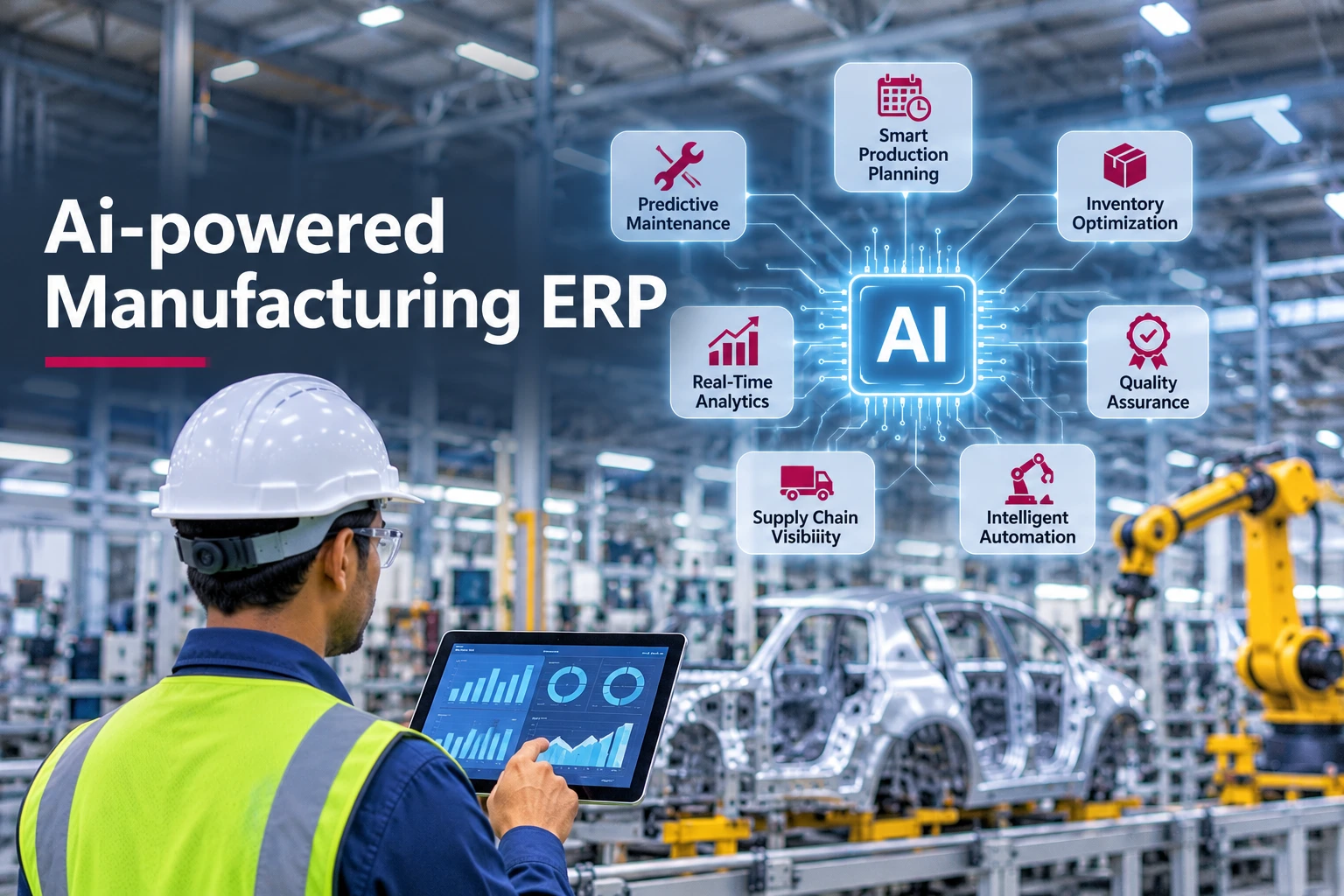
- AI-powered Manufacturing ERP software provides strategic insights for better risk identification, smart decision-making, cost reduction, and better quality.
- AI-powered ERP helps manufacturers reduce costs, save energy, utilise resources efficiently, and comply with regulatory standards.
- AI offers smart scenario planning, warehouse optimisation, equipment monitoring, and real-time quality checks.
- Sage X3 is an AI-enabled ERP that offers intelligent automation, predictive insights, and data-driven decision-making.
What is an AI-Powered Manufacturing ERP?
An AI-powered manufacturing ERP software integrates Artificial Intelligence (AI), Machine Learning (ML), and Natural Language Processing (NLP) at its core, benefiting businesses with intelligent workflow automation, predictive analytics, and intelligent decision-making. It empowers manufacturers with business-critical features such as AI-generated insight-driven reports, smart scenario planning, pattern recognition, and accurate forecasting.
AI-powered manufacturing ERP software automates routine, time-consuming operations, predicts equipment failures, monitors compliance violations, and summarises large volumes of data within minutes. It simulates various scenarios, empowering decision-makers with powerful What-If modeling features for strong planning and decision-making. With AI at your assistance, organisations can eliminate the risks of human oversight, misinterpreted compliance data, quality inconsistencies, and incorrect forecasts.
Why are AI-Enabled ERP Solutions Gaining Importance in Manufacturing Process?
With the introduction of AI in ERP, the large amount of data generated in factories, including data from IoT sensors, transactional and operational data across business functions, can now be exploited to gain new business intelligence. Because AI-enabled ERP solutions can analyze and learn from vast data sets as well as recognize patterns in them, these intelligent systems are being increasingly deployed to solve complex business problems and gain actionable insights.
A report published by NITI Aayog, “AI for Viksit Bharat: The Opportunity for Accelerated Economic Growth” (Sept 2025), states that AI-led productivity gains in manufacturing could add USD 85-100 billion by 2035, over and above current growth, and manufacturing and financial services could see AI account for 20-25% of their sectoral GDP by 2035.
Let’s look at the key factors that are promoting the use of AI in Manufacturing Software:
- Rising Competition: Current competition is no longer about large-scale production abilities, but about the flexibility to respond to changing customer requirements at speed and deliver high-precision quality, all while maintaining leaner operations at lower costs.
- Supply Chain Disruptions: Prolonged supply chain disruptions and ongoing geopolitical conflicts are a crucial lesson for manufacturers that staying agile and flexible forever is the only way to mitigate business risks.
- Faster Decision-Making: Waiting for monthly or weekly reports before a decision is taken is not the way forward. Today, manufacturers want to make swift data-driven decisions and have actionable intelligence at their fingertips.
- Access to Technology: As cloud ERP solutions see wider adoption in the manufacturing sector, leveraging AI capabilities has become more accessible, leading to rapid scalability. Besides, it promotes faster collaboration with vendors and clients.
Benefits of Using Artificial Intelligence in Manufacturing Software
By adopting AI software tools for manufacturing, forward-thinking leaders are ultimately seeking new ways to improve efficiency, reduce costs, and deliver more value to their customers. The following benefits of AI in ERP are worth taking note of :
- Faster Resolution of Production Issues: AI-driven ERP platforms integrated with production software & IoT devices enable manufacturers to identify production variances at the micro level, thereby preventing avoidable downtime.
- Intelligent Automation of Repetitive Tasks: Repetitive tasks like production scheduling can be achieved dynamically without letting disruptions affect the continuity of operations. Labor and machines can be auto-assigned to maximize efficiency.
- Real-time Operational Alerts: ERP systems enhanced by AI are skilled at sending proactive operational alerts. Such alerts allow timely action for dealing with potential issues like advance flagging of production risks due to supplier delays.
- Improved Demand and Supply Planning: With AI in ERP, manufacturers can use predictive analytics to forecast demand using historical and current sales data. Resource allocation and supplies can therefore be more closely aligned with demand.
- Stronger Traceability & Compliance: Through automated data capture, AI ERP can track batches forward & backward, reducing human errors. It can even interpret unstructured compliance documents to simplify reporting.
Also Read: AI in Automotive Industry – Applications, Benefits And Future Trends
Key Capabilities of AI-Powered Manufacturing ERP Software for Manufacturers
AI-enabled manufacturing software is bringing new, transformational capabilities to the front. From intelligent production automation to smarter quality control, from flexible order scheduling to visible gains across the supply chain, these intelligent ERP solutions are empowering manufacturing in extraordinary ways.
Here are some innovative capabilities emerging as we observe ERPs coupling with AI :
1. Intelligent Production Control
AI integration with ERP enables flexible production rescheduling, allowing production managers to efficiently accommodate changing order delivery priorities. AI can proactively guide load balancing to prevent assembly bottlenecks. Analysis of data from IoT devices further allows AI-powered ERP to spot production variances and highlight material and operational issues in advance.
2. Predictive Maintenance
AI in ERP simplifies equipment management through predictive maintenance, ensuring longer asset life and lower repair and maintenance costs. They can compare historical and current data on machine performance and detect anomalies, thereby reducing wear and preventing machine failure. For example, if the system detects a 2% variance in motor heat, it can auto-schedule maintenance, order spare parts, and adjust the production schedule to minimize unplanned downtime.
3. Supply Chain Optimization
Frequent supply chain disruptions are common in the manufacturing industry. The bullwhip effect, due to demand fluctuations and inaccurate demand forecasting, further makes supply chain planning difficult. AI in ERP can analyze data on weather, market trends, and order patterns to make accurate predictions about future demand. Going beyond tier-1 suppliers, it can map risk associated with tier-2, tier-3, and tier-4 suppliers and suggest ways to mitigate supply risks.
4. Inventory Management
Raw material delays often occur due to improper material order timing and quantity. ERP software enabled by AI can track material consumption & demand in real time, enabling better material requirements planning and automatic safety stock adjustments. This helps to maintain adequate stock levels across warehouses, reducing overstocking or stock-out situations. AI-led ERP also minimizes dead stock by actively predicting slow-moving stock before it becomes a liability.
5. Quality Excellence
AI-driven ERP software solutions can support root cause analysis for better quality control. For example, real-time production data analysis can highlight risky batches and point out problems with a particular machine setting or shift operator. In fast-moving manufacturing environments where computerized AI vision and image-based systems are deployed for inspecting parts, ERP solutions with AI-based analysis allow faster detection of microdefects.
6. Procurement Automation
AI can help you predict vendor lead time and enable automatic stock reordering, thereby improving order fulfillment rates with minimal human intervention. These high-powered ERP systems can intelligently monitor billing transactions for unusual patterns. By continually learning from past data, they become more intelligent at identifying fraudulent and incorrect invoices and preventing wrongful payments to vendors.
7. Conversational Queries
Another area where AI in ERP is making rapid advancement is natural language processing and generative AI, allowing users to ask questions to chatbots and get quick answers to complex queries. This significantly reduces the time spent on navigating layers of data and reports, improving employee productivity and customer service. For example, AI chatbots can predict which vendors are likely to miss delivery deadlines during high seasonal demand, and suggest better alternatives to fulfill demand.
Also Read: AI in Food Industry – Applications, Benefits and Examples
AI-Powered ERP Trends in Manufacturing
Artificial intelligence and ERP software have together unlocked newer capabilities for manufacturing. Some trends that will shape the future of AI-enabled ERP solutions are as follows:
- Explainable AI – To build trust in AI models, users will seek logical explanations behind AI responses.
- Hyperautomation – Merging AI tools and data warehouses in ERP for rapid automation of specific business processes.
- Augmented Intelligence – Positioning AI as an enabler that complements human intelligence.
- Chatbots & Virtual Assistants – Getting instant answers and support for advanced queries through AI assistants like Sage Copilot.
- Blockchain & AI Integration – Leveraging blockchain to enhance data security and ensure immutable audit trails for compliance.
Also Read: AI Features in Sage X3
Conclusion
AI-powered ERP software is improving manufacturing workflows through widespread applications across production, quality control, supply chain, and asset management – ultimately driving greater efficiency, profitability, and customer satisfaction.
Sage X3 is a future-ready ERP software for manufacturing, with robust AI capabilities to automate manufacturing processes and accelerate decision-making. Keeping innovation at the forefront, Sage X3 ERP offers hyper-customized intelligent solutions to power smart factories.
FAQs
1. What are the real-world use cases of AI-powered ERP software?
Here are some real-world use cases of AI-powered Manufacturing ERP:
- Demand Forecasting: Accurately forecast demand for your products and improve customer satisfaction.
- Predictive Maintenance: Get real-time insights about equipment health & performance, and plan maintenance activities to improve equipment lifespan.
- Financial Reconciliation: Verify the accuracy of financial data, provide clarity, and ensure compliance.
- Business Intelligence (BI): Improve the accuracy of your sales forecasts, predict equipment breakdowns in advance, and develop smart strategies.
- Workflow Automation: Replace manual processes with AI-powered automated workflows for better accuracy and improved efficiency.
2. How does AI-powered Manufacturing ERP improve demand forecasting accuracy?
As manufacturing becomes smarter and more interlinked, businesses benefit from AI-powered ERP software’s robust demand forecasting capabilities. AI-powered manufacturing ERP software analyses large volumes of data, including past sales and market trends, providing accurate insights for optimum inventory management.
3. What Are the Challenges to AI Adoption in Manufacturing Software?
While the integration of AI in manufacturing ERP software is breaking all barriers in improving efficiency, concerns around the use of AI remain. Many manufacturers are not sure if they can trust AI, especially the software that uses generalized AI models without adapting to specific business requirements. Even more concerning are AI hallucinations, wherein AI generates non-verified, factually incorrect, or nonsensical answers. Apart from that, there are also issues related to biased responses as well as concerns about data security and privacy. In addressing these challenges, responsible manufacturing software solution providers are continuously upgrading their AI innovations and making them more precisely aligned with business expectations.
4. Will AI replace ERP software?
No, Artificial Intelligence (AI) is unlikely to replace ERP software. Instead, AI-powered ERP solutions will redefine the future of manufacturing, helping you stay ahead of your competitors and focus on growing your business. AI will offer valuable insights, process optimisation, quality control, predictive analytics, and better defect detection.
5. How AI-Powered Manuafcturing ERP Software Revamps Traditional Manufacturing
AI in manufacturing helps businesses with smart warehouse optimisation, scenario planning, reduced production downtime, consistency in product quality, and cost reductions.
- Warehouse Optimisation: AI-powered ERP software empowers businesses with smart warehouse capacity management by analysing past sales data and market trends.
- Scenario Planning: AI in ERP enables businesses to identify and mitigate risks through robust scenario planning and risk detection.
- Reduces Production Downtime: ERP software offers deeper integration with the IoT sensors, predicting equipment breakdown in advance and bringing down production downtime.
- Flags Inconsistencies in Quality: AI systems can intelligently flag inconsistencies in product quality in real time without manual intervention, leading to waste reduction and improved customer satisfaction.
- Cost Reductions: AI helps businesses save costs in various ways, such as waste reduction, optimum energy consumption, better risk management, and avoiding regulatory penalties.