Key Takeaways:
- AI in Manufacturing automates high-volume tasks, enables natural-language interactions, and provides advanced data analysis & accurate forecasting.
- Artificial Intelligence in manufacturing has been shown to reduce product defects by 41% and energy consumption by 28%, according to a World Economic Forum report.
- The success relies on choosing the right manufacturing ERP software, ensuring clean & accurate data, tracking critical KPIs, and training your employees.
- AI-powered Sage X3 offers next-gen capabilities such as an intelligent conversational assistant, OCR data extraction, predictive maintenance alerts, and automated quality controls.
What is AI in Manufacturing?
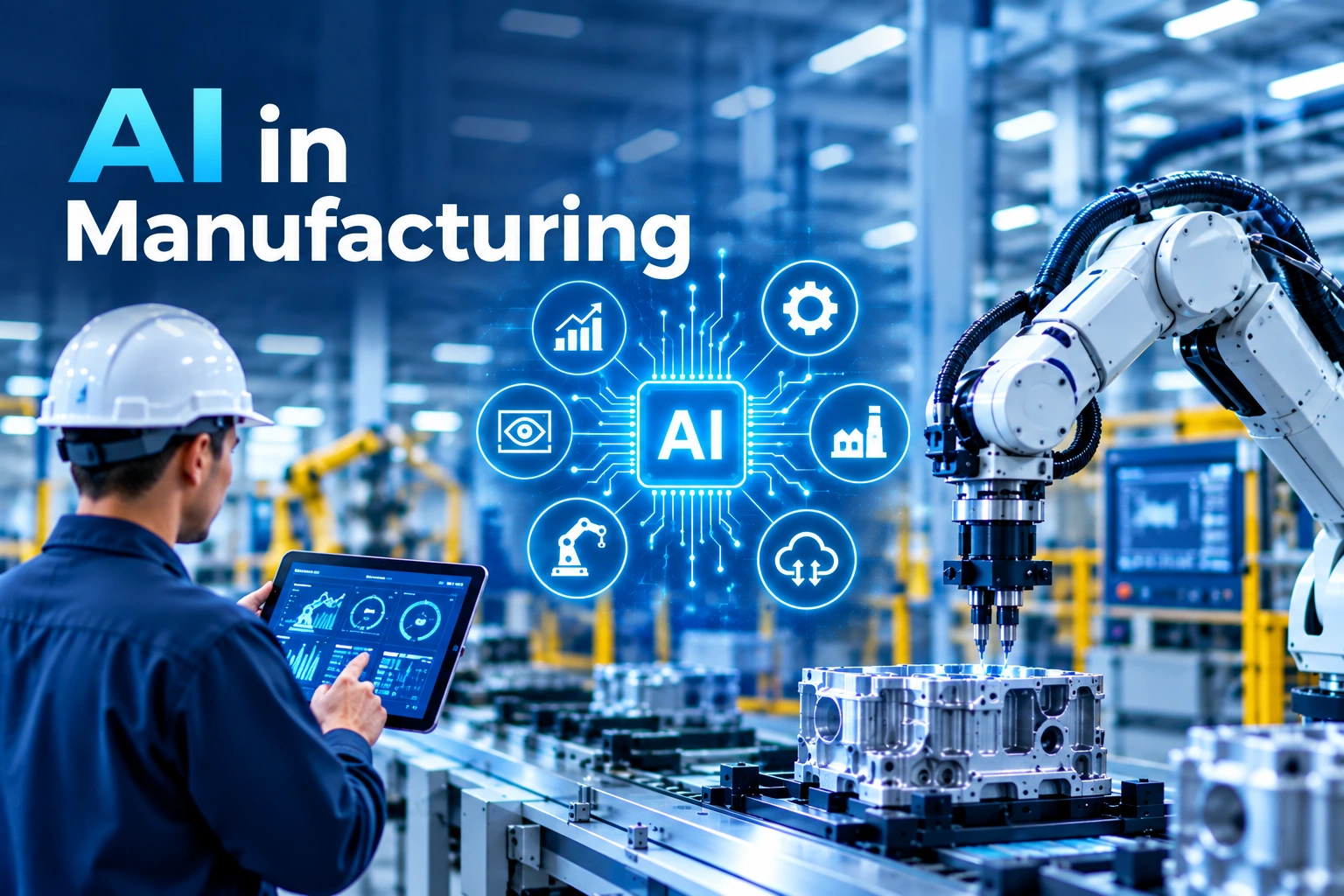
AI in Manufacturing refers to the integration of Artificial Intelligence (AI) and Machine Learning (ML) technologies to analyse large volumes of data and automate high-volume tasks across the manufacturing lifecycle, enabling greater precision, accuracy, and operational efficiency.
Artificial Intelligence in manufacturing ERP software enables businesses to interact using natural-language prompts to get precise reports, identify unusual trends & patterns, generate & compare scenarios, summarise transactions, and identify potential disruptions. AI empowers them with advanced data analysis, precise forecasting, risk assessment, cost optimisation, and enhanced decision-making.
Benefits of Artificial Intelligence in Manufacturing
AI delivers predictive analytics, meaningful data insights, intelligent order management, reduced product defects & energy consumption, and complete visibility across processes.
1. Predictive Analytics
AI-powered manufacturing ERP software analyses large volumes of historical data to uncover trends & patterns and make accurate predictions. AI can analyse data and predict consumer behavior, allowing leaders to make accurate manufacturing & inventory-centric decisions.
2. Convert Raw Data into Meaningful Insights
A popular mid-sized discrete manufacturer in Surat, Gujarat, increased production efficiency by 22% after deploying AI in ERP. ERP delivers meaningful data insights with interactive charts, reports, and personalised dashboards, enabling cross-functional analysis, better risk mitigation, and optimum production planning.
3. Intelligent Order Management
AI transforms the traditional order management process from order placement to final fulfilment. It continuously monitors the entire process, helping you make complex decisions, optimise routes, and respond intelligently to sudden demand spikes, shipping errors, and vendor delays.
4. Reduced Product Defects & Energy Consumption
A Global Lighthouse Network 2025 report published by the World Economic Forum states that the adoption of AI and GenAI resulted in a 41% decrease in product defects and a 28% decrease in energy consumption, transforming the traditional manufacturing process.
5. AI-Assisted Workflow
AI provides complete visibility across different departmental data and automates workflows. It helps recognise unusual demand patterns, flag potential stock shortages, perform scenario analysis, and understand the potential downstream impact of new decisions.
What are the Common Use Cases of AI in Manufacturing?
Some of the common use cases of AI-powered manufacturing ERP software are raw material procurement, demand forecasting, inventory management, process optimisation, and financial planning & budgeting.
1. Seamless Raw Material Procurement
Automatically monitor raw material shipments for potential delays and disruptions. In case of delays from the supplier, AI automates work orders and workload reallocation, thereby ensuring continuous production activity.
2. Precise Demand Forecasting
AI-enabled systems don’t just rely on historical sales data. They perform a 360-degree analysis by analysing market signals, seasonal trends, changes in the weather, and macroeconomic conditions, improving overall accuracy.
3. Automated Inventory Management
Artificial Intelligence in manufacturing replaces manual inventory tracking with automated systems that take care of your safety stock threshold management. AI-powered inventory management software reduces your inventory holding costs by automatically triggering reorder points and reducing manual delays.
4. Process Optimisation
Artificial Intelligence in manufacturing eliminates workforce oversight and tweaks operating parameters, thereby improving overall production efficiency. It enables businesses to identify key areas of improvement, optimise existing processes, and maintain the desired results.
5. Financial Planning & Budgeting
The AI-powered financial management module in ERP replaces traditional, rigid budgeting with modern, dynamic multi-variable scenario analysis models. It automatically flags financial risks, cost overruns, and revenue variances.
Also Read: GenAI in ERP: What are the Primary Use Cases and Solutions?
Best Practices to Make the Most of AI in Manufacturing ERP
To avoid common pitfalls and harness the true potential of AI-powered manufacturing ERP software, choose the right system, use high-quality data, conduct regular employee training, avoid automating high-risk decisions, and track KPIs.
- Choose the Right System: AI-powered manufacturing ERPs may differ in features, price, and implementation & integration process.
- Use High-Quality Data: Use clean, complete, and unbiased data to improve the quality of AI outputs.
- Employee Training: Increase the user adoption rate with employee training, questionnaires, and support.
- Don’t Automate High-Risk Decisions: Don’t let AI handle high-risk financial, product & quality decisions. Instead, combine human talent and AI to achieve greater precision.
- KPI Tracking: Don’t stop right after implementing an ERP. Regularly track the important Key Performance Indicators to measure the impact of your implementation.
What Next-Gen AI Features Does Sage X3 Offer for Manufacturers?
Sage X3 is an AI-powered, cloud-first ERP software that offers Sage Copilot, intelligent OCR & data extraction, demand forecasting & inventory optimisation, automated quality controls, and predictive maintenance alerts.
1. Sage Copilot
Get quick, accurate answers to your questions in natural language with an intelligent conversational assistant, Sage Copilot. Streamline month-end close, reconcile ledgers, monitor financial data, and detect trends & patterns with this fully AI-powered assistant.
2. Intelligent OCR & Data Extraction
Automatically extract key information from scanned documents (such as receipts and invoices) in digital, searchable, and editable formats. Eliminate data entry and improve speed & efficiency with AI-powered Optical Character Recognition (OCR).
3. Demand Forecasting & Inventory Optimisation
One of the interesting AI features in Sage X3 is powerful algorithms that improve the accuracy of your baseline forecasts. These algorithms allow your team to make better predictions about consumer behaviour, order patterns, material requirements, and changes in product lifecycle.
4. Automated Quality Controls
AI helps manufacturers ensure consistent quality across all production batches by automating quality control, defect detection, and supplier performance evaluation. By consistently producing better quality products, companies can improve customer experience and achieve greater market share.
5. Preventive Maintenance Alerts
Manufacturers install integrated sensors on machines to transmit real-time machine logs, performance, temperature, and friction information to the ERP software. Artificial Intelligence in manufacturing detects repeated equipment issues and provides preventive maintenance alerts, leading to fewer unexpected downtimes and optimum production performance.
Aslo Read: Why Sage X3 ERP is an Ideal Choice for Manufacturing Businesses
Conclusion
AI in Manufacturing ERP and the Future of the Smart Indian Factory
AI-powered manufacturing ERP supports the fourth industrial revolution by integrating data-driven automation into core business processes. It enables smarter planning, advanced data analysis, powerful forecasting, and improved operational efficiency.
Sage X3 is a next-gen solution that enables manufacturers to automate core processes and gain a more personalised & tailored experience with a combination of tools and adaptable Machine Learning (ML) & Natural Language Processing (NLP) algorithms.
Frequently Asked Questions (FAQs)
1. How Can Generative AI be Used in Manufacturing?
Adoption of Generative AI (GenAI) in manufacturing processes allows manufacturers to benefit from cost reduction, enhanced productivity, reduced wastage, and better control & visibility. In today’s highly complex and rapidly changing manufacturing process, businesses use GenAI in manufacturing ERP software to increase profitability and achieve sustainable business growth.
2. How Does AI in Manufacturing ERP Differ from Traditional Reporting?
AI-powered ERP systems can generate reports based on live transaction streams. They provide conversational chatbots that can interact in natural language, allowing businesses to get quick insights and answers to their questions. In contrast, ordinary ERPs with traditional reporting capabilities lack such advanced features, limiting the user’s data insights to only historical reports and past transactions. They may require manual data entry and verification, which can lead to delays and inefficiencies.
3. How to Integrate Artificial Intelligence in Manufacturing Operations?
Here are the simple steps to adapt Artificial Intelligence in Manufacturing:
- Identify Key Areas of Improvement: First things first, identify which areas of your business will benefit from AI, such as manufacturing, customer support, financial.
- Legacy Integration: If you’re looking to use legacy tools alongside AI-powered systems, make sure they support the integration.
- Data Collection: Gather data from different sources to train the AI system. Make sure the data is clean, complete, and accurate.
- ERP Selection: The next step is to select a high-end AI-embedded ERP system that supports your business & industry requirements and aligns with your budget.
- Test Run: Deploy the system in phases. Don’t perform organisation-wide full-scale implementation to avoid potential disruptions.
- Employee Training: Conduct regular employee training and workshops to increase adoption and achieve the objectives of implementation.
- Feedback: Gather feedback from your employees, report potential bugs to the ERP vendor, and tweak & re-configure the system to meet your unique workflows.
4. What are the Key Challenges with AI Adoption in Manufacturing?
Here are some common challenges during the implementation of AI-powered manufacturing ERP software:
- Poor Data Quality: If the AI tools are trained with poor-quality data, they may not be very helpful, especially for business decision-making.
- Implementation Delays: Lack of planning can delay the ERP implementation process.
- Integration Issues with Legacy Tools: Some outdated legacy tools may not support integration with advanced technologies.
- Skill Gap and Workforce Readiness: Unskilled employees may not be able to use AI effectively for greater business benefits.
- Data Bias: AI systems can suffer from historically prejudiced data sets, leading to biased and inaccurate outputs.