







Skip to content

Best ERP for Manufacturing Industry in India

Sage X3 ERP Software offers streamlined production planning, BOM management, quality control, inventory & supply chain management from one unified platform. Trusted by leading Indian manufacturers.

What is Manufacturing ERP Software?

Manufacturing ERP Software is a specialized system that manages and integrates core manufacturing operations, including production planning, inventory management, supply chain management, sales, and finance. It serves as a unified system that provides complete control over manufacturing processes, enabling manufacturers to meet production targets and enhance profitability.

ERP Software streamlines highly specialized processes in the manufacturing industry, such as BOM management, quality control, inventory reordering & replenishment, and order tracking. It empowers you with superior management of resources, richly detailed analytical reports, predictive analytics, and robust demand forecasting to proactively address potential challenges and capture new opportunities.

Growth Trajectory of India’s Manufacturing Industry

India’s manufacturing sector is estimated to be $1.74 trillion in 2026, according to a market research report by Mordor Intelligence. By 2031, it is expected to reach $2.47 trillion, witnessing a growth of 7.26% CAGR. India stands firmly among the world’s top five manufacturing nations by output. 

The manufacturing sector is a major contributor to India’s GDP, accounting for a 16% share.   As India aims for a $7 trillion GDP by 2030, this share is expected to grow to 21%. Notably, rising domestic consumption, government incentives, and India’s emergence as a global manufacturing hub are the leading factors driving the growth of the manufacturing sector in India.

Gain Control with Essential Features of Manufacturing ERP

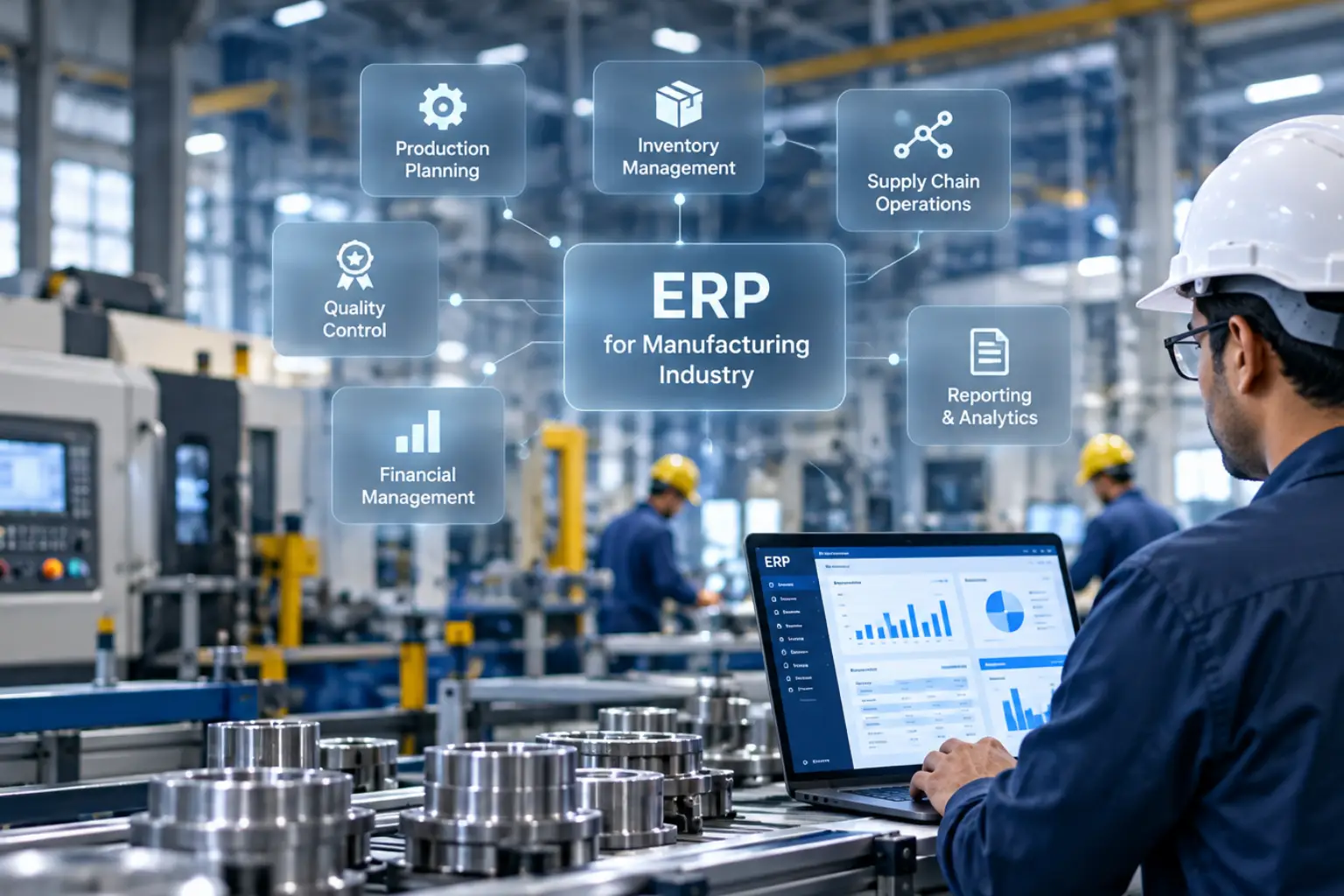
Robust financial management, supply chain management, quality control, order management, and inventory control are some of the key features of the manufacturing erp.

1. Financial Management

Get key insights into your company’s financial operations with a comprehensive finance module in ERP. Empowers your company with proactive planning, budgeting, performance benchmarking, AP automation, and AR automation.

2. Production Management:

A single integrated platform to manage your production activities, coordinate with suppliers, manage demand variations, and align production resources. Avoid cost overruns, align resources efficiently, and meet your production and delivery targets.

3. Supply Chain Management

Gain visibility across multiple aspects of the supply chain process, and identify & mitigate potential disruptions with integrated supply chain management tools. Improve process flow, get insightful reporting, and reduce time-to-market in a multifaceted process like the supply chain.

4. Quality Control

Built-in quality control mechanisms help you ensure your quality benchmarks are met. Identify quality variances on time, reduce returns & refunds, improve customer experience, and build strong brand reputation.

5. Order Management

Streamline purchase order creation, invoice generation, order tracking, and payment confirmation. Centralize your ordering process, optimize workflows, and improve customer experience.

6. Inventory Control

Gain real-time information about your inventory status, streamline inventory replenishment, and avoid overstocking & understocking with an inventory management system. Adapt to the dynamic shifts in the modern-day supply chain dynamics.

7. Reporting and Analytics

Acts as the central repository of information that aids strategic planning and decision-making. Provides business-critical information at your fingertips to help you gain competitiveness and meet evolving market challenges.

Game-Changing Benefits of Manufacturing ERP Software

Manufacturing ERP systems offer various game-changing benefits, including process automation, improved data management, better customer service, higher quality, and reduced costs, among others.

Benefits of Manufacturing ERP software

1. Streamlined Processes

Sage X3 ERP for manufacturers helps manufacturing companies streamline their processes, reduce overheads, and improve overall productivity. With the help of automated processes, companies can eliminate manual errors, improve accuracy, and reduce time-consuming tasks.

2. Improved Data Management

Sage X3 provides a single source of truth for all manufacturing data, making it easier to find, track, and analyze the data. Its intelligent Business Intelligence tools allow companies to identify areas of improvement, stay compliant, and make data-driven decisions.

3. Enhanced Customer Service

The ERP software for manufacturers can provide customers with accurate information about their orders, deliveries, pricing, and inventory levels. It helps to improve customer relationships and increase customer satisfaction.

4. Increased Visibility

Sage X3 ERP for manufacturing industry provides real-time visibility into operational performance and helps to identify potential issues before they become problems. The best ERP application for manufacturing industry improves the overall performance of the manufacturing process.

5. Quality Assessment

In today’s competitive environment, businesses have to consistently produce safe & high-quality goods to maximize customer satisfaction, meet industry standards, and reduce non-compliance penalties. Best ERP for manufacturing industry enables businesses to track quality at every level, maintain quality data, and compare it with industry standards.

6. Production Planning

Integrating the Manufacturing erp software into the manufacturing process leads to lower lead times. Businesses can reduce downtimes, and meet consumer demands on time. ERP for manufacturer provides powerful tools to make detailed production plans and efficiently allocate production resources.

7. Lower Overhead Cost

ERP software for manufacturers eliminates production bottlenecks, minimizes waste, ensures optimum use of resources, and reduces supply chain gaps, all of which collectively help keep the manufacturing (overhead) cost lower. Ultimately, you benefit from increased profit margin, competitive pricing, and expansion of your consumer base.

8. Dedicated Manufacturing Modules

ERP software for manufacturing industry provides access to industry-specific tools and sophisticated modules to automate various processes, reduce cost, improve productivity, enhance quality, and ensure end-to-end compliance management

Here’s why leading manufacturers across India choose Sage X3

Sage X3 is a highly scalable and customizable Manufacturing ERP Solution powered by Sage Copilot, featuring an integrated set of modules designed to streamline various aspects, including procurement, production, sales, inventory & supply chain, project management, and finance. This best-in-class manufacturing software offers robust integration capabilities and extensive customization to meet your unique business needs and improve market responsiveness.

✔️Achieve end-to-end quality control and minimize returns and recalls
✔️Evaluate seasonal changes and quickly respond to market dynamics
✔️Get rid of disconnected systems and improve the bottom line
✔️Reduce costs, recognize growth opportunities, and increase revenue stream
✔️Gain quick, actionable insights with intuitive charts, reports, and customizable dashboards
✔️Multi-site, multi-company, multi-country, and multi-legislative capabilities

From Implementation to Impact — 3 Pillars That Drive Results

The success of Manufacturing ERP software implementation depends on the following three factors:

1. Cross-functional Connectivity

Keep everyone on the same platform, improve coordination across teams, and make decisions based on clear plans, directions, and structure. Cross-functional collaboration ensures that integrated teams better understand and respond to market challenges.

Use data-driven insights and advanced analytical reports to make profitable decisions and improve the level of accuracy of your forecasts. Position yourself for long-term success, higher risk tolerance, and better growth opportunities.


Production Tracking in Manufacturing Software

Future-proof your production processes to meet different conditions, reduce operational bottlenecks, and enhance manufacturing & distribution performance. Implement better quality control across processes to reduce defects and minimize recall risks.

See Why Manufacturers Choose Sage X3

Unlock your manufacturing potential and elevate your results with ERP Software

Major Challenges Faced by the Manufacturing Industry

Manufacturers in India face several challenges, including the complexity of multi-location integration, limited access to critical information, inefficient resource utilization, low employee productivity, and high inventory costs. 

1. Integration of Operations

Manufacturing companies with multiple locations find it difficult to integrate their operations. It is mainly due to a lack of standardization, complex process management, and resource fragmentation across areas. To overcome this, companies must streamline and coordinate their operations across all locations.

2. Lack of Critical Information

With ever-evolving customer preferences, regulatory changes, and technological advancements, manufacturers must quickly access accurate information to remain competitive. Without the right data, companies struggle to keep up, leading to decreased profits.

3. Inefficient Resource Utilization

Manufacturing companies must ensure that their production capacity, inventory, and human resources are deployed efficiently and cost-effectively. Common resource utilization challenges include a lack of the right digital tools, a shortage of skilled employees, and inadequate planning and forecasting.

4. Reduced Employee Productivity

Low productivity at the workplace impacts a company’s revenue and customer service. Factors affecting employee productivity include job stress, lack of motivation, excessive paperwork, and inefficient work processes. Companies must solve these issues to ensure their employees remain productive and motivated.

5. Higher Inventory Costs & Wastage

Holding sufficient material on hand is necessary to meet customer orders on time. At the same time, manufacturers must avoid unnecessary surplus stock as it ties up working capital and increases the risks of dead stock. Adopting inventory management software is essential to forecast demand, streamline replenishment processes, and ensure optimal stock levels.

How Does Best ERP for Manufacturing Industry Work?

Large manufacturing enterprises have complex workflow, which often results in delays, inefficiencies, and increased costs. Manufacturing ERP promotes smooth workflow and enables them to simplify operational complexities, leading to better growth potential.

Let’s deep dive into how the Manufacturing ERP software works:

• Single Source of Truth: Consolidate data from different business departments and gain a holistic view of operations for smart decision-making.

• Process Unification: Automate processes across different business aspects, from production management and sales to supply chain.

• Manufacturing Planning: Plan & schedule manufacturing processes, streamline procurement, reduce costs, and collaborate seamlessly with your vendors.

• Inventory Optimization: Track your inventory levels, forecast demand for your products, and reduce inventory storage & handling costs.

• Quality Assurance: Streamline quality control, track material usage, and ensure adherence to the regulatory standards to build high-quality and safe products.

• Deep Analytical Insights: Analyze sales trends, improve turnover, reduce costs, and unlock new opportunities with custom reporting and analytical features.

Bring Asset Maintenance into Your Manufacturing ERP

In a manufacturing setup, it is the machines that bring in revenue. Yet, machinery maintenance is one of the most overlooked aspects of manufacturing in India. A survey by ABB revealed that every hour of unexpected production breakdown costs typical Indian manufacturers Rs 7 million – a collective cost of halted production, idle workers, and lost customer orders.

Here’s why asset maintenance matters for manufacturers:

  • Unplanned downtime disrupts production schedule and delays order deliveries
  • Crores of capital investment in heavy machinery is at stake 
  • Poor equipment maintenance leads to frequent product quality failures
  • Highly regulated industries like pharma, chemical, food, and automotive require documented evidence of asset maintenance for compliance and safety 
  • Keeping spare parts purchasing costs and stock levels under control 

However, even the most advanced ERP software are not built for managing asset maintenance. This is exactly why Sage Software Solutions offers DimoMaint MX – a cloud-based CMMS or Computerised Maintenance Management System for systematic asset maintenance. 

⇒ What DimoMaint MX Does for Manufacturers? 

  • Minimises unplanned downtime with automated preventive maintenance schedules
  • Reduces spare parts costs with real-time stock tracking and intelligent procurement
  • Extends equipment life and supports capital investment decisions through data-driven maintenance insights

⇒ Sage X3 ERP with CMMS Integration

DimoMaint MX integrates seamlessly with Sage X3 ERP, allowing maintenance costs to flow directly into Sage X3 General Ledger for complete financial control. It further enables you to synchronise spare parts inventory and suppliers databases, apply purchase and inventory rules in Sage X3 to DimoMaint MX, and eliminate duplicate data entries. 

How to choose the Best Manufacturing ERP Software for your business?

Here’s a simple guide to choosing the best manufacturing erp software for your company:

  • Evaluate your company’s strategic goals and map out the essential business processes that need to be transformed.
  • Outline the functional and non-functional requirements for your new ERP system in terms of its functionality and integration.
  • Pick up ERP vendors with long industry experience, reputation, and greater customization capabilities.
  • Compare your ERP budgets against the vendor’s pricing. Take the training, customization, integration, and other costs into consideration.
  • Request personalized demos from the shortlisted vendors, ask any doubts you may have, and make an informed decision.

How Industry 4.0 is Transforming into Smart Manufacturing with ERP

Implementing 4.0 standards requires manufacturers to have the right mix of systems and tools, such as IIoT sensors and computer vision systems that can collect real-time data from machines, and advanced ERP software like Sage X3, driven by artificial intelligence and machine learning algorithms to analyze large volumes of complex data from machines.

Here’s how ERP helps manufacturers implement Industry 4.0 standards:

  • Identify and fix production bottlenecks & optimize production processes with minimal human intervention
  • Significantly increase production output, maintain quality benchmarks, reduce costs, and improve competitiveness
  • Prevent potential machine breakdowns & minimize unplanned downtime by implementing predictive maintenance using ERP 
  • Develop faster response mechanism to rapidly changing market requirements
  • Adopt smart manufacturing practices for enhanced flexibility and agility

Explore more about Manufacturing Industry

Top Industries We Serve

Manufacturing Industry FAQ

ERP in Manufacturing Industry is a comprehensive, integrated application suite that automates and streamlines manufacturing and production processes. These systems give companies greater visibility into their production processes, allowing them to track and manage their resources better. ERP system enable production businesses to monitor inventory levels better, monitor supplier performance and manage customer orders.

Here are the best ERP software for manufacturing businesses:

  • Sage X3: Best for superior integration capabilities, accurate demand planning, supply chain visibility, and extensive customizability.
  • Oracle NetSuite: Best for rapidly growing manufacturing companies with global presence.
  • SAP: Best for manufacturers needing better control over production, quality control, and inventory tracking.
  • Epicor Kinetic: Best for automation, real-time reports, and a user-friendly interface.
  • Acumatica: Best for companies looking for advanced material management, production scheduling, and financial automation.

Here are the must-have features to look for in Manufacturing ERP Software:

  1. Production Planning & Scheduling: Align your resources and pre-plan production activities for on-time order delivery.
  2. Inventory Control: Automated inventory replenishment saves your time and improves accuracy.
  3. Quality Assessment: Analyze product quality at every stage of the production level to meet industry standards and improve customer satisfaction.
  4. Business Intelligence: Get readily available insights, and pre-built reports & dashboards for strongly data-driven decision-making.
  5. Compliance Management: Streamline financial management and ensure audit-readiness.

ERP Software for Manufacturing industry is an indispensable solution for modern-day businesses. Here’s why:

  • It helps to streamline operations and improve efficiency.

  • Provides real-time information on production and inventory.

  • Allows manufacturers to make better decisions about what to produce and when to produce it.

  • Improves customer service by allowing manufacturers to quickly and easily access customer information.

  • Reduces costs by automating multiple business processes.

Yes, we customize ERP system as per the requirement of your company. Our team of experienced professionals understands your company’s business needs and customizes the ERP system to match your company’s specific requirements. We can customize the ERP system to integrate with existing systems and provide you with the flexibility to customize the system to suit the ever-changing needs of your business.

Enterprise resource planning implementation can be a complex process. The time it takes for an ERP system to go will depend mainly on the project’s scope and the complexity of the system being implemented. Generally, organizations can expect an ERP implementation in the manufacturing industry anywhere from two weeks to six months, depending on the size and complexity of the project.

For a small business, the time frame can be relatively short. Initially, the length of time it will take to go live can be estimated by assessing the project’s scope. As the project management software progresses for the manufacturing industry, the timeline may need to be adjusted depending on the team’s progress.

1.Production Method:

  • Discrete Manufacturing ERP: Deals with a series of assembly processes and detailed tracking of components. Automates BOMs, assembly lines, and production schedules.
  • Process Manufacturing ERP: Manage complex production formulas, achieve higher quality, maintain compliance, and reduce your operational expenditures.
  • Mixed-mode ERP: An all-inclusive platform to deal with discrete production, process manufacturing, and engineer-to-order (ETO) for better efficiency and industry needs.

2.Deployment Method:

  • Cloud ERP: Hosts user data on the cloud to provide remote accessibility, flexibility, and cost-effectiveness.
  • On-premise ERP: Hosts user data on the company’s servers for better control, privacy, and customization needs.
  • Hybrid ERP: Leverage both cloud and on-premise solutions within a single platform for specific industry requirements and function needs.

Here’s the list of top manufacturing ERP solutions in 2026:

  • Sage X3: A highly focused and customizable solution to manage your assembly lines, automate manual processes, and ensure smoother production workflow
  • Odoo: Plan, schedule, and process manufacturing operations with advanced quality control & inventory-specific features.
  • Oracle NetSuite: A unified system to handle production complexity and support various aspects of the manufacturing business
  • Microsoft Dynamics 365: Gain end-to-end visibility into your operations to reduce production downtime and improve supply chain.
  • Acumatica Cloud ERP: Manage production routine, Bill of Materials, and lot & serial traceability with an advanced manufacturing ERP solution.
  • QAD Adaptive ERP: Enterprise-level solution to help manufacturers adjust to supply chain disruptions and become competitive.

Here’s how the ERP software is supporting manufacturing companies:

  • Integrated Workflow: Seamlessly connect data and processes across different departments and avoid delays & production disruptions.
  • Single Source of Truth: Real-time insights into your company’s operations for strategic decision-making.
  • Increased Operational Efficiency: Eliminate repetitive tasks, reduce delays, improve market responsiveness, and improve your productivity.
  • Simplified Compliance: Automate compliance activity to prevent oversight, regulatory fines, penalties, and lawsuits.
  • Optimal Inventory Control: Manage your inventory efficiently, automate replenishment activity, and reduce carrying costs.
  • Enhanced Supply Chain Collaboration: Integrate different aspects of your supply chain process, and manage & mitigate supply chain risks efficiently.

A generic ERP is an all-inclusive ERP software designed for companies across various industries and varying sizes. Since it is built with a one-size-fits-all objective, you may find some unnecessary features, which are part of its broader set of functionalities. It may lack various industry-specific capabilities, making your business less responsive to changing market dynamics.

A Manufacturing ERP software can be a perfect fit for manufacturers as it is built to meet the unique needs of the manufacturing industry. It includes various modules from procurement, shop floor management, Bill of Materials (BoM), quality control, supply chain, and financial management, among others. It provides better control over the manufacturing and supply chain operations, helping you meet the varying needs of the manufacturing operations.

In the manufacturing industry, the majority of the revenue is generated through physical assets like production machinery and equipment. Reliability of such assets is thus crucial to prevent production failures. The objective of asset maintenance is to ensure that the machinery lasts for as many years as possible while delivering peak performance. 

Equally important are the savings generated through efficient maintenance practices like

  • timely servicing to minimise breakdowns, 
  • spare parts inventory control to lower storage costs, 
  • skillfully assigning the right technicians and subcontractors, and 
  • tracking repair history to optimise future maintenance tasks. 

DimoMaint MX is the new generation of web CMMS that simplifies the lives of maintenance teams. Mobile, scalable, and user-friendly solution, DimoMaint MX promotes collaboration and communication among team members so that they can effectively plan maintenance work and swiftly respond to breakdown and repair requests. 

Manufacturing Software Explained:

Schedule Product Tour

"*" indicates required fields

This field is for validation purposes and should be left unchanged.